
Welcome to Trigonometric Functions
In earlier classes, trigonometry meant ratios of sides in a right triangle — useful, but stuck with acute angles. This chapter performs a major upgrade: sine, cosine and friends become functions of any real number, with graphs, domains, ranges and an army of identities. Here is the roadmap:
- Angles and their measures (this section) — degrees, radians, and the arc-length relation .
- Trigonometric functions on the unit circle — definitions valid for every angle, standard values, periodicity.
- Signs, domains, ranges and graphs — the complete behaviour of all six functions.
- Sum and difference formulas — the identity machine, starting from .
- Multiple angles and product-sum transformations — the 2x, 3x formulas and the factoring toolkit.
Key Point: An angle is a measure of rotation of a ray about its initial point. The original ray is the initial side, its final position the terminal side, and the point of rotation the vertex. Anticlockwise rotation gives a positive angle; clockwise rotation gives a negative angle.
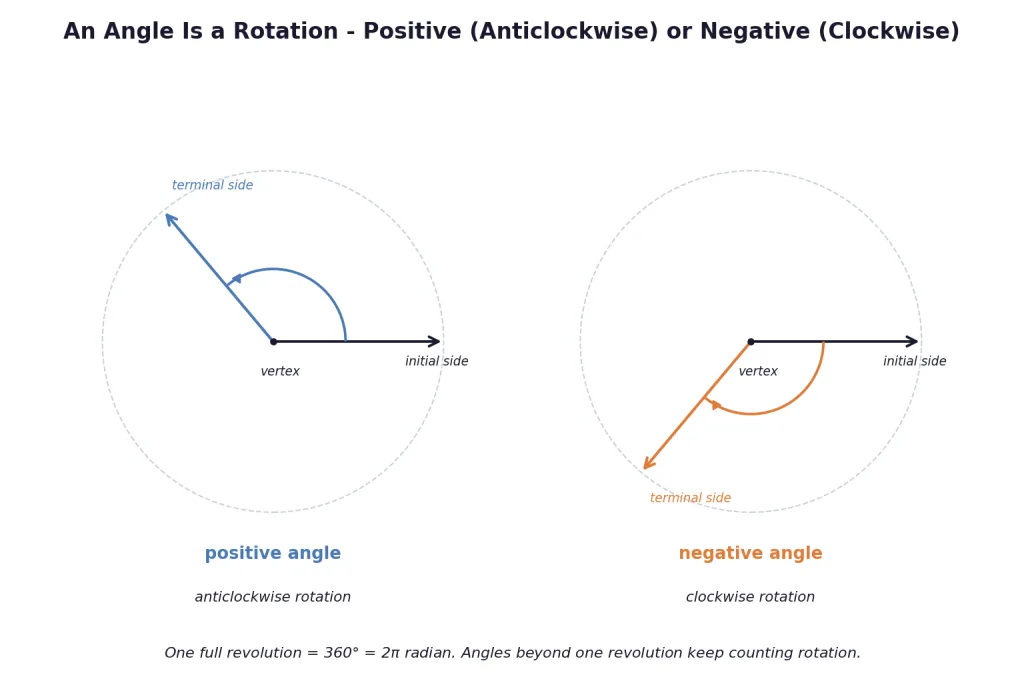
Because angles measure rotation, they are NOT confined to 0°-360°: a spinning wheel can turn through 15 revolutions (5400°), and rotating clockwise by a quarter turn gives .
[JEE Tip] This chapter is the single most-leveraged foundation for JEE — trigonometric identities and equations appear directly every year, and complex numbers, vectors and all of calculus quietly reuse them.
Degree Measure and Radian Measure
Degrees
If a rotation from initial to terminal side is of a revolution, the angle measures one degree (1°). Finer units: 1° = 60 minutes (60') and 1' = 60 seconds (60''). A full revolution is 360°.
Radians
The second unit is the mathematician's favourite:
Key Point (Definition): An angle subtended at the centre of a circle by an arc equal in length to the radius measures 1 radian.
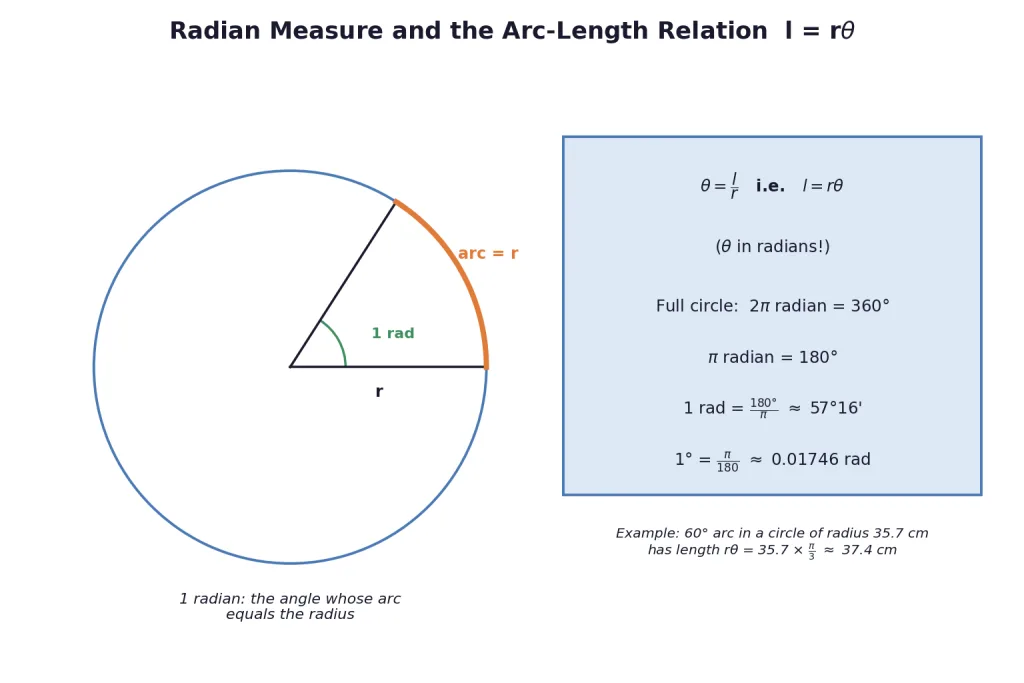
Since a full circle of radius r has circumference — that is, radius-lengths of arc — one revolution measures radians.
The arc-length relation
In a circle of radius r, an arc of length l subtends an angle (in radians) at the centre, where
This clean formula is the whole reason radians exist — in degrees it would carry an ugly factor of .
Key Point: works ONLY with in radians. Convert first, always.
[Board Important] Radian measure also connects to real numbers: wrapping the real number line around the unit circle identifies every real number with an angle — which is exactly what lets us treat sin and cos as functions of real numbers in the next section.
Converting Between Degrees and Radians
One revolution gives the master relation:
From it, the two conversion machines:
- Radian measure = Degree measure
- Degree measure = Radian measure
Useful approximations: 1 radian = (a radian is BIG — nearly a sixth of a full turn), and 1° = radian.
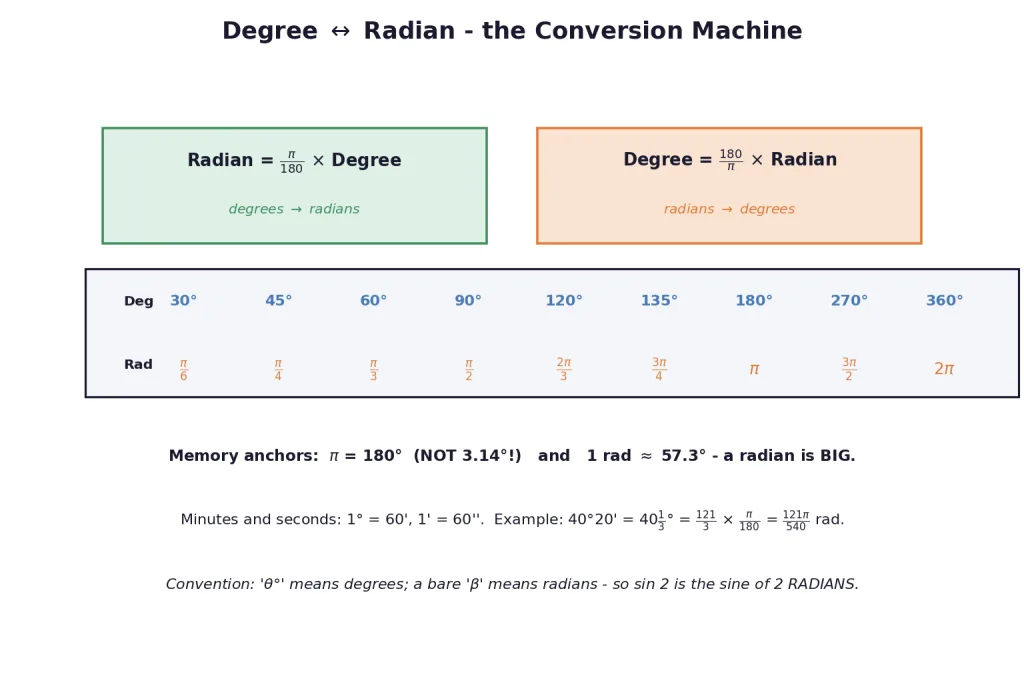
The standard pairs to know instantly: 30° = , 45° = , 60° = , 90° = , 180° = , 270° = , 360° = .
Notational convention
Writing means degrees; writing a bare means radians. So "" means the sine of 2 radians (about 114.6°), not of 2 degrees — a distinction that decides answers.
[JEE Tip] For angles with minutes, convert to a fraction of a degree first: , then multiply by to get radian. Keep answers as exact fractions of unless a decimal is demanded.
Solved Examples
Example 1. Convert 40°20' into radian measure.
Solution.
Step 1 — fractionalise the minutes. , so degree.
Step 2 — apply the conversion machine. Radian measure degree measure .
Step 3 — simplify. radian.
Takeaway: convert minutes into a fraction of a degree FIRST; the factor then does the rest in one multiplication.
Example 2. Convert 6 radians into degree measure (use ).
Solution.
Step 1 — radians to degrees. .
Step 2 — leftover degrees to minutes. .
Step 3 — leftover minutes to seconds. .
Step 4 — assemble. radians .
Takeaway: cascade the leftover fraction downward — degrees → minutes → seconds — multiplying by 60 at each stage.
Example 3. Find the radius of the circle in which a central angle of 60° intercepts an arc of length 37.4 cm (use ).
Solution.
Step 1 — convert the angle to radians (non-negotiable). radian — the formula refuses degrees.
Step 2 — rearrange for the radius. .
Step 3 — substitute . cm.
Takeaway: every arc-length computation begins with a degree→radian conversion; skipping it is the classic zero-mark error.
Example 4. The minute hand of a watch is 1.5 cm long. How far does its tip move in 40 minutes? (Use .)
Solution.
Step 1 — fraction of a revolution. The minute hand completes one revolution in 60 minutes, so in 40 minutes it turns of a revolution.
Step 2 — convert to radians. radian.
Step 3 — arc length. cm.
Takeaway: clock problems are fraction-of-revolution problems — find the fraction, multiply by , then apply .
Example 5. If arcs of the same length in two circles subtend angles of 65° and 110° at their centres, find the ratio of their radii.
Solution.
Step 1 — write the equal-arc condition. Same arc length: .
Step 2 — form the ratio. — the conversion factor cancels in the ratio, so degree measures may be used directly here.
Step 3 — simplify. , so .
Takeaway: for a fixed arc, radius and angle are inversely proportional — the larger angle belongs to the smaller circle.
Example 6. A wheel makes 360 revolutions in one minute. Through how many radians does it turn in one second?
Solution.
Step 1 — revolutions per second. revolutions each second.
Step 2 — radians per revolution. One revolution radians.
Step 3 — multiply. radians per second.
Takeaway: rate conversions go revolution-by-revolution — normalise the time unit first, then convert turns to radians.
Example 7. Find the degree measure of the angle subtended at the centre of a circle of radius 100 cm by an arc of length 22 cm (use ).
Solution.
Step 1 — radian measure from the arc formula. radian.
Step 2 — convert to degrees. .
Step 3 — decimal degrees to minutes. , so .
Takeaway: the 22's cancel beautifully with — and always convert the decimal part of degrees into minutes at the end.
Example 8. In a circle of diameter 40 cm, the length of a chord is 20 cm. Find the length of the minor arc of the chord.
Solution.
Step 1 — spot the special triangle. Radius cm, equal to the chord — so the two radii and the chord form an EQUILATERAL triangle.
Step 2 — read off the central angle. Each angle of an equilateral triangle is 60° radian.
Step 3 — arc length. cm.
Takeaway: a chord equal to the radius always subtends 60° at the centre — spot the equilateral triangle and the problem collapses to one line.
Example 9. A pendulum 75 cm long swings so that its tip describes an arc of (i) 10 cm (ii) 15 cm (iii) 21 cm. Find the angle swung in each case, in radians.
Solution.
Step 1 — the direct formula. With both lengths in centimetres, IS the radian measure — no conversion factor anywhere.
(i) Step 2. radian.
(ii) Step 3. radian.
(iii) Step 4. radian.
Takeaway: the ratio of two same-unit lengths is dimensionless — that is exactly why radian measure needs no here.
Example 10. Convert: (i) 25° to radians (ii) to radians (iii) radian to degrees (iv) to degrees.
Solution.
(i) Step 1. radian.
(ii) Step 2. Fractionalise first: . Then radian.
(iii) Step 3. . Cascade: , so .
(iv) Step 4. Multiples of convert instantly — replace by 180°: .
Takeaway: -multiples are instant conversions; bare fractions like need the full factor and usually produce minutes and seconds.
Example 11. What is the radian measure of the angle traced by (i) 3 full clockwise revolutions (ii) 1.25 anticlockwise revolutions?
Solution.
(i) Step 1. Clockwise means NEGATIVE: revolutions radian.
(ii) Step 2. Anticlockwise is positive: radian — more than one full turn, and that is perfectly legal.
Takeaway: angles are signed rotation counts — nothing restricts them to a single turn or to positive values.
Example 12. If in two circles, arcs of the same length subtend angles of 60° and 75° at the centre, find the ratio of their radii.
Solution.
Step 1 — equal-arc condition. .
Step 2 — ratio, with the conversion factor cancelling. .
Step 3 — state. .
Takeaway: in a pure RATIO of angles the unit cancels — this is the one computation where degrees may stay as degrees.