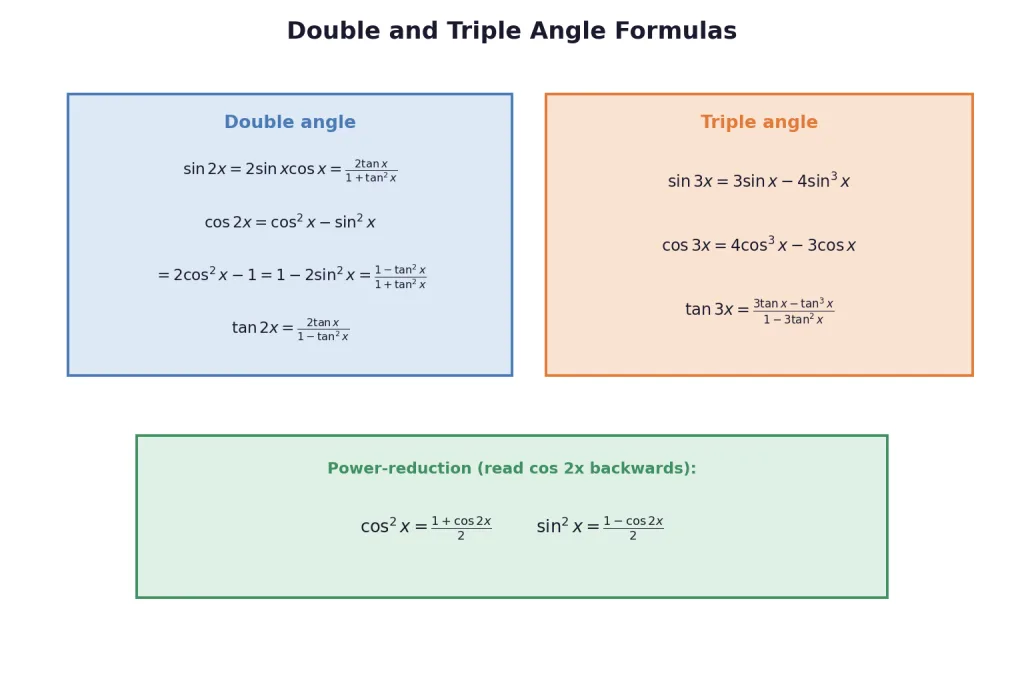
The three faces of cos 2x come from substituting sin2x=1−cos2x or cos2x=1−sin2x — pick whichever face matches the problem.
There are also tan-only forms (divide through by cos2x):
sin2x=1+tan2x2tanxcos2x=1+tan2x1−tan2x
Power reduction — reading cos 2x backwards
cos2x=21+cos2xsin2x=21−cos2x
These turn squares into first powers — the key to half-angle values like cos8π and, later, to integration.
[JEE Tip]1+cos2x=2cos2x and 1−cos2x=2sin2x — recognising "1 ± cos(something)" as a perfect double-angle square is the single most-used move in JEE trig simplification. Likewise 1±sin2x=(sinx±cosx)2.
Triple Angles
Writing 3x = 2x + x and expanding with the sum and double-angle formulas:
Memory anchors: sin 3x starts with 3 sin x (and subtracts the cube term); cos 3x starts with the cube term (and subtracts 3 cos x) — they are mirror-shaped.
Derivation sketch for sin 3x (examinable): sin(2x+x)=sin2xcosx+cos2xsinx=2sinxcos2x+(1−2sin2x)sinx=2sinx(1−sin2x)+sinx−2sin3x=3sinx−4sin3x. ∎
Key Point: These formulas run BOTH ways: 4cos3x=cos3x+3cosx lets you reduce cubes, and the factored forms sin3x=sinx(3−4sin2x)=sinx(2cos2x+1) appear in product identities.
[JEE Tip] From cos 3x with x=9π (20°): 4cos320°−3cos20°=cos60°=21 — the reason cos20° satisfies the cubic 8t3−6t−1=0. JEE loves this bridge between trigonometry and cubic equations.
Product ↔ Sum Transformations
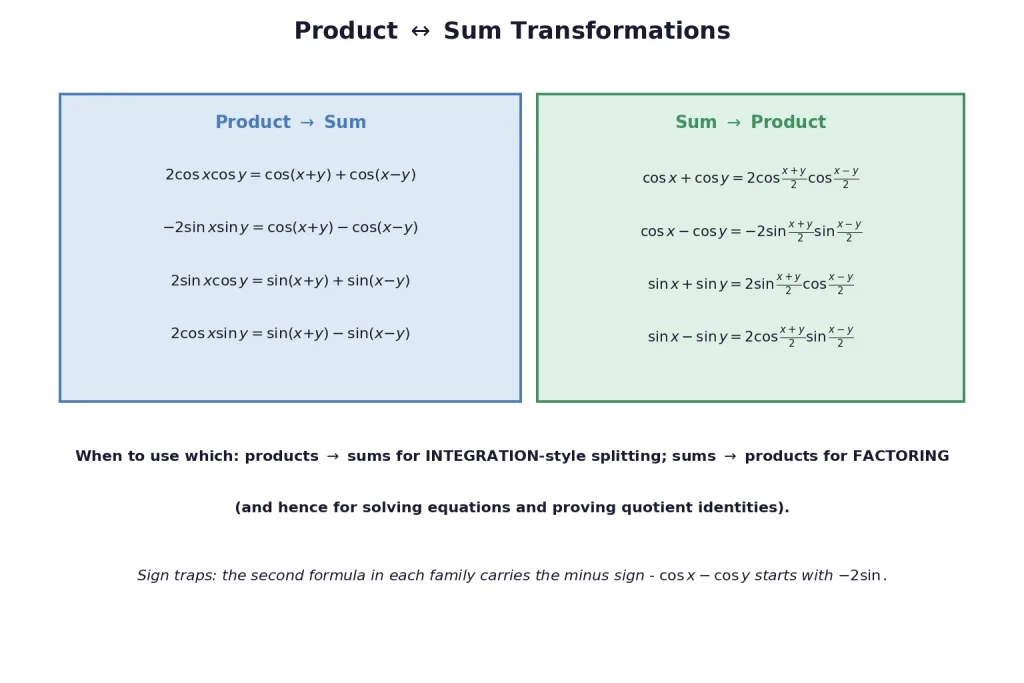
Adding and subtracting the four sum-difference formulas yields two interchangeable toolkits:
When to use which: sums → products when you want to FACTOR (prove quotient identities, solve equations); products → sums when you want to SPLIT (evaluate products of cosines, prepare for integration).
Key Point (sign traps):cosx−cosy opens with −2sin…sin — the only formula with a leading minus. And in sinx−siny=2cos2x+ysin2x−y, the HALF-DIFFERENCE sits inside the sine.
[Board Important] Identity questions of the type cos5x+cos3xsin5x+sin3x=tan4x are near-guaranteed: convert both sums to products, cancel the common factor, read off the tangent.
Solved Examples
Example 1: Double-angle values from tan x
If tanx=43 with x acute, find sin 2x, cos 2x and tan 2x.
Solution:
Step 1 — Use the tan-only form for sin 2x.sin2x=1+tan2x2tanx=1+1692⋅43=25/163/2=2524.
Step 2 — Tan-only form for cos 2x.cos2x=1+tan2x1−tan2x=25/167/16=257.
Step 3 — Tan-only form for tan 2x.tan2x=1−tan2x2tanx=7/163/2=724.
Step 3 — Apply with 2x = 45°.tan22.5°=1+cos45°sin45°=1+2121=2+11.
Step 4 — Rationalise. Multiply by 2−12−1: tan22.5°=2−1.
Takeaway: The half-angle-tangent identity tanx=1+cos2xsin2x is a value factory: 22.5°, 15°, 75° all fall to it.
Example 4: A sin 3x factoring
Prove that sin3x+sinx=2sin2xcosx=4sinxcos2x.
Solution:
Step 1 — Sum to product.sin3x+sinx=2sin23x+xcos23x−x=2sin2xcosx — first target reached.
Step 2 — Expand the double angle.2sin2xcosx=2(2sinxcosx)cosx=4sinxcos2x — second target. ∎
Takeaway: Both target forms come from the SAME factoring — stop at whichever the question asks for.
Example 5: The tan 4x quotient
Prove that cos5x+cos3xsin5x+sin3x=tan4x.
Solution:
Step 1 — Factor the numerator.sin5x+sin3x=2sin25x+3xcos25x−3x=2sin4xcosx.
Step 2 — Factor the denominator.cos5x+cos3x=2cos4xcosx.
Step 3 — Cancel the common factor.2cos4xcosx2sin4xcosx=cos4xsin4x=tan4x. ∎
Takeaway: Matching half-sums (4x) and half-differences (x) top and bottom guarantee a clean cancellation — this is the flagship sum-to-product pattern.
Example 6: A minus-sign quotient
Prove that sin7x−sin5xcos7x+cos5x=cotx.
Solution:
Step 1 — Factor the numerator.cos7x+cos5x=2cos6xcosx.
Step 2 — Factor the denominator, minding the minus.sin7x−sin5x=2cos27x+5xsin27x−5x=2cos6xsinx.
Step 3 — Cancel 2cos6x.sinxcosx=cotx. ∎
Takeaway:sinA−sinB produces a COSINE of the half-sum — exactly what cancels against the numerator. Trust the formulas' asymmetry.
Example 7: Product of three cosines
Prove that cos20°cos40°cos80°=81.
Solution:
Step 1 — Multiply and divide by 2sin20°. The product becomes 2sin20°(2sin20°cos20°)cos40°cos80°=2sin20°sin40°cos40°cos80°.
Step 2 — Telescope again.sin40°cos40°=21sin80°, so the expression is 4sin20°sin80°cos80°=8sin20°sin160°.
Step 3 — Reduce the top.sin160°=sin(180°−20°)=sin20°, which cancels: the product is 81. ∎
Takeaway: Angles doubling in a cosine product (20°, 40°, 80°) invite the 2sinθsin2θ telescope — a JEE evergreen.
Example 8: cos 2x from cos x, both directions
If cosx=−53 with x in Q II, find cos 2x and sin 2x, and locate the quadrant of 2x.
Solution:
Step 1 — cos 2x needs only cos x.cos2x=2cos2x−1=2⋅259−1=2518−25=−257.
Step 2 — Complete sin x with the quadrant sign.sin2x=1−259=2516, and Q II keeps sine positive: sinx=54.
Step 3 — sin 2x.sin2x=2sinxcosx=2⋅54⋅(−53)=−2524.
Step 4 — Read the quadrant of 2x from the signs. cos 2x < 0 and sin 2x < 0: Q III. Consistent: x∈(2π,π) gives 2x∈(π,2π). ✓
Takeaway: Doubling the angle can land in any quadrant — compute both values and read the signs rather than guessing.
Example 9: Proving with power reduction
Prove that cos2x+cos2(x+3π)+cos2(x−3π)=23.
Solution:
Step 1 — Power-reduce every square. Each cos2θ=21+cos2θ, so the sum is 23+21[cos2x+cos(2x+32π)+cos(2x−32π)].
Step 2 — Sum-to-product on the shifted pair.cos(2x+32π)+cos(2x−32π)=2cos2xcos32π=2cos2x⋅(−21)=−cos2x.
Step 3 — Watch the bracket collapse.cos2x−cos2x=0, leaving exactly 23 — independent of x. ∎
Takeaway: Sums of squared cosines at symmetric shifts: power-reduce, then let sum-to-product annihilate the oscillating part.
Example 10: sin 3x in action
If sinx=31, find the exact value of sin 3x.
Solution:
Step 1 — Quote the triple-angle formula.sin3x=3sinx−4sin3x — a polynomial in sin x alone.
Step 2 — Substitute.=3⋅31−4⋅(31)3=1−274.
Step 3 — Combine.=2727−4=2723.
Takeaway: No need for cos x at all — sin 3x is a polynomial in sin x alone (and cos 3x in cos x alone).
Example 11: The famous cot-tan collapse
Prove that cotx−tanx=2cot2x.
Solution:
Step 1 — Put both terms over one denominator.cotx−tanx=sinxcosx−cosxsinx=sinxcosxcos2x−sin2x.
Step 2 — Recognise double angles top and bottom. Numerator =cos2x; denominator sinxcosx=21sin2x.
Takeaway:sinxcosx=21sin2x upgrades denominators instantly; its family: tanx+cotx=sin2x2.
Example 12: A product-to-sum evaluation
Evaluate 2sin75°sin15°, and hence sin75°sin15°.
Solution:
Step 1 — Apply product-to-sum.2sinxsiny=cos(x−y)−cos(x+y) with x = 75°, y = 15°.
Step 2 — Substitute the angles.=cos60°−cos90°=21−0=21.
Step 3 — Halve for the plain product.sin75°sin15°=41.
Takeaway: Products of sines/cosines at complementary or supplementary pairs collapse to standard values via the transformation formulas — no surds needed.
Example 13: A four-term sum to product
Prove that cosx+cos3xsinx+sin3x=tan2x, and then that (sin3x+sinx)sinx+(cos3x−cosx)cosx=0.
Solution:
Step 1 — First identity: factor top and bottom. Numerator =2sin2xcosx; denominator =2cos2xcosx; cancelling 2cosx leaves tan2x. ∎
Step 2 — Second identity: expand the brackets.sin3xsinx+sin2x+cos3xcosx−cos2x.
Step 3 — Group into recognisable patterns.(cos3xcosx+sin3xsinx)−(cos2x−sin2x)=cos(3x−x)−cos2x.
Step 4 — Collapse.cos2x−cos2x=0. ∎
Takeaway: Two different toolkits (sum-to-product; difference formula recognised in reverse) — choose by SHAPE: quotients want factoring, mixed dot-product shapes want cos(A − B).
Example 14: cos 6x in terms of cos 2x
Express cos 6x as a polynomial in cos 2x, and verify at x = 30°.
Solution:
Step 1 — Nest the multiple angles.6x=3(2x), so apply the triple-angle formula to the angle 2x: cos6x=4cos32x−3cos2x.
Step 2 — Verify at x = 30°. LHS: cos180°=−1. RHS: 4cos360°−3cos60°=4⋅81−23=21−23=−1. ✓
Takeaway: Multiple-angle formulas nest: 6x = 3(2x) = 2(3x) — pick the nesting that matches the target variable.
Ready to test your knowledge?
Take a quick interactive quiz on this topic —
free, works without login.