How to Use This Section
Here are 32 fully worked problems covering the entire chapter — angle conversions and arc lengths, unit-circle evaluations, sign and quadrant work, sum-difference identities, multiple angles and the product-sum toolkit, including the heavyweight miscellaneous-level identities — arranged in a deliberate easy → medium → hard progression.
One suggestion that multiplies the value of every problem: attempt each yourself before reading the solution. For identity proofs, write your own line of attack first (which side to start from, which formula family to use) and compare strategies, not just answers. Problems 1-10 warm up on measures and values, 11-22 build identity fluency, 23-32 are Board and JEE-level proofs.
Solved Examples
Example 1: Conversion warm-up
Convert (i) 75° to radians (ii) 7 π 6 \frac{7\pi}{6} 6 7 π
Solution:
Step 1 — (i) Degrees to radians: multiply by π 180 \frac{\pi}{180} 180 π 75 ° = 75 × π 180 = 5 π 12 75° = 75 \times \frac{\pi}{180} = \frac{5\pi}{12} 75° = 75 × 180 π = 12 5 π
Step 2 — (ii) Radians to degrees: multiply by 180 ° π \frac{180°}{\pi} π 180° 7 π 6 = 7 × 180 ° 6 = 210 ° \frac{7\pi}{6} = \frac{7 \times 180°}{6} = 210° 6 7 π = 6 7 × 180° = 210°
Step 3 — (iii) Decimal estimate. 1 radian ≈ 57.3 ° \approx 57.3° ≈ 57.3° ≈ 114.6 ° \approx 114.6° ≈ 114.6°
Takeaway: Exact fractions of π \pi π
Example 2: Arc length both ways
A circular wire of radius 3 cm is cut and bent along a circle of radius 48 cm. Find the angle it subtends at the centre.
Solution:
Step 1 — Find the length of the wire. The wire is a full circle of radius 3, so its length is the circumference 2 π × 3 = 6 π 2\pi \times 3 = 6\pi 2 π × 3 = 6 π
Step 2 — Treat that length as an arc of the big circle. θ = l r = 6 π 48 = π 8 \theta = \frac{l}{r} = \frac{6\pi}{48} = \frac{\pi}{8} θ = r l = 48 6 π = 8 π
Step 3 — Convert if degrees are wanted. π 8 = 180 ° 8 = 22.5 ° \frac{\pi}{8} = \frac{180°}{8} = 22.5° 8 π = 8 180° = 22.5°
Takeaway: A classic two-step: compute the arc length from one circle, divide by the radius of the other.
Example 3: Five functions from tan
If tan x = − 5 12 \tan x = -\frac{5}{12} tan x = − 12 5
Solution:
Step 1 — Go through the companion identity. sec 2 x = 1 + tan 2 x = 1 + 25 144 = 169 144 \sec^2 x = 1 + \tan^2 x = 1 + \frac{25}{144} = \frac{169}{144} sec 2 x = 1 + tan 2 x = 1 + 144 25 = 144 169 sec x = ± 13 12 \sec x = \pm\frac{13}{12} sec x = ± 12 13
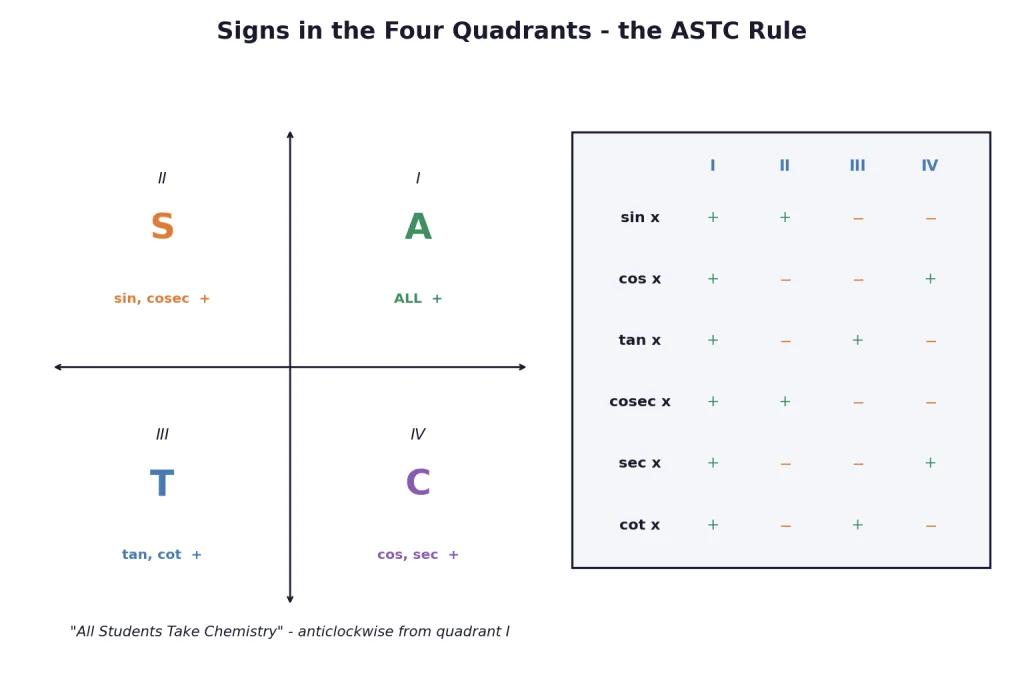
Step 2 — Sign from the quadrant. In Q II cosine (and sec) are negative: sec x = − 13 12 \sec x = -\frac{13}{12} sec x = − 12 13 cos x = − 12 13 \cos x = -\frac{12}{13} cos x = − 13 12
Step 3 — Recover sine as a product. sin x = tan x ⋅ cos x = ( − 5 12 ) ( − 12 13 ) = 5 13 \sin x = \tan x \cdot \cos x = \left(-\frac{5}{12}\right)\left(-\frac{12}{13}\right) = \frac{5}{13} sin x = tan x ⋅ cos x = ( − 12 5 ) ( − 13 12 ) = 13 5
Takeaway: The 5-12-13 triangle plus quadrant signs — the standard machine for completing a function set.
Example 4: Big-angle evaluation set
Evaluate (i) sin 17 π 6 \sin\frac{17\pi}{6} sin 6 17 π tan ( − 7 π 4 ) \tan\left(-\frac{7\pi}{4}\right) tan ( − 4 7 π ) sec 420 ° \sec 420° sec 420°
Solution:
Step 1 — (i) Strip a revolution. 17 π 6 = 2 π + 5 π 6 \frac{17\pi}{6} = 2\pi + \frac{5\pi}{6} 6 17 π = 2 π + 6 5 π sin 17 π 6 = sin 5 π 6 = sin ( π − π 6 ) = sin π 6 = 1 2 \sin\frac{17\pi}{6} = \sin\frac{5\pi}{6} = \sin\left(\pi - \frac{\pi}{6}\right) = \sin\frac{\pi}{6} = \frac{1}{2} sin 6 17 π = sin 6 5 π = sin ( π − 6 π ) = sin 6 π = 2 1
Step 2 — (ii) Odd rule, then reduce. tan ( − 7 π 4 ) = − tan 7 π 4 = − tan ( 2 π − π 4 ) = − ( − tan π 4 ) = 1 \tan\left(-\frac{7\pi}{4}\right) = -\tan\frac{7\pi}{4} = -\tan\left(2\pi - \frac{\pi}{4}\right) = -\left(-\tan\frac{\pi}{4}\right) = 1 tan ( − 4 7 π ) = − tan 4 7 π = − tan ( 2 π − 4 π ) = − ( − tan 4 π ) = 1
Step 3 — (iii) Strip 360°. 420 ° = 360 ° + 60 ° 420° = 360° + 60° 420° = 360° + 60° sec 420 ° = sec 60 ° = 2 \sec 420° = \sec 60° = 2 sec 420° = sec 60° = 2
Takeaway: Strip revolutions, use allied angles, track signs — three moves cover every evaluation.
Example 5: Identity from the fundamental trio
Prove that sec 2 x + csc 2 x = sec 2 x csc 2 x \sec^2 x + \csc^2 x = \sec^2 x \csc^2 x sec 2 x + csc 2 x = sec 2 x csc 2 x
Solution:
Step 1 — Drop to sines and cosines. LHS = 1 cos 2 x + 1 sin 2 x = \frac{1}{\cos^2 x} + \frac{1}{\sin^2 x} = c o s 2 x 1 + s i n 2 x 1
Step 2 — Combine over a common denominator. = sin 2 x + cos 2 x sin 2 x cos 2 x = \frac{\sin^2 x + \cos^2 x}{\sin^2 x \cos^2 x} = s i n 2 x c o s 2 x s i n 2 x + c o s 2 x
Step 3 — Apply the fundamental identity. The numerator is 1: = 1 sin 2 x cos 2 x = sec 2 x csc 2 x = \frac{1}{\sin^2 x \cos^2 x} = \sec^2 x\csc^2 x = s i n 2 x c o s 2 x 1 = sec 2 x csc 2 x
Takeaway: Whenever secs and cosecs mix, drop to sines and cosines — the fundamental identity is usually waiting one line down.
Example 6: Quadrant from double conditions
If tan x > 0 \tan x > 0 tan x > 0 sec x < 0 \sec x < 0 sec x < 0 sin x 2 \sin\frac{x}{2} sin 2 x π < x < 3 π 2 \pi < x < \frac{3\pi}{2} π < x < 2 3 π
Solution:
Step 1 — List each condition's quadrants from the ASTC chart. tan positive → Q I or Q III; sec (same sign as cos) negative → Q II or Q III.
Step 2 — Intersect. The only common quadrant is Q III .
Step 3 — Halve the interval for the half angle. π < x < 3 π 2 \pi < x < \frac{3\pi}{2} π < x < 2 3 π π 2 < x 2 < 3 π 4 \frac{\pi}{2} < \frac{x}{2} < \frac{3\pi}{4} 2 π < 2 x < 4 3 π
Step 4 — Read the sign. In Q II sine is positive: sin x 2 > 0 \sin\frac{x}{2} > 0 sin 2 x > 0
Takeaway: Halving an angle halves its interval — re-locate the quadrant of x 2 \frac{x}{2} 2 x
Example 7: The 2-sin-cos completing trick
If sin x + cos x = 1 2 \sin x + \cos x = \frac{1}{2} sin x + cos x = 2 1 sin x cos x \sin x \cos x sin x cos x sin 3 x + cos 3 x \sin^3 x + \cos^3 x sin 3 x + cos 3 x
Solution:
Step 1 — Square the given equation. ( sin x + cos x ) 2 = sin 2 x + cos 2 x + 2 sin x cos x = 1 + 2 sin x cos x = 1 4 (\sin x + \cos x)^2 = \sin^2 x + \cos^2 x + 2\sin x\cos x = 1 + 2\sin x\cos x = \frac{1}{4} ( sin x + cos x ) 2 = sin 2 x + cos 2 x + 2 sin x cos x = 1 + 2 sin x cos x = 4 1
Step 2 — Solve for the product. 2 sin x cos x = 1 4 − 1 = − 3 4 2\sin x\cos x = \frac{1}{4} - 1 = -\frac{3}{4} 2 sin x cos x = 4 1 − 1 = − 4 3 sin x cos x = − 3 8 \sin x\cos x = -\frac{3}{8} sin x cos x = − 8 3
Step 3 — Use the cube identity. a 3 + b 3 = ( a + b ) 3 − 3 a b ( a + b ) a^3 + b^3 = (a + b)^3 - 3ab(a + b) a 3 + b 3 = ( a + b ) 3 − 3 ab ( a + b ) a + b = 1 2 a + b = \frac{1}{2} a + b = 2 1 a b = − 3 8 ab = -\frac{3}{8} ab = − 8 3
Step 4 — Substitute. ( 1 2 ) 3 − 3 ( − 3 8 ) 1 2 = 1 8 + 9 16 = 11 16 \left(\frac{1}{2}\right)^3 - 3\left(-\frac{3}{8}\right)\frac{1}{2} = \frac{1}{8} + \frac{9}{16} = \frac{11}{16} ( 2 1 ) 3 − 3 ( − 8 3 ) 2 1 = 8 1 + 16 9 = 16 11
Takeaway: ( sin x + cos x ) 2 = 1 + sin 2 x (\sin x + \cos x)^2 = 1 + \sin 2x ( sin x + cos x ) 2 = 1 + sin 2 x
Example 8: Allied-angle evaluation chain
Evaluate sin 780 ° sin 480 ° + cos 120 ° cos 60 ° \sin 780° \sin 480° + \cos 120° \cos 60° sin 780° sin 480° + cos 120° cos 60°
Solution:
Step 1 — Reduce each sine. sin 780 ° = sin ( 720 ° + 60 ° ) = sin 60 ° = 3 2 \sin 780° = \sin(720° + 60°) = \sin 60° = \frac{\sqrt{3}}{2} sin 780° = sin ( 720° + 60° ) = sin 60° = 2 3 sin 480 ° = sin ( 360 ° + 120 ° ) = sin 120 ° = sin ( 180 ° − 60 ° ) = 3 2 \sin 480° = \sin(360° + 120°) = \sin 120° = \sin(180° - 60°) = \frac{\sqrt{3}}{2} sin 480° = sin ( 360° + 120° ) = sin 120° = sin ( 180° − 60° ) = 2 3
Step 2 — Write the cosines. cos 120 ° = cos ( 180 ° − 60 ° ) = − 1 2 \cos 120° = \cos(180° - 60°) = -\frac{1}{2} cos 120° = cos ( 180° − 60° ) = − 2 1 cos 60 ° = 1 2 \cos 60° = \frac{1}{2} cos 60° = 2 1
Step 3 — Assemble. 3 2 ⋅ 3 2 + ( − 1 2 ) 1 2 = 3 4 − 1 4 = 1 2 \frac{\sqrt{3}}{2} \cdot \frac{\sqrt{3}}{2} + \left(-\frac{1}{2}\right)\frac{1}{2} = \frac{3}{4} - \frac{1}{4} = \frac{1}{2} 2 3 ⋅ 2 3 + ( − 2 1 ) 2 1 = 4 3 − 4 1 = 2 1
Takeaway: Reduce each factor independently, then combine — never mix reduction and arithmetic in one step.
Example 9: A √2 extraction
Prove that sin x + cos x = 2 cos ( x − π 4 ) \sin x + \cos x = \sqrt{2}\cos\left(x - \frac{\pi}{4}\right) sin x + cos x = 2 cos ( x − 4 π )
Solution:
Step 1 — Expand the right side. 2 cos ( x − π 4 ) = 2 [ cos x cos π 4 + sin x sin π 4 ] \sqrt{2}\cos\left(x - \frac{\pi}{4}\right) = \sqrt{2}\left[\cos x\cos\frac{\pi}{4} + \sin x \sin\frac{\pi}{4}\right] 2 cos ( x − 4 π ) = 2 [ cos x cos 4 π + sin x sin 4 π ]
Step 2 — Substitute the values. = 2 ⋅ 1 2 ( cos x + sin x ) = sin x + cos x = \sqrt{2} \cdot \frac{1}{\sqrt{2}}(\cos x + \sin x) = \sin x + \cos x = 2 ⋅ 2 1 ( cos x + sin x ) = sin x + cos x
Takeaway: Factoring 2 \sqrt{2} 2 sin x + cos x \sin x + \cos x sin x + cos x a sin x + b cos x = R sin ( x + ϕ ) a\sin x + b\cos x = R\sin(x + \phi) a sin x + b cos x = R sin ( x + ϕ )
Example 10: Value of cos(x + y)cos(x − y)
Prove that cos ( x + y ) cos ( x − y ) = cos 2 x − sin 2 y \cos(x + y)\cos(x - y) = \cos^2 x - \sin^2 y cos ( x + y ) cos ( x − y ) = cos 2 x − sin 2 y
Solution:
Step 1 — Expand as a difference of squares. ( cos x cos y − sin x sin y ) ( cos x cos y + sin x sin y ) = cos 2 x cos 2 y − sin 2 x sin 2 y (\cos x\cos y - \sin x\sin y)(\cos x\cos y + \sin x\sin y) = \cos^2 x\cos^2 y - \sin^2 x\sin^2 y ( cos x cos y − sin x sin y ) ( cos x cos y + sin x sin y ) = cos 2 x cos 2 y − sin 2 x sin 2 y
Step 2 — Convert everything toward x-cosines and y-sines. = cos 2 x ( 1 − sin 2 y ) − ( 1 − cos 2 x ) sin 2 y = \cos^2 x(1 - \sin^2 y) - (1 - \cos^2 x)\sin^2 y = cos 2 x ( 1 − sin 2 y ) − ( 1 − cos 2 x ) sin 2 y
Step 3 — Expand and cancel. = cos 2 x − cos 2 x sin 2 y − sin 2 y + cos 2 x sin 2 y = cos 2 x − sin 2 y = \cos^2 x - \cos^2 x\sin^2 y - \sin^2 y + \cos^2 x\sin^2 y = \cos^2 x - \sin^2 y = cos 2 x − cos 2 x sin 2 y − sin 2 y + cos 2 x sin 2 y = cos 2 x − sin 2 y
Takeaway: The difference-of-squares shape ( A − B ) ( A + B ) (A-B)(A+B) ( A − B ) ( A + B )
Example 11: The 2cos(x/2) family flagship
Prove that cos x + cos y + cos z + cos ( x + y + z ) = 4 cos x + y 2 cos y + z 2 cos z + x 2 \cos x + \cos y + \cos z + \cos(x + y + z) = 4\cos\frac{x+y}{2}\cos\frac{y+z}{2}\cos\frac{z+x}{2} cos x + cos y + cos z + cos ( x + y + z ) = 4 cos 2 x + y cos 2 y + z cos 2 z + x
Solution:
Step 1 — Pair strategically. Group as [ cos x + cos y ] + [ cos z + cos ( x + y + z ) ] [\cos x + \cos y] + [\cos z + \cos(x+y+z)] [ cos x + cos y ] + [ cos z + cos ( x + y + z )]
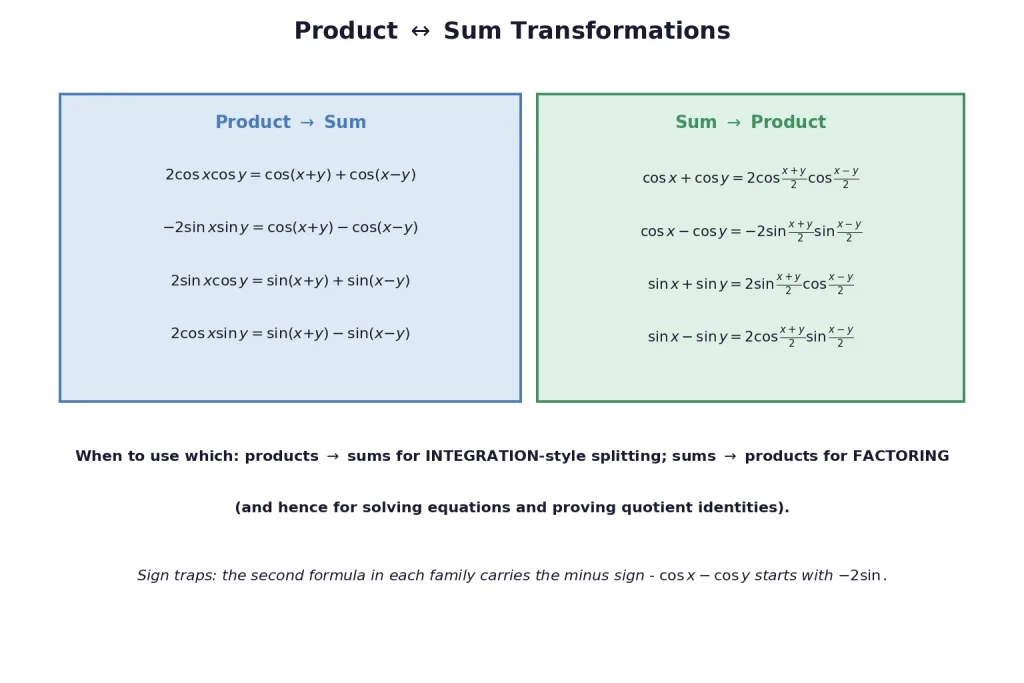
Step 2 — Sum to product on each pair. 2 cos x + y 2 cos x − y 2 + 2 cos x + y + 2 z 2 cos x + y 2 2\cos\frac{x+y}{2}\cos\frac{x-y}{2} + 2\cos\frac{x+y+2z}{2}\cos\frac{x+y}{2} 2 cos 2 x + y cos 2 x − y + 2 cos 2 x + y + 2 z cos 2 x + y
Step 3 — Factor the common half-sum. = 2 cos x + y 2 [ cos x − y 2 + cos x + y + 2 z 2 ] = 2\cos\frac{x+y}{2}\left[\cos\frac{x-y}{2} + \cos\frac{x+y+2z}{2}\right] = 2 cos 2 x + y [ cos 2 x − y + cos 2 x + y + 2 z ]
Step 4 — Sum to product again inside the bracket. Half-sum: 1 2 [ x − y 2 + x + y + 2 z 2 ] = x + z 2 \frac{1}{2}\left[\frac{x-y}{2} + \frac{x+y+2z}{2}\right] = \frac{x+z}{2} 2 1 [ 2 x − y + 2 x + y + 2 z ] = 2 x + z y + z 2 \frac{y+z}{2} 2 y + z 2 cos x + z 2 cos y + z 2 2\cos\frac{x+z}{2}\cos\frac{y+z}{2} 2 cos 2 x + z cos 2 y + z
Step 5 — Multiply out. Total = 4 cos x + y 2 cos y + z 2 cos z + x 2 = 4\cos\frac{x+y}{2}\cos\frac{y+z}{2}\cos\frac{z+x}{2} = 4 cos 2 x + y cos 2 y + z cos 2 z + x
Takeaway: Pair the terms so both pairs share a common half-sum factor; two rounds of sum-to-product finish it — a Board favourite.
Example 12: Sum of two squared pair-sums
Prove that ( cos x + cos y ) 2 + ( sin x + sin y ) 2 = 4 cos 2 x − y 2 (\cos x + \cos y)^2 + (\sin x + \sin y)^2 = 4\cos^2\frac{x - y}{2} ( cos x + cos y ) 2 + ( sin x + sin y ) 2 = 4 cos 2 2 x − y
Solution:
Step 1 — Expand both squares and add. The four squared terms give ( cos 2 x + sin 2 x ) + ( cos 2 y + sin 2 y ) = 2 (\cos^2 x + \sin^2 x) + (\cos^2 y + \sin^2 y) = 2 ( cos 2 x + sin 2 x ) + ( cos 2 y + sin 2 y ) = 2 2 ( cos x cos y + sin x sin y ) 2(\cos x\cos y + \sin x\sin y) 2 ( cos x cos y + sin x sin y )
Step 2 — Recognise the difference formula. cos x cos y + sin x sin y = cos ( x − y ) \cos x\cos y + \sin x\sin y = \cos(x - y) cos x cos y + sin x sin y = cos ( x − y ) 2 + 2 cos ( x − y ) 2 + 2\cos(x - y) 2 + 2 cos ( x − y )
Step 3 — Half-angle square. 1 + cos θ = 2 cos 2 θ 2 1 + \cos\theta = 2\cos^2\frac{\theta}{2} 1 + cos θ = 2 cos 2 2 θ θ = x − y \theta = x - y θ = x − y 2 [ 1 + cos ( x − y ) ] = 4 cos 2 x − y 2 2[1 + \cos(x-y)] = 4\cos^2\frac{x-y}{2} 2 [ 1 + cos ( x − y )] = 4 cos 2 2 x − y
Takeaway: Sums of squares of paired sines/cosines almost always reduce to 2 + 2 cos ( gap ) 2 + 2\cos(\text{gap}) 2 + 2 cos ( gap ) 1 + cos θ = 2 cos 2 θ 2 1 + \cos\theta = 2\cos^2\frac{\theta}{2} 1 + cos θ = 2 cos 2 2 θ
Example 13: A three-angle telescoping product
Prove the classic: sin 20 ° sin 40 ° sin 60 ° sin 80 ° = 3 16 \sin 20° \sin 40° \sin 60° \sin 80° = \frac{3}{16} sin 20° sin 40° sin 60° sin 80° = 16 3
Solution:
Step 1 — Peel off the known value. sin 60 ° = 3 2 \sin 60° = \frac{\sqrt{3}}{2} sin 60° = 2 3 3 2 [ sin 20 ° sin 40 ° sin 80 ° ] \frac{\sqrt{3}}{2}\left[\sin 20°\sin 40°\sin 80°\right] 2 3 [ sin 20° sin 40° sin 80° ]
Step 2 — Recognise the triple-angle product family. sin θ sin ( 60 ° − θ ) sin ( 60 ° + θ ) = 1 4 sin 3 θ \sin\theta \sin(60° - \theta)\sin(60° + \theta) = \frac{1}{4}\sin 3\theta sin θ sin ( 60° − θ ) sin ( 60° + θ ) = 4 1 sin 3 θ θ = 20 ° \theta = 20° θ = 20°
Step 3 — Apply it. sin 20 ° sin 40 ° sin 80 ° = 1 4 sin 60 ° = 3 8 \sin 20°\sin 40°\sin 80° = \frac{1}{4}\sin 60° = \frac{\sqrt{3}}{8} sin 20° sin 40° sin 80° = 4 1 sin 60° = 8 3
Step 4 — Multiply. 3 2 ⋅ 3 8 = 3 16 \frac{\sqrt{3}}{2} \cdot \frac{\sqrt{3}}{8} = \frac{3}{16} 2 3 ⋅ 8 3 = 16 3
Takeaway: The triple-angle product identity sin θ sin ( 60 ° − θ ) sin ( 60 ° + θ ) = sin 3 θ 4 \sin\theta\sin(60°-\theta)\sin(60°+\theta) = \frac{\sin 3\theta}{4} sin θ sin ( 60° − θ ) sin ( 60° + θ ) = 4 s i n 3 θ
Example 14: tan sum with a condition
If x + y = π 4 x + y = \frac{\pi}{4} x + y = 4 π ( 1 + tan x ) ( 1 + tan y ) = 2 (1 + \tan x)(1 + \tan y) = 2 ( 1 + tan x ) ( 1 + tan y ) = 2
Solution:
Step 1 — Take tan of the condition. tan ( x + y ) = tan π 4 = 1 \tan(x + y) = \tan\frac{\pi}{4} = 1 tan ( x + y ) = tan 4 π = 1 tan x + tan y 1 − tan x tan y = 1 \frac{\tan x + \tan y}{1 - \tan x\tan y} = 1 1 − t a n x t a n y t a n x + t a n y = 1
Step 2 — Cross-multiply. tan x + tan y = 1 − tan x tan y \tan x + \tan y = 1 - \tan x\tan y tan x + tan y = 1 − tan x tan y
Step 3 — Expand the target product. ( 1 + tan x ) ( 1 + tan y ) = 1 + tan x + tan y + tan x tan y (1 + \tan x)(1 + \tan y) = 1 + \tan x + \tan y + \tan x\tan y ( 1 + tan x ) ( 1 + tan y ) = 1 + tan x + tan y + tan x tan y
Step 4 — Substitute Step 2. = 1 + ( 1 − tan x tan y ) + tan x tan y = 2 = 1 + (1 - \tan x\tan y) + \tan x\tan y = 2 = 1 + ( 1 − tan x tan y ) + tan x tan y = 2
Takeaway: Conditions on x + y convert to relations between tan x and tan y through the sum formula — then it is pure algebra.
Example 15: Half-angle values from cos x
If cos x = − 1 3 \cos x = -\frac{1}{3} cos x = − 3 1 π < x < 3 π 2 \pi < x < \frac{3\pi}{2} π < x < 2 3 π sin x 2 \sin\frac{x}{2} sin 2 x cos x 2 \cos\frac{x}{2} cos 2 x tan x 2 \tan\frac{x}{2} tan 2 x
Solution:
Step 1 — Locate the half angle FIRST. π < x < 3 π 2 \pi < x < \frac{3\pi}{2} π < x < 2 3 π π 2 < x 2 < 3 π 4 \frac{\pi}{2} < \frac{x}{2} < \frac{3\pi}{4} 2 π < 2 x < 4 3 π
Step 2 — Power-reduce for sine. sin 2 x 2 = 1 − cos x 2 = 1 + 1 3 2 = 2 3 \sin^2\frac{x}{2} = \frac{1 - \cos x}{2} = \frac{1 + \frac{1}{3}}{2} = \frac{2}{3} sin 2 2 x = 2 1 − c o s x = 2 1 + 3 1 = 3 2 sin x 2 = + 2 3 = 6 3 \sin\frac{x}{2} = +\sqrt{\frac{2}{3}} = \frac{\sqrt{6}}{3} sin 2 x = + 3 2 = 3 6
Step 3 — Power-reduce for cosine. cos 2 x 2 = 1 + cos x 2 = 1 − 1 3 2 = 1 3 \cos^2\frac{x}{2} = \frac{1 + \cos x}{2} = \frac{1 - \frac{1}{3}}{2} = \frac{1}{3} cos 2 2 x = 2 1 + c o s x = 2 1 − 3 1 = 3 1 cos x 2 = − 1 3 = − 3 3 \cos\frac{x}{2} = -\frac{1}{\sqrt{3}} = -\frac{\sqrt{3}}{3} cos 2 x = − 3 1 = − 3 3
Step 4 — Divide for tangent. tan x 2 = 6 / 3 − 3 / 3 = − 2 \tan\frac{x}{2} = \frac{\sqrt{6}/3}{-\sqrt{3}/3} = -\sqrt{2} tan 2 x = − 3 /3 6 /3 = − 2
Takeaway: Locate the half-angle's quadrant FIRST, then power-reduce and attach signs.
Example 16: The cot x cot 2x identity
Prove that cot x cot 2 x − cot 2 x cot 3 x − cot 3 x cot x = 1 \cot x \cot 2x - \cot 2x \cot 3x - \cot 3x \cot x = 1 cot x cot 2 x − cot 2 x cot 3 x − cot 3 x cot x = 1
Solution:
Step 1 — Write 3x as a sum with cot. cot 3 x = cot ( 2 x + x ) = cot 2 x cot x − 1 cot 2 x + cot x \cot 3x = \cot(2x + x) = \frac{\cot 2x\cot x - 1}{\cot 2x + \cot x} cot 3 x = cot ( 2 x + x ) = c o t 2 x + c o t x c o t 2 x c o t x − 1
Step 2 — Cross-multiply. cot 3 x ( cot 2 x + cot x ) = cot 2 x cot x − 1 \cot 3x(\cot 2x + \cot x) = \cot 2x\cot x - 1 cot 3 x ( cot 2 x + cot x ) = cot 2 x cot x − 1 cot 3 x cot 2 x + cot 3 x cot x = cot 2 x cot x − 1 \cot 3x\cot 2x + \cot 3x\cot x = \cot 2x\cot x - 1 cot 3 x cot 2 x + cot 3 x cot x = cot 2 x cot x − 1
Step 3 — Rearrange to the target. cot x cot 2 x − cot 2 x cot 3 x − cot 3 x cot x = 1 \cot x\cot 2x - \cot 2x\cot 3x - \cot 3x\cot x = 1 cot x cot 2 x − cot 2 x cot 3 x − cot 3 x cot x = 1
Takeaway: The cot-sum formula cross-multiplied — mirror twin of the tan 3A identity.
Example 17: Four-term sum-to-product
Prove that sin x + sin 3 x + sin 5 x + sin 7 x cos x + cos 3 x + cos 5 x + cos 7 x = tan 4 x \frac{\sin x + \sin 3x + \sin 5x + \sin 7x}{\cos x + \cos 3x + \cos 5x + \cos 7x} = \tan 4x c o s x + c o s 3 x + c o s 5 x + c o s 7 x s i n x + s i n 3 x + s i n 5 x + s i n 7 x = tan 4 x
Solution:
Step 1 — Pair outers with outers, inners with inners. [ sin 7 x + sin x ] + [ sin 5 x + sin 3 x ] [\sin 7x + \sin x] + [\sin 5x + \sin 3x] [ sin 7 x + sin x ] + [ sin 5 x + sin 3 x ]
Step 2 — Factor the numerator. 2 sin 4 x cos 3 x + 2 sin 4 x cos x = 2 sin 4 x ( cos 3 x + cos x ) 2\sin 4x\cos 3x + 2\sin 4x\cos x = 2\sin 4x(\cos 3x + \cos x) 2 sin 4 x cos 3 x + 2 sin 4 x cos x = 2 sin 4 x ( cos 3 x + cos x )
Step 3 — Same pairing below. cos x + cos 3 x + cos 5 x + cos 7 x = 2 cos 4 x cos 3 x + 2 cos 4 x cos x = 2 cos 4 x ( cos 3 x + cos x ) \cos x + \cos 3x + \cos 5x + \cos 7x = 2\cos 4x\cos 3x + 2\cos 4x\cos x = 2\cos 4x(\cos 3x + \cos x) cos x + cos 3 x + cos 5 x + cos 7 x = 2 cos 4 x cos 3 x + 2 cos 4 x cos x = 2 cos 4 x ( cos 3 x + cos x )
Step 4 — Cancel the common bracket. Quotient = sin 4 x cos 4 x = tan 4 x = \frac{\sin 4x}{\cos 4x} = \tan 4x = c o s 4 x s i n 4 x = tan 4 x
Takeaway: With four terms, pair so both pairs produce the SAME half-sum (here 4x) — outer-with-outer, inner-with-inner.
Example 18: A conditional identity with x + y
If sin x + sin y = a \sin x + \sin y = a sin x + sin y = a cos x + cos y = b \cos x + \cos y = b cos x + cos y = b tan x + y 2 \tan\frac{x+y}{2} tan 2 x + y
Solution:
Step 1 — Convert both data to products. a = 2 sin x + y 2 cos x − y 2 a = 2\sin\frac{x+y}{2}\cos\frac{x-y}{2} a = 2 sin 2 x + y cos 2 x − y b = 2 cos x + y 2 cos x − y 2 b = 2\cos\frac{x+y}{2}\cos\frac{x-y}{2} b = 2 cos 2 x + y cos 2 x − y
Step 2 — Divide to kill the common factor. a b = sin x + y 2 cos x + y 2 = tan x + y 2 \frac{a}{b} = \frac{\sin\frac{x+y}{2}}{\cos\frac{x+y}{2}} = \tan\frac{x+y}{2} b a = c o s 2 x + y s i n 2 x + y = tan 2 x + y b ≠ 0 b \neq 0 b = 0
Takeaway: Dividing the two sum-to-product forms kills the common half-difference factor — the half-sum's tangent pops out free.
Example 19: Range preview with identities
Find the maximum value of cos 2 x − sin 2 x + 1 \cos^2 x - \sin^2 x + 1 cos 2 x − sin 2 x + 1
Solution:
Step 1 — Recognise the double angle. cos 2 x − sin 2 x = cos 2 x \cos^2 x - \sin^2 x = \cos 2x cos 2 x − sin 2 x = cos 2 x cos 2 x + 1 \cos 2x + 1 cos 2 x + 1
Step 2 — Bound it. cos 2 x ∈ [ − 1 , 1 ] \cos 2x \in [-1, 1] cos 2 x ∈ [ − 1 , 1 ] cos 2 x + 1 ∈ [ 0 , 2 ] \cos 2x + 1 \in [0, 2] cos 2 x + 1 ∈ [ 0 , 2 ]
Step 3 — Attainment. The maximum 2 occurs when cos 2 x = 1 \cos 2x = 1 cos 2 x = 1 x = n π x = n\pi x = nπ
Takeaway: Identities convert ugly quadratic-in-sin/cos expressions into single trig functions whose range is known on sight.
Example 20: Half-angle set from tan x
If tan x = − 4 3 \tan x = -\frac{4}{3} tan x = − 3 4 sin x 2 \sin\frac{x}{2} sin 2 x cos x 2 \cos\frac{x}{2} cos 2 x tan x 2 \tan\frac{x}{2} tan 2 x
Solution:
Step 1 — Recover cos x with the quadrant sign. sec 2 x = 1 + 16 9 = 25 9 \sec^2 x = 1 + \frac{16}{9} = \frac{25}{9} sec 2 x = 1 + 9 16 = 9 25 sec x = − 5 3 \sec x = -\frac{5}{3} sec x = − 3 5 cos x = − 3 5 \cos x = -\frac{3}{5} cos x = − 5 3
Step 2 — Locate the half angle. π 2 < x < π \frac{\pi}{2} < x < \pi 2 π < x < π π 4 < x 2 < π 2 \frac{\pi}{4} < \frac{x}{2} < \frac{\pi}{2} 4 π < 2 x < 2 π
Step 3 — Power-reduce for sine. sin x 2 = 1 − cos x 2 = 1 + 3 5 2 = 4 5 = 2 5 \sin\frac{x}{2} = \sqrt{\frac{1 - \cos x}{2}} = \sqrt{\frac{1 + \frac{3}{5}}{2}} = \sqrt{\frac{4}{5}} = \frac{2}{\sqrt{5}} sin 2 x = 2 1 − c o s x = 2 1 + 5 3 = 5 4 = 5 2 1 − cos x = 1 + 3 5 1 - \cos x = 1 + \frac{3}{5} 1 − cos x = 1 + 5 3
Step 4 — Power-reduce for cosine. cos x 2 = 1 + cos x 2 = 1 − 3 5 2 = 1 5 \cos\frac{x}{2} = \sqrt{\frac{1 + \cos x}{2}} = \sqrt{\frac{1 - \frac{3}{5}}{2}} = \frac{1}{\sqrt{5}} cos 2 x = 2 1 + c o s x = 2 1 − 5 3 = 5 1
Step 5 — Divide. tan x 2 = 2 / 5 1 / 5 = 2 \tan\frac{x}{2} = \frac{2/\sqrt{5}}{1/\sqrt{5}} = 2 tan 2 x = 1/ 5 2/ 5 = 2
Takeaway: Note 1 − cos x = 1 + 3 5 1 - \cos x = 1 + \frac{3}{5} 1 − cos x = 1 + 5 3
Example 21: An equation solved by factoring (preview)
Find all x in [ 0 , 2 π ] [0, 2\pi] [ 0 , 2 π ] sin 2 x = sin x \sin 2x = \sin x sin 2 x = sin x
Solution:
Step 1 — Bring everything to one side and factor. 2 sin x cos x − sin x = sin x ( 2 cos x − 1 ) = 0 2\sin x\cos x - \sin x = \sin x(2\cos x - 1) = 0 2 sin x cos x − sin x = sin x ( 2 cos x − 1 ) = 0
Step 2 — Case sin x = 0. In [ 0 , 2 π ] [0, 2\pi] [ 0 , 2 π ] x = 0 , π , 2 π x = 0, \pi, 2\pi x = 0 , π , 2 π
Step 3 — Case cos x = 1 2 \cos x = \frac{1}{2} cos x = 2 1 In [ 0 , 2 π ] [0, 2\pi] [ 0 , 2 π ] x = π 3 , 5 π 3 x = \frac{\pi}{3}, \frac{5\pi}{3} x = 3 π , 3 5 π
Step 4 — Collect. Solution set: { 0 , π 3 , π , 5 π 3 , 2 π } \left\{0, \frac{\pi}{3}, \pi, \frac{5\pi}{3}, 2\pi\right\} { 0 , 3 π , π , 3 5 π , 2 π }
Takeaway: NEVER divide by sin x — factoring keeps the sin x = 0 family alive. (General solutions of such equations: JEE Corner.)
Example 22: Proving via difference of squares
Prove that cos 2 2 x − cos 2 6 x = sin 4 x sin 8 x \cos^2 2x - \cos^2 6x = \sin 4x \sin 8x cos 2 2 x − cos 2 6 x = sin 4 x sin 8 x
Solution:
Step 1 — Factor as a difference of squares. ( cos 2 x − cos 6 x ) ( cos 2 x + cos 6 x ) (\cos 2x - \cos 6x)(\cos 2x + \cos 6x) ( cos 2 x − cos 6 x ) ( cos 2 x + cos 6 x )
Step 2 — Sum-to-product on each factor. cos 2 x − cos 6 x = − 2 sin 4 x sin ( − 2 x ) = 2 sin 4 x sin 2 x \cos 2x - \cos 6x = -2\sin 4x\sin(-2x) = 2\sin 4x \sin 2x cos 2 x − cos 6 x = − 2 sin 4 x sin ( − 2 x ) = 2 sin 4 x sin 2 x cos 2 x + cos 6 x = 2 cos 4 x cos 2 x \cos 2x + \cos 6x = 2\cos 4x\cos 2x cos 2 x + cos 6 x = 2 cos 4 x cos 2 x
Step 3 — Regroup into double angles. [ 2 sin 4 x sin 2 x ] [ 2 cos 4 x cos 2 x ] = ( 2 sin 4 x cos 4 x ) ( 2 sin 2 x cos 2 x ) = sin 8 x sin 4 x \left[2\sin 4x\sin 2x\right]\left[2\cos 4x\cos 2x\right] = (2\sin 4x\cos 4x)(2\sin 2x\cos 2x) = \sin 8x \sin 4x [ 2 sin 4 x sin 2 x ] [ 2 cos 4 x cos 2 x ] = ( 2 sin 4 x cos 4 x ) ( 2 sin 2 x cos 2 x ) = sin 8 x sin 4 x
Takeaway: Difference of squared cosines → factor → sum-to-product both factors → double angles reassemble.
Example 23: The cos 6x expansion
Express cos 6x in terms of cos x — outline the chain and give the result.
Solution:
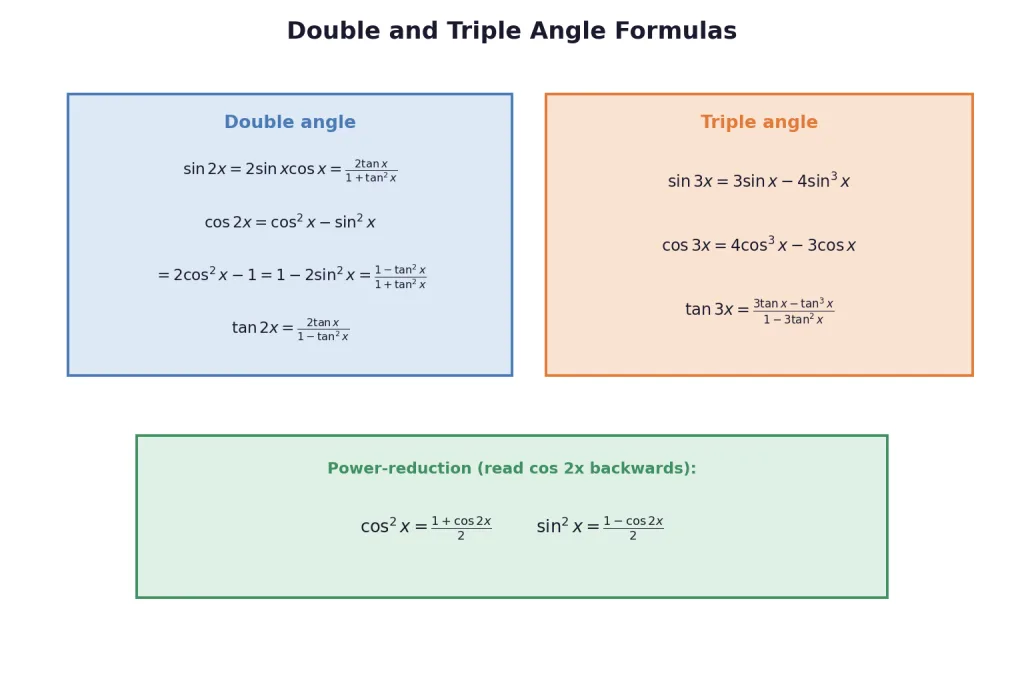
Step 1 — Choose the nesting. 6 x = 2 ( 3 x ) 6x = 2(3x) 6 x = 2 ( 3 x ) cos 6 x = 2 cos 2 3 x − 1 \cos 6x = 2\cos^2 3x - 1 cos 6 x = 2 cos 2 3 x − 1 cos 3 x = 4 cos 3 x − 3 cos x \cos 3x = 4\cos^3 x - 3\cos x cos 3 x = 4 cos 3 x − 3 cos x
Step 2 — Substitute. cos 6 x = 2 ( 4 cos 3 x − 3 cos x ) 2 − 1 \cos 6x = 2(4\cos^3 x - 3\cos x)^2 - 1 cos 6 x = 2 ( 4 cos 3 x − 3 cos x ) 2 − 1
Step 3 — Expand the square. ( 4 cos 3 x − 3 cos x ) 2 = 16 cos 6 x − 24 cos 4 x + 9 cos 2 x (4\cos^3 x - 3\cos x)^2 = 16\cos^6 x - 24\cos^4 x + 9\cos^2 x ( 4 cos 3 x − 3 cos x ) 2 = 16 cos 6 x − 24 cos 4 x + 9 cos 2 x
Step 4 — Finish. cos 6 x = 32 cos 6 x − 48 cos 4 x + 18 cos 2 x − 1 \cos 6x = 32\cos^6 x - 48\cos^4 x + 18\cos^2 x - 1 cos 6 x = 32 cos 6 x − 48 cos 4 x + 18 cos 2 x − 1
Step 5 — Check at x = 0. 32 − 48 + 18 − 1 = 1 = cos 0 32 - 48 + 18 - 1 = 1 = \cos 0 32 − 48 + 18 − 1 = 1 = cos 0
Takeaway: Nest 6x = 2(3x): double-angle outside, triple-angle inside — and check the coefficients 32, −48, 18, −1 at x = 0.
Example 24: sin x sin 2x sin 3x expansion
Prove that sin x sin 2 x sin 3 x \sin x \sin 2x \sin 3x sin x sin 2 x sin 3 x 1 4 ( sin 2 x + sin 4 x − sin 6 x ) \frac{1}{4}(\sin 2x + \sin 4x - \sin 6x) 4 1 ( sin 2 x + sin 4 x − sin 6 x )
Solution:
Step 1 — Product-to-sum on the outer pair. sin x sin 3 x = 1 2 [ cos 2 x − cos 4 x ] \sin x\sin 3x = \frac{1}{2}[\cos 2x - \cos 4x] sin x sin 3 x = 2 1 [ cos 2 x − cos 4 x ]
Step 2 — Multiply by sin 2x. 1 2 [ sin 2 x cos 2 x − sin 2 x cos 4 x ] \frac{1}{2}[\sin 2x\cos 2x - \sin 2x\cos 4x] 2 1 [ sin 2 x cos 2 x − sin 2 x cos 4 x ]
Step 3 — Product-to-sum on each piece. sin 2 x cos 2 x = 1 2 sin 4 x \sin 2x\cos 2x = \frac{1}{2}\sin 4x sin 2 x cos 2 x = 2 1 sin 4 x sin 2 x cos 4 x = 1 2 [ sin 6 x + sin ( − 2 x ) ] = 1 2 [ sin 6 x − sin 2 x ] \sin 2x\cos 4x = \frac{1}{2}[\sin 6x + \sin(-2x)] = \frac{1}{2}[\sin 6x - \sin 2x] sin 2 x cos 4 x = 2 1 [ sin 6 x + sin ( − 2 x )] = 2 1 [ sin 6 x − sin 2 x ]
Step 4 — Assemble. 1 4 sin 4 x − 1 4 sin 6 x + 1 4 sin 2 x = 1 4 ( sin 2 x + sin 4 x − sin 6 x ) \frac{1}{4}\sin 4x - \frac{1}{4}\sin 6x + \frac{1}{4}\sin 2x = \frac{1}{4}(\sin 2x + \sin 4x - \sin 6x) 4 1 sin 4 x − 4 1 sin 6 x + 4 1 sin 2 x = 4 1 ( sin 2 x + sin 4 x − sin 6 x )
Takeaway: Triple products fall to two rounds of product-to-sum — work outside-in, keeping every 1 2 \frac{1}{2} 2 1
Example 25: A cot identity with three terms
Prove that cot 4 x ( sin 5 x + sin 3 x ) = cot x ( sin 5 x − sin 3 x ) \cot 4x(\sin 5x + \sin 3x) = \cot x(\sin 5x - \sin 3x) cot 4 x ( sin 5 x + sin 3 x ) = cot x ( sin 5 x − sin 3 x )
Solution:
Step 1 — Simplify the LHS. cos 4 x sin 4 x ⋅ ( sin 5 x + sin 3 x ) = cos 4 x sin 4 x ⋅ 2 sin 4 x cos x = 2 cos 4 x cos x \frac{\cos 4x}{\sin 4x} \cdot (\sin 5x + \sin 3x) = \frac{\cos 4x}{\sin 4x} \cdot 2\sin 4x\cos x = 2\cos 4x\cos x s i n 4 x c o s 4 x ⋅ ( sin 5 x + sin 3 x ) = s i n 4 x c o s 4 x ⋅ 2 sin 4 x cos x = 2 cos 4 x cos x
Step 2 — Simplify the RHS. cos x sin x ⋅ ( sin 5 x − sin 3 x ) = cos x sin x ⋅ 2 cos 4 x sin x = 2 cos 4 x cos x \frac{\cos x}{\sin x} \cdot (\sin 5x - \sin 3x) = \frac{\cos x}{\sin x} \cdot 2\cos 4x\sin x = 2\cos 4x\cos x s i n x c o s x ⋅ ( sin 5 x − sin 3 x ) = s i n x c o s x ⋅ 2 cos 4 x sin x = 2 cos 4 x cos x
Step 3 — Compare. Both sides equal 2 cos 4 x cos x 2\cos 4x\cos x 2 cos 4 x cos x
Takeaway: When both sides look messy, simplify EACH side independently to a common target — often faster than transforming one into the other.
Example 26: The sin²-difference identity
Prove that sin 2 6 x − sin 2 4 x = sin 2 x sin 10 x \sin^2 6x - \sin^2 4x = \sin 2x \sin 10x sin 2 6 x − sin 2 4 x = sin 2 x sin 10 x
Solution:
Step 1 — Quote the compact identity. sin 2 A − sin 2 B = sin ( A + B ) sin ( A − B ) \sin^2 A - \sin^2 B = \sin(A + B)\sin(A - B) sin 2 A − sin 2 B = sin ( A + B ) sin ( A − B ) sin 10 x sin 2 x \sin 10x \sin 2x sin 10 x sin 2 x
Step 2 — Know why it works. sin 2 A − sin 2 B = ( sin A − sin B ) ( sin A + sin B ) \sin^2 A - \sin^2 B = (\sin A - \sin B)(\sin A + \sin B) sin 2 A − sin 2 B = ( sin A − sin B ) ( sin A + sin B ) 2 cos A + B 2 sin A − B 2 ⋅ 2 sin A + B 2 cos A − B 2 2\cos\frac{A+B}{2}\sin\frac{A-B}{2} \cdot 2\sin\frac{A+B}{2}\cos\frac{A-B}{2} 2 cos 2 A + B sin 2 A − B ⋅ 2 sin 2 A + B cos 2 A − B sin ( A + B ) sin ( A − B ) \sin(A+B)\sin(A-B) sin ( A + B ) sin ( A − B )
Takeaway: Memorise sin 2 A − sin 2 B = sin ( A + B ) sin ( A − B ) \sin^2 A - \sin^2 B = \sin(A+B)\sin(A-B) sin 2 A − sin 2 B = sin ( A + B ) sin ( A − B ) cos 2 A − cos 2 B = − sin ( A + B ) sin ( A − B ) \cos^2 A - \cos^2 B = -\sin(A+B)\sin(A-B) cos 2 A − cos 2 B = − sin ( A + B ) sin ( A − B )
Example 27: Conditional identity, A + B + C = π preview
If x + y + z = π x + y + z = \pi x + y + z = π sin 2 x + sin 2 y + sin 2 z = 4 sin x sin y sin z \sin 2x + \sin 2y + \sin 2z = 4\sin x\sin y\sin z sin 2 x + sin 2 y + sin 2 z = 4 sin x sin y sin z
Solution:
Step 1 — Pair the first two. sin 2 x + sin 2 y = 2 sin ( x + y ) cos ( x − y ) = 2 sin z cos ( x − y ) \sin 2x + \sin 2y = 2\sin(x + y)\cos(x - y) = 2\sin z\cos(x - y) sin 2 x + sin 2 y = 2 sin ( x + y ) cos ( x − y ) = 2 sin z cos ( x − y ) sin ( x + y ) = sin ( π − z ) = sin z \sin(x + y) = \sin(\pi - z) = \sin z sin ( x + y ) = sin ( π − z ) = sin z
Step 2 — Open the third. sin 2 z = 2 sin z cos z \sin 2z = 2\sin z\cos z sin 2 z = 2 sin z cos z
Step 3 — Factor 2 sin z 2\sin z 2 sin z Total = 2 sin z [ cos ( x − y ) + cos z ] = 2 sin z [ cos ( x − y ) − cos ( x + y ) ] = 2\sin z[\cos(x - y) + \cos z] = 2\sin z[\cos(x - y) - \cos(x + y)] = 2 sin z [ cos ( x − y ) + cos z ] = 2 sin z [ cos ( x − y ) − cos ( x + y )] cos z = cos ( π − ( x + y ) ) = − cos ( x + y ) \cos z = \cos(\pi - (x+y)) = -\cos(x+y) cos z = cos ( π − ( x + y )) = − cos ( x + y )
Step 4 — Product form. cos ( x − y ) − cos ( x + y ) = 2 sin x sin y \cos(x-y) - \cos(x+y) = 2\sin x\sin y cos ( x − y ) − cos ( x + y ) = 2 sin x sin y 4 sin x sin y sin z 4\sin x\sin y\sin z 4 sin x sin y sin z
Takeaway: Under x + y + z = π x + y + z = \pi x + y + z = π sin ( x + y ) = sin z \sin(x+y) = \sin z sin ( x + y ) = sin z cos ( x + y ) = − cos z \cos(x+y) = -\cos z cos ( x + y ) = − cos z
Example 28: Evaluating a mixed surd expression
Show that sin 75 ° − sin 15 ° cos 75 ° + cos 15 ° = tan 30 ° \frac{\sin 75° - \sin 15°}{\cos 75° + \cos 15°} = \tan 30° c o s 75° + c o s 15° s i n 75° − s i n 15° = tan 30°
Solution:
Step 1 — Factor the numerator. sin 75 ° − sin 15 ° = 2 cos 75 ° + 15 ° 2 sin 75 ° − 15 ° 2 = 2 cos 45 ° sin 30 ° \sin 75° - \sin 15° = 2\cos\frac{75° + 15°}{2}\sin\frac{75° - 15°}{2} = 2\cos 45°\sin 30° sin 75° − sin 15° = 2 cos 2 75° + 15° sin 2 75° − 15° = 2 cos 45° sin 30°
Step 2 — Factor the denominator. cos 75 ° + cos 15 ° = 2 cos 45 ° cos 30 ° \cos 75° + \cos 15° = 2\cos 45°\cos 30° cos 75° + cos 15° = 2 cos 45° cos 30°
Step 3 — Cancel and evaluate. sin 30 ° cos 30 ° = tan 30 ° = 1 3 \frac{\sin 30°}{\cos 30°} = \tan 30° = \frac{1}{\sqrt{3}} c o s 30° s i n 30° = tan 30° = 3 1
Takeaway: Even with concrete angles, sum-to-product beats plugging in surd values — cleaner and error-proof.
Example 29: The mixed-sign square sum
Prove that ( cos x + cos y ) 2 + ( sin x − sin y ) 2 = 4 cos 2 x + y 2 (\cos x + \cos y)^2 + (\sin x - \sin y)^2 = 4\cos^2\frac{x+y}{2} ( cos x + cos y ) 2 + ( sin x − sin y ) 2 = 4 cos 2 2 x + y
Solution:
Step 1 — Expand and add. Squared terms total 2; cross terms give 2 ( cos x cos y − sin x sin y ) 2(\cos x\cos y - \sin x\sin y) 2 ( cos x cos y − sin x sin y )
Step 2 — Recognise the SUM formula. cos x cos y − sin x sin y = cos ( x + y ) \cos x\cos y - \sin x\sin y = \cos(x + y) cos x cos y − sin x sin y = cos ( x + y ) 2 + 2 cos ( x + y ) 2 + 2\cos(x + y) 2 + 2 cos ( x + y )
Step 3 — Half-angle square. 2 [ 1 + cos ( x + y ) ] = 4 cos 2 x + y 2 2[1 + \cos(x+y)] = 4\cos^2\frac{x+y}{2} 2 [ 1 + cos ( x + y )] = 4 cos 2 2 x + y
Takeaway: Compare with Example 12: a PLUS pairing gives the half-DIFFERENCE, a mixed pairing gives the half-SUM — the sign pattern in the squares decides which.
Example 30: An 8-fold angle chain
Prove that cos x cos 2 x cos 4 x cos 8 x = sin 16 x 16 sin x \cos x \cos 2x \cos 4x \cos 8x = \frac{\sin 16x}{16\sin x} cos x cos 2 x cos 4 x cos 8 x = 16 s i n x s i n 16 x sin x ≠ 0 \sin x \neq 0 sin x = 0
Solution:
Step 1 — Multiply and divide by 2 sin x 2\sin x 2 sin x The numerator starts telescoping: 2 sin x cos x = sin 2 x 2\sin x\cos x = \sin 2x 2 sin x cos x = sin 2 x
Step 2 — Keep doubling. 2 sin 2 x cos 2 x = sin 4 x 2\sin 2x\cos 2x = \sin 4x 2 sin 2 x cos 2 x = sin 4 x 2 sin 4 x cos 4 x = sin 8 x 2\sin 4x\cos 4x = \sin 8x 2 sin 4 x cos 4 x = sin 8 x 2 sin 8 x cos 8 x = sin 16 x 2\sin 8x\cos 8x = \sin 16x 2 sin 8 x cos 8 x = sin 16 x
Step 3 — Count the 2's. Four doublings introduce 2 4 = 16 2^4 = 16 2 4 = 16 sin 16 x 16 sin x \frac{\sin 16x}{16\sin x} 16 s i n x s i n 16 x
Takeaway: The doubling telescope in full generality: ∏ k = 0 n − 1 cos 2 k x = sin 2 n x 2 n sin x \prod_{k=0}^{n-1}\cos 2^k x = \frac{\sin 2^n x}{2^n \sin x} ∏ k = 0 n − 1 cos 2 k x = 2 n s i n x s i n 2 n x
Example 31: From identity to value
Using sin 2 A − sin 2 B = sin ( A + B ) sin ( A − B ) \sin^2 A - \sin^2 B = \sin(A+B)\sin(A-B) sin 2 A − sin 2 B = sin ( A + B ) sin ( A − B ) sin 2 75 ° − sin 2 15 ° \sin^2 75° - \sin^2 15° sin 2 75° − sin 2 15°
Solution:
Step 1 — Substitute A = 75°, B = 15°. sin 2 75 ° − sin 2 15 ° = sin 90 ° sin 60 ° \sin^2 75° - \sin^2 15° = \sin 90°\sin 60° sin 2 75° − sin 2 15° = sin 90° sin 60°
Step 2 — Evaluate. = 1 × 3 2 = 3 2 = 1 \times \frac{\sqrt{3}}{2} = \frac{\sqrt{3}}{2} = 1 × 2 3 = 2 3
Takeaway: One line via the identity versus messy surds by direct substitution — identities ARE the calculator.
Example 32: A final Board-style proof
Prove that cos 4 x + cos 3 x + cos 2 x sin 4 x + sin 3 x + sin 2 x = cot 3 x \frac{\cos 4x + \cos 3x + \cos 2x}{\sin 4x + \sin 3x + \sin 2x} = \cot 3x s i n 4 x + s i n 3 x + s i n 2 x c o s 4 x + c o s 3 x + c o s 2 x = cot 3 x
Solution:
Step 1 — Pair the outer terms around the middle. cos 4 x + cos 2 x = 2 cos 3 x cos x \cos 4x + \cos 2x = 2\cos 3x\cos x cos 4 x + cos 2 x = 2 cos 3 x cos x 2 cos 3 x cos x + cos 3 x = cos 3 x ( 2 cos x + 1 ) 2\cos 3x\cos x + \cos 3x = \cos 3x(2\cos x + 1) 2 cos 3 x cos x + cos 3 x = cos 3 x ( 2 cos x + 1 )
Step 2 — Same pairing below. sin 4 x + sin 2 x = 2 sin 3 x cos x \sin 4x + \sin 2x = 2\sin 3x\cos x sin 4 x + sin 2 x = 2 sin 3 x cos x sin 3 x ( 2 cos x + 1 ) \sin 3x(2\cos x + 1) sin 3 x ( 2 cos x + 1 )
Step 3 — Cancel ( 2 cos x + 1 ) (2\cos x + 1) ( 2 cos x + 1 ) Quotient = cos 3 x sin 3 x = cot 3 x = \frac{\cos 3x}{\sin 3x} = \cot 3x = s i n 3 x c o s 3 x = cot 3 x
Takeaway: Three-term sums: pair the OUTERS around the middle term; the middle's angle (3x) is always the surviving half-sum.