JEE Corner — Trigonometry for JEE Main and Advanced
Why This Section Exists
The rationalised textbook stops at identities — but the official JEE Main syllabus explicitly includes trigonometrical equations, and JEE constantly tests the range of asinx+bcosx, special values like sin 18°, and conditional identities. This section restores the full JEE toolkit:
Trigonometric equations — principal solutions and general solutions;
The asinx+bcosx machine — range, maxima-minima, solvability;
Special values — sin 18°, cos 36° and the 15°-75° family collected;
Conditional identities — the A+B+C=π family;
Assorted JEE patterns — telescoping products and quadratics in sin/cos.
The worked examples and practice questions here are modelled on the JEE Main and Advanced pattern and difficulty; they are practice questions in the exam style, not reproductions of specific past papers.
[Board Note] CBSE students: trigonometric equations were removed from the rationalised syllabus — treat this section as JEE preparation. The asinx+bcosx range technique, however, quietly helps even in Board-level maximum-minimum questions.
Trigonometric Equations — Principal and General Solutions
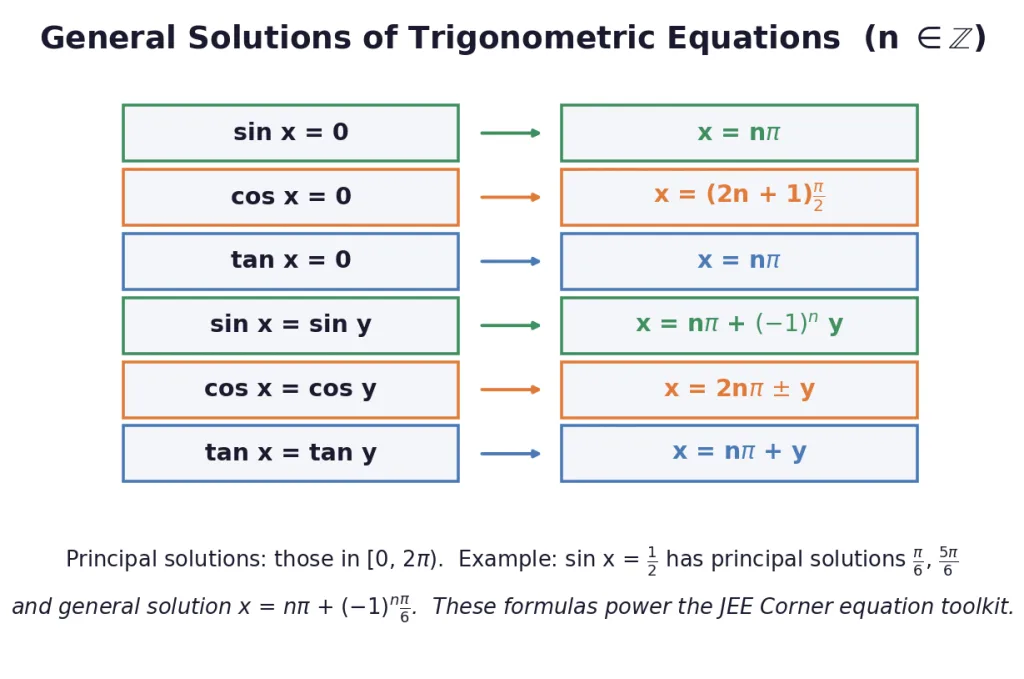
An equation like sinx=21 has infinitely many solutions (the sine wave crosses the level 21 forever). Two vocabularies organise them:
Principal solutions: those in [0,2π). For sinx=21: x=6π and 65π.
General solution: a formula with an integer parameter n capturing ALL solutions.
Reduce the equation to the form (trig function) = (known value), by factoring or identities — never divide away a factor that can vanish.
Name a convenient y with that value (e.g. siny=21, take y=6π).
Quote the master formula.
[JEE Tip] The (−1)n in the sine formula alternates the sign of y as n steps — check your general solution by extracting n = 0, 1, 2 and comparing with the principal solutions. A general solution that cannot reproduce the principal ones is wrong.
The Range of a sin x + b cos x
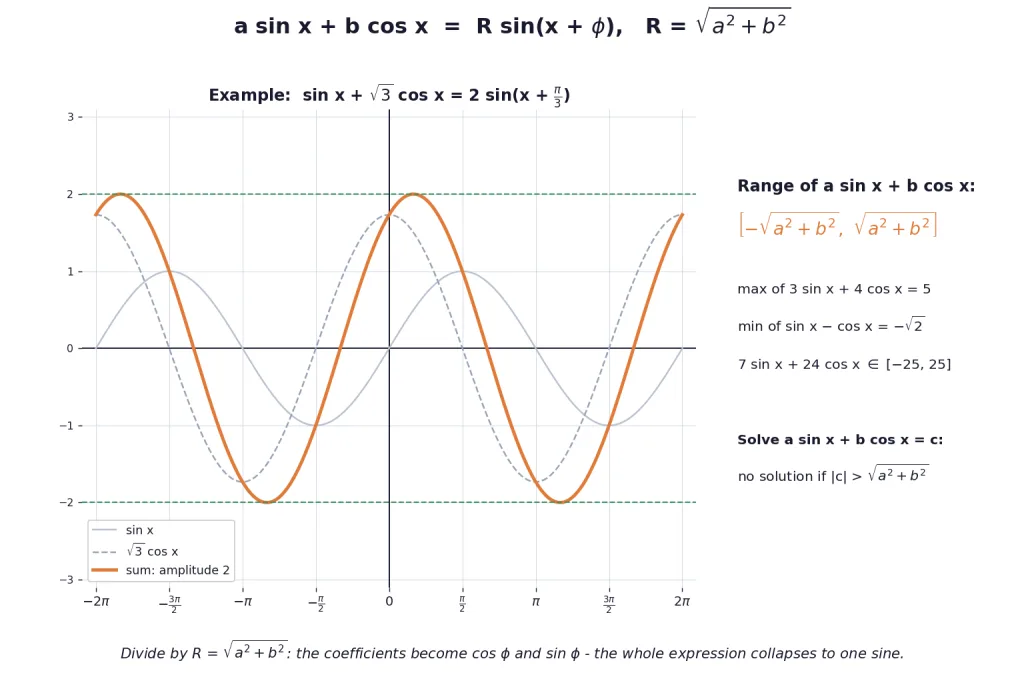
Divide by R=a2+b2: the coefficients Ra,Rb have squares summing to 1, so they are cosϕ and sinϕ for some ϕ, and
asinx+bcosx=Rsin(x+ϕ),R=a2+b2,tanϕ=ab
Key Point: The range of asinx+bcosx is [−a2+b2,a2+b2].
Instant consequences:
max of 3sinx+4cosx is 5; min is −5.
sinx−cosx∈[−2,2].
The equation asinx+bcosx=c has solutions iff∣c∣≤a2+b2.
Range of asinx+bcosx+c: [c−R,c+R].
Special values the exam assumes
sin18°=45−1cos36°=45+1
(Derivation sketch for sin 18°: let θ=18°; then 5θ=90°, so 2θ=90°−3θ, giving sin2θ=cos3θ; expanding both sides in s=sinθ yields 4s2+2s−1=0, whose positive root is 45−1.)
Companions: cos18°=410+25, sin36°=410−25, and the memorable product sin18°cos36°=41.
[JEE Tip] For f(x)=asinx+bcosx+c style questions asking "number of integer values in the range" — compute [c−R,c+R] and count. R need not be an integer; the count is ⌊c+R⌋−⌈c−R⌉+1.
Conditional Identities — the A + B + C = π Family
When A, B, C are angles of a triangle (A+B+C=π), the constraint generates a whole catalogue. The two conversion facts powering every proof:
sin(A+B)=sinC,cos(A+B)=−cosC
and for half-angles, 2A+B=2π−2C, so sin2A+B=cos2C and cos2A+B=sin2C.
The standard catalogue (all provable by pair → factor → convert):
sin2A+sin2B+sin2C=4sinAsinBsinC
cos2A+cos2B+cos2C=−1−4cosAcosBcosC
sinA+sinB+sinC=4cos2Acos2Bcos2C
cosA+cosB+cosC=1+4sin2Asin2Bsin2C
tanA+tanB+tanC=tanAtanBtanC
tan2Atan2B+tan2Btan2C+tan2Ctan2A=1
Proof of the tan identity (the shortest of the family): A+B=π−C gives tan(A+B)=−tanC, i.e. 1−tanAtanBtanA+tanB=−tanC; cross-multiplying and rearranging: tanA+tanB+tanC=tanAtanBtanC. ∎
[JEE Tip] The tan identity means: for triangle angles, the SUM of tangents equals their PRODUCT. It reappears in coordinate geometry (slopes of triangle sides) and complex numbers — recognise it in disguise.
Solved Examples
Example 1: Principal solutions
Find the principal solutions of (i) sinx=23 (ii) tanx=−31.
Solution:
Step 1 — (i) Reference angle first.sin3π=23, so the reference angle is 3π.
Step 2 — Place by sign. Sine is positive in Q I and Q II: x=3π and x=π−3π=32π — both in [0,2π).
Step 3 — (ii) Reference angle.tan6π=31; the given value is negative.
Step 4 — Place by sign. tan is negative in Q II and Q IV: x=π−6π=65π and x=2π−6π=611π.
Takeaway: Principal solutions = reference angle + quadrant placement; there are exactly two per basic equation (unless the value is 0 or ±1).
Example 2: General solution of a sine equation
Solve sinx=21 in general.
Solution:
Step 1 — Name a convenient y.sin6π=21, so take y=6π.
Step 2 — Quote the sine master formula.x=nπ+(−1)n6π, n∈Z.
Step 3 — Check against the principal solutions. n = 0: 6π ✓; n = 1: π−6π=65π ✓ — both reproduced.
Takeaway: Always run the n = 0, 1 check; it catches sign and formula slips instantly.
Example 3: General solution with cos
Solve cosx=−21 in general.
Solution:
Step 1 — Name y.cos32π=−21, so take y=32π.
Step 2 — Quote the cosine master formula.x=2nπ±32π, n∈Z.
Step 3 — Check. n = 0 gives ±32π; the minus branch equals 2π−32π=34π modulo 2π — both principal solutions covered. ✓
Takeaway: For cosine, the ± handles both principal solutions in one formula.
Example 4: A factorable equation
Solve sin2x−sinx=0 in general.
Solution:
Step 1 — Expand and factor.2sinxcosx−sinx=sinx(2cosx−1)=0 — never divide by sin x.
Step 2 — Family 1.sinx=0: x=nπ.
Step 3 — Family 2.cosx=21=cos3π: x=2nπ±3π.
Step 4 — State the union.x=nπ or x=2nπ±3π, n∈Z.
Takeaway: Factor, never divide — dividing by sin x silently deletes the entire nπ family.
Example 5: A quadratic in cos x
Solve 2cos2x+3sinx=0 in general.
Solution:
Step 1 — Convert to one function.cos2x=1−sin2x: the equation becomes 2−2sin2x+3sinx=0, i.e. 2sin2x−3sinx−2=0.
Step 2 — Factor the quadratic.(2sinx+1)(sinx−2)=0.
Step 3 — Reject the impossible root with a reason.sinx=2 is outside [−1,1] — rejected.
Step 4 — Solve the survivor.sinx=−21=sin(−6π): x=nπ+(−1)n(−6π)=nπ−(−1)n6π, n∈Z.
Takeaway: Quadratics in sin/cos: substitute, factor, REJECT roots outside [−1,1] with a stated reason — that rejection carries a mark.
Example 6: Equation with equal functions of different angles
Solve sin3x=sinx in general.
Solution:
Step 1 — Apply the master formula to the pair (3x, x).3x=nπ+(−1)nx.
Step 2 — Split into even n. n = 2m: 3x=2mπ+x, so 2x=2mπ, giving x=mπ.
Step 3 — Split into odd n. n = 2m + 1: 3x=(2m+1)π−x, so 4x=(2m+1)π, giving x=(2m+1)4π.
Step 4 — Union.x=mπ or x=(2m+1)4π, m∈Z.
Takeaway: When both sides carry x, split the (−1)n into even/odd cases and solve each linear equation for x.
Example 7: The a sin + b cos equation
Solve 3cosx+sinx=2.
Solution:
Step 1 — Compute the amplitude.R=(3)2+12=2; since ∣2∣≤2, solutions exist.
Step 2 — Divide by R and compress.23cosx+21sinx=22, i.e. cos(x−6π)=21 (recognising cos6π=23, sin6π=21).
Step 3 — Apply the cosine master formula.x−6π=2nπ±4π.
Step 4 — Solve for x.x=2nπ+6π+4π=2nπ+125π, or x=2nπ+6π−4π=2nπ−12π.
Takeaway: Compress asinx+bcosx into a single cosine (or sine), then apply one master formula — the standard two-step for mixed equations.
Example 8: Max-min of a sin x + b cos x + c
Find the maximum and minimum values of f(x)=3sinx+4cosx+5, and the general x at which the maximum occurs.
Solution:
Step 1 — Amplitude of the wave part.R=9+16=5, so 3sinx+4cosx∈[−5,5].
Step 2 — Shift by the constant.f(x)∈[5−5,5+5]=[0,10]: maximum 10, minimum 0.
Step 3 — Locate the maximum. Write f=5sin(x+ϕ)+5 with tanϕ=34; the maximum needs sin(x+ϕ)=1, i.e. x+ϕ=2nπ+2π, so x=2nπ+2π−ϕ.
Takeaway: The min of 3sinx+4cosx+5 is exactly 0 — a designed coincidence JEE reuses to build always-non-negative expressions.
Example 9: Solvability test
For which values of k does sinx+cosx=k have a solution?
Solution:
Step 1 — Compress.sinx+cosx=2sin(x+4π).
Step 2 — Read off the range. The right side ranges over [−2,2], so solutions exist iff ∣k∣≤2.
Takeaway: "Has a solution" questions are range questions — no solving needed.
Example 10: sin 18° derivation
Prove that sin18°=45−1.
Solution:
Step 1 — Set up the angle equation. Let θ=18°; then 5θ=90°, so 2θ=90°−3θ.
Step 2 — Take sines of both sides.sin2θ=sin(90°−3θ)=cos3θ, i.e. 2sinθcosθ=4cos3θ−3cosθ.
Step 3 — Divide by cosθ (non-zero for 18°).2sinθ=4cos2θ−3=4(1−sin2θ)−3=1−4sin2θ.
Step 4 — Solve the quadratic. With s=sin18°: 4s2+2s−1=0, so s=8−2+4+16=4−1+5 — the positive root, since 18° is acute.
Takeaway: The 5θ = 90° trick converts a value question into a quadratic — same method yields cos 36° = 45+1.
Example 11: A value chain with 18°-36°
Evaluate sin18°cos36° exactly.
Solution:
Step 1 — Substitute both surds.sin18°cos36°=45−1⋅45+1.
Step 2 — Multiply the conjugates.=16(5)2−12=164=41.
Takeaway: The conjugate pair multiplies to 41 — quote sin18°cos36°=41 as a standard result.
Example 12: Conditional identity — the cos family
If A + B + C = π, prove that cosA+cosB+cosC=1+4sin2Asin2Bsin2C.
Solution:
Step 1 — Pair the first two.cosA+cosB=2cos2A+Bcos2A−B=2sin2Ccos2A−B, using 2A+B=2π−2C.
Step 2 — Open the third with a half-angle.cosC=1−2sin22C.
Step 3 — Factor 2sin2C. Total =1+2sin2C[cos2A−B−sin2C], and substitute sin2C=cos2A+B.
Step 4 — Sum-to-product on the bracket.cos2A−B−cos2A+B=2sin2Asin2B. Total: 1+4sin2Asin2Bsin2C. ∎
Takeaway: The half-angle conversions sin2C=cos2A+B are the hinge of every half-angle conditional identity.
Example 13: tan identity application
In a triangle, tan A = 1 and tan B = 2. Find tan C.
Solution:
Step 1 — Quote the triangle-tangent identity.tanA+tanB+tanC=tanAtanBtanC.
Step 2 — Substitute the data.1+2+tanC=1⋅2⋅tanC, i.e. 3+tanC=2tanC.
Step 3 — Solve.tanC=3.
Takeaway: With two tangents known, the identity is a one-line linear equation for the third — no angles needed.
Example 14: Counting solutions in an interval
How many solutions does 2sin2x−sinx−1=0 have in [0,2π]?
Solution:
Step 1 — Factor.(2sinx+1)(sinx−1)=0: sinx=−21 or sinx=1.
Step 2 — Count the first family.sinx=−21 in [0,2π]: two crossings, at 67π and 611π.
Step 3 — Count the second.sinx=1: one touch, at 2π (the peak counts once).
Step 4 — Total.2+1=3 solutions.
Takeaway: JEE asks for the COUNT more often than the list — factor, then count level-crossings per family on the sine graph.
Example 15: A range question with a square
Find the range of f(x)=sin2x+sinx+1.
Solution:
Step 1 — Substitute. Let t=sinx∈[−1,1]: f=t2+t+1.
Step 2 — Complete the square.f=(t+21)2+43 — a parabola with vertex at t=−21, which LIES INSIDE [−1,1].
Step 4 — Assemble the range. Minimum 43 (vertex), maximum 3 (endpoint t = 1): range [43,3].
Takeaway: Quadratic-in-sine ranges = parabola on [−1,1]: check the vertex if it lies inside, plus both endpoints. The maximum is at an ENDPOINT here, not the vertex.
Ready to test your knowledge?
Take a quick interactive quiz on this topic —
free, works without login.