
Signs in the Four Quadrants
On the unit circle, cos x is an x-coordinate and sin x a y-coordinate — so their signs simply track which quadrant the point P is in:
- Quadrant I (): a > 0, b > 0 — ALL six functions positive.
- Quadrant II (): a < 0, b > 0 — only sin and cosec positive.
- Quadrant III (): a < 0, b < 0 — only tan and cot positive (ratio of two negatives).
- Quadrant IV (): a > 0, b < 0 — only cos and sec positive.
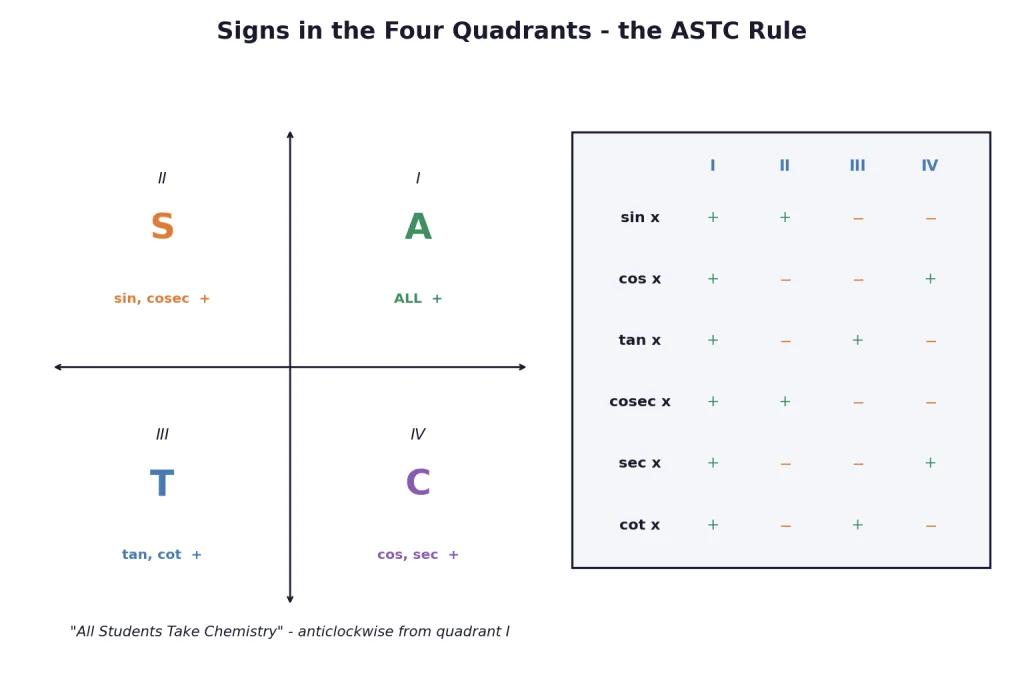
The mnemonic ASTC — All, Sin, Tan, Cos — reads anticlockwise from quadrant I ("All Students Take Chemistry").
Key Point: A function and its reciprocal always share a sign — cosec goes with sin, sec with cos, cot with tan.
[Board Important] Before evaluating ANY trigonometric expression at an angle outside quadrant I, first announce the quadrant, then the sign, then the magnitude. Marks are lost to signs far more often than to values.
Domain and Range of the Six Functions
Sine and cosine accept every real number and, being coordinates on the unit circle, output values in . The other four are ratios, and each loses the points where its denominator vanishes ( at ; at ):
| Function | Domain | Range |
|---|---|---|
The sec/cosec range "" means or — reciprocals of numbers in land outside .
How each function moves
In quadrant I, sin climbs 0 → 1 while cos falls 1 → 0; in quadrant II, sin falls 1 → 0 while cos falls 0 → ; and so on around the circle. Tan increases within every quadrant, blowing up to as x approaches an odd multiple of from the left and returning from on the other side.
[JEE Tip] " increases from 0 to " is shorthand for unbounded growth, not a value reached. Domain-exclusion questions (" is not defined at…") are free marks: just quote where cos or sin vanish.
The Graphs
Sine and cosine — the waves
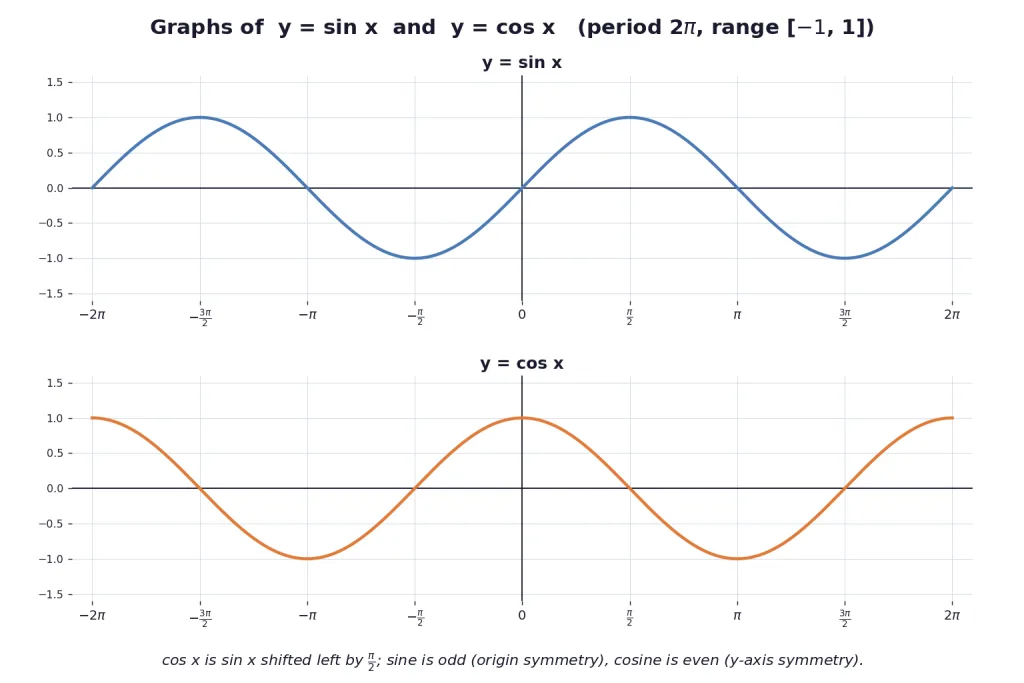
Both have period and range . The cosine curve is the sine curve slid left by — because . Sine passes through the origin (odd function); cosine starts at its peak (even function).
The other four — asymptotes everywhere
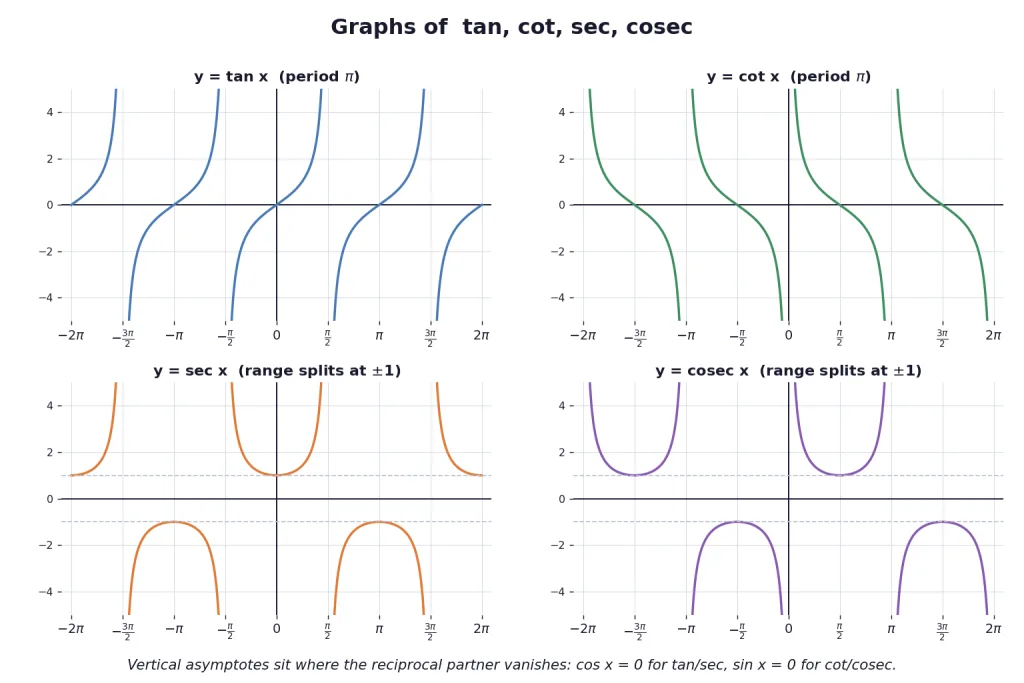
- tan x: period (we will prove tan( + x) = tan x in the next section); vertical asymptotes at odd multiples of ; increasing on each branch.
- cot x: period ; asymptotes at multiples of ; decreasing on each branch.
- sec x and cosec x: period ; U-shaped branches that never enter the strip ; asymptotes where their partner (cos or sin) vanishes.
Key Point (periods): sin, cos, sec, cosec repeat every ; tan and cot repeat every .
[JEE Tip] Graph-recognition MCQs hinge on three checks: value at 0 (defined? 0? 1? asymptote?), period ( vs ), and behaviour near the first asymptote. Those three answers identify any of the six graphs uniquely.
Solved Examples
Example 1: Sign detective
Determine the sign of: (i) (ii) (iii) (iv) (radians).
Solution:
Step 1 — (i) Place 200°. , so 200° is in Q III, where sine is negative.
Step 2 — (ii) Place 155°. : Q II, where tangent is negative (only sin/cosec survive there).
Step 3 — (iii) Place 300°. : Q IV, where cos — and with it sec — is positive.
Step 4 — (iv) Convert the radian benchmark. and , so 4 rad () lies in Q III: cosine negative.
Takeaway: Radian inputs: compare against , , to place the quadrant.
Example 2: Where is tan x undefined?
List all x in where (i) tan x and sec x are undefined (ii) cot x and cosec x are undefined.
Solution:
Step 1 — (i) Find the zero-set of the denominator. tan and sec both have cos x in the denominator; in at and .
Step 2 — (ii) Same idea with sin. cot and cosec have sin x in the denominator; in at .
Takeaway: Each ratio function inherits its holes from its denominator — memorise the two zero-sets and every domain question is instant.
Example 3: Range bookkeeping
Which are possible? (i) (ii) (iii) (iv) .
Solution:
Step 1 — (i) Test against the cosine range. cos is confined to , and : impossible.
Step 2 — (ii) Test against the cotangent range. cot takes ALL real values, however large or negative: possible.
Step 3 — (iii) Test against the secant range. always, but : impossible.
Step 4 — (iv) Test against the cosecant range. ✓ — attained at , where : possible.
Takeaway: The range table is a possibility oracle: for sin/cos, everything for tan/cot, outside for sec/cosec.
Example 4: Increasing or decreasing?
State whether each is increasing or decreasing in the given quadrant: (i) sin x in Q II (ii) cos x in Q III (iii) tan x in Q II (iv) sec x in Q I.
Solution:
Step 1 — (i) Track the y-coordinate across Q II. As x runs , the point P slides from (0, 1) to (, 0): sin decreases from 1 to 0.
Step 2 — (ii) Track the x-coordinate across Q III. As x runs , the x-coordinate moves : cos increases from to 0.
Step 3 — (iii) Use tan's branch rule. tan increases on EVERY branch; across Q II it climbs from (just past ) to 0 (at ): increasing.
Step 4 — (iv) Reciprocate cos in Q I. cos falls 1 → 0 there, so its reciprocal sec increases from 1 to .
Takeaway: tan increases in EVERY quadrant and cot decreases in every quadrant — the two monotone workhorses.
Example 5: Reading a graph point
The graph of y = cos x on crosses the x-axis at which points, and where does it bottom out?
Solution:
Step 1 — Crossings are the zeros. in at and — the two axis crossings.
Step 2 — The minimum is the trough. cos x reaches its least value at , the bottom of the wave.
Takeaway: One period of cosine: peak (0, 1) → zero at → trough (, ) → zero at → peak (, 1).
Example 6: Sine curve as a shifted cosine
Using , explain how the cosine graph is obtained from the sine graph.
Solution:
Step 1 — Read the identity as an input shift. : cosine at x equals sine at a point FURTHER along the axis.
Step 2 — Translate the shift into a slide. Advancing the input by slides the graph LEFT by .
Step 3 — Verify with the peaks. Sine peaks at ; sliding left by puts that peak at 0 — exactly where cosine peaks. ✓
Takeaway: All six graphs are one family; sin and cos differ by a quarter-period slide.
Example 7: Counting solutions from graphs
How many solutions does have in ? And in ?
Solution:
Step 1 — Draw the picture for one period. The horizontal line cuts the single arch of the sine wave twice in : at and . Two solutions.
Step 2 — Extend by periodicity. holds two full periods; the second period repeats both crossings at and . Four solutions.
Takeaway: Solution counting = intersection counting on the graph — the picture prevents both overcounting and misses.
Example 8: Signs decide the quadrant
If sin x > 0 and tan x < 0, in which quadrant does x lie? And if cos x < 0 and cot x > 0?
Solution:
Step 1 — First case: list each condition's quadrants. sin x > 0 → Q I or Q II; tan x < 0 → Q II or Q IV.
Step 2 — Intersect. The only common quadrant is Quadrant II.
Step 3 — Second case: same method. cos x < 0 → Q II or Q III; cot x > 0 → Q I or Q III. Intersection: Quadrant III.
Takeaway: Two sign conditions intersect to a unique quadrant — solve these as a two-line set intersection.
Example 9: Range of a transformed sine
Find the range of (i) (ii) for real x.
Solution:
Step 1 — (i) Start from the raw range. .
Step 2 — Scale, then shift. Multiplying by 2: ; adding 3: .
Step 3 — (ii) Watch the negative coefficient. gives (the interval flips ends but keeps the same width); adding 5: .
Takeaway: Chain the bounds: scaling changes the width, but a negative coefficient swaps which endpoint comes from which extreme.
Example 10: Domain of a built-up function
Find the domain of in terms of excluded points.
Solution:
Step 1 — Locate the denominator's zeros. , which happens only at whole revolutions: , n an integer.
Step 2 — Delete them. Domain .
Takeaway: "cos x = 1" happens only at full revolutions — a finer condition than cos x = 0; read the equation, not a memorised list.
Example 11: A minimum-maximum pair
Find the maximum and minimum values of and state where (in ) they occur.
Solution:
Step 1 — Bound the variable part. , so .
Step 2 — Shift by 3. .
Step 3 — Match extremes to angles. Maximum 7 needs : at . Minimum needs : at .
Takeaway: With a NEGATIVE coefficient on sin, the max of f comes from the MINIMUM of sin — match extremes carefully.
Example 12: True or false, graph edition
(i) The graph of cosec x touches the lines y = 1 and y = . (ii) tan x has period . (iii) sec x is an even function.
Solution:
Step 1 — (i) Check where equality holds. exactly when (at ), and when . The branches TOUCH the lines without crossing into the strip: True.
Step 2 — (ii) Recall tan's period. , so the period is , not : False.
Step 3 — (iii) Test evenness. : True.
Takeaway: cosec's U-branches kiss ; tan's short period and sec's evenness are the standard true/false bait.