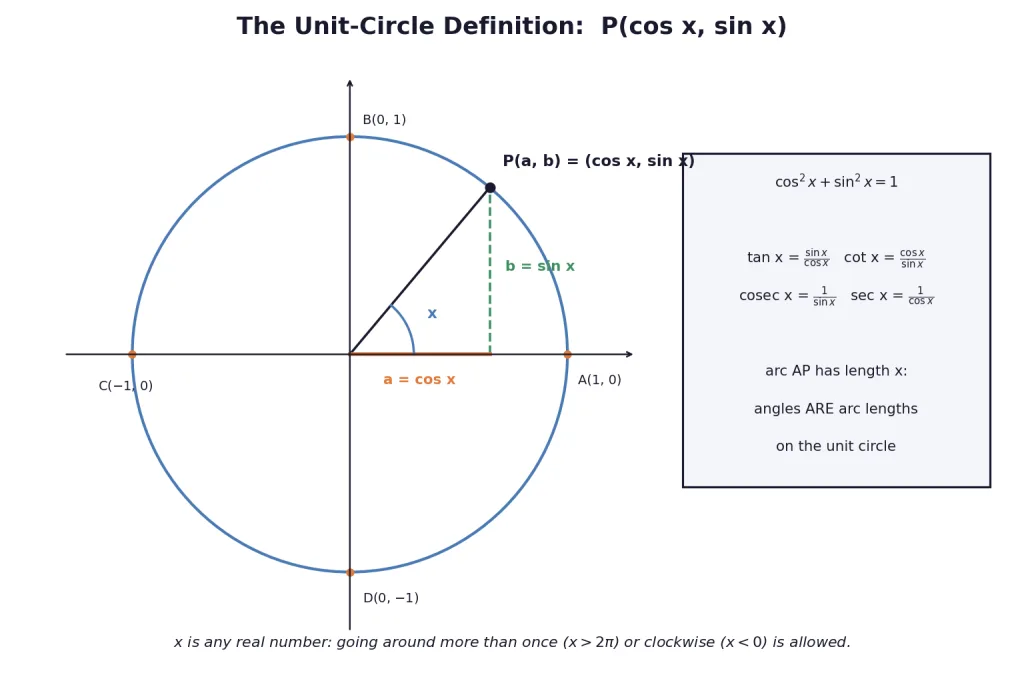
Take a unit circle (radius 1, centre at the origin). Let P(a, b) be the point where the terminal side of angle x (in radians) meets the circle — equivalently, walk a distance x anticlockwise along the circle from A(1, 0).
Key Point (Definition):cosx=a and sinx=b — cosine is the x-coordinate and sine is the y-coordinate of the point P.
Because P lies on the unit circle, a2+b2=1 — that is,
cos2x+sin2x=1
for EVERY real x. The Pythagoras theorem became a trigonometric identity.
The other four functions are built from these two, wherever the denominators are non-zero:
Dividing the fundamental identity by cos2x and by sin2x gives its two companions:
1+tan2x=sec2x1+cot2x=csc2x
[Board Important] For acute angles this agrees exactly with the right-triangle ratios you know — but the new definition works for ANY angle: obtuse, reflex, negative, or thirty revolutions around.
Values at the Standard Angles
Quadrantal angles
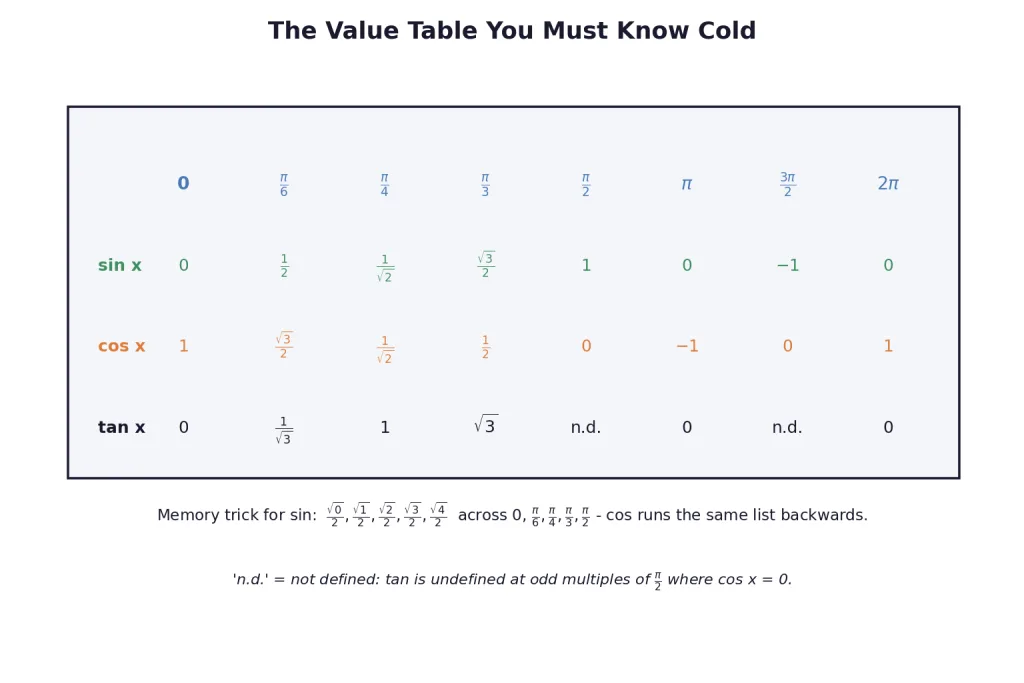
The circle meets the axes at A(1, 0), B(0, 1), C(−1, 0), D(0, −1) — the positions for x = 0, 2π, π, 23π (the quadrantal angles, integral multiples of 2π). Reading coordinates:
cos0=1, sin0=0; cos2π=0, sin2π=1
cosπ=−1, sinπ=0; cos23π=0, sin23π=−1
The famous three
From earlier classes, valid still: sin6π=21, sin4π=21, sin3π=23, with cosines running the same list backwards.
When is sin x or cos x zero?
Reading the circle: sine vanishes on the x-axis, cosine on the y-axis.
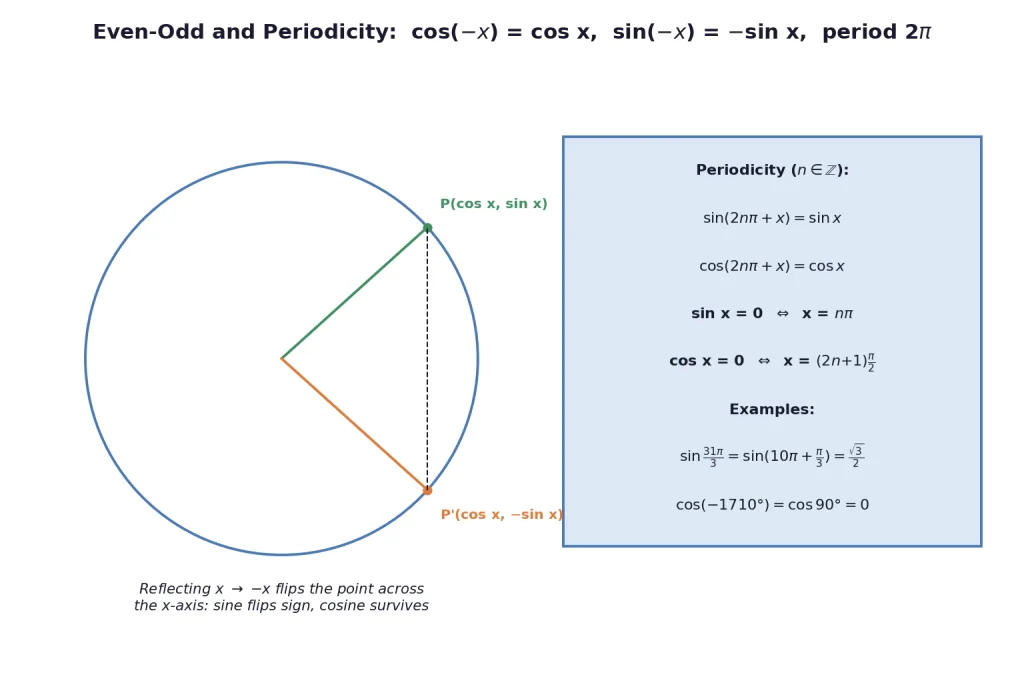
Key Point:sinx=0⟺x=nπ, and cosx=0⟺x=(2n+1)2π, for some integer n.
These two facts control the domains of the other four functions in the next section.
[JEE Tip] The memory pattern 20,21,22,23,24 generates all sines from 0 to 2π — one second to rebuild the whole table in an exam.
Periodicity and Even-Odd Behaviour
Going around again changes nothing
Adding a full revolution (2π) to x lands P on exactly the same point. Hence for any integer n:
sin(2nπ+x)=sinx,cos(2nπ+x)=cosx
Sine and cosine are periodic with period 2π. This is the tool for evaluating monster angles: strip whole multiples of 2π (or 360°) and work with what is left.
Negative angles
Replacing x by −x reflects P across the x-axis: the y-coordinate flips, the x-coordinate survives:
sin(−x)=−sinxcos(−x)=cosx
Sine is an odd function, cosine an even function. Consequently tan, cot, cosec are odd, and sec is even.
The reduction recipe for any angle
Make the angle positive using even-odd rules.
Strip multiples of 2π (360°).
Read the value (using quadrant signs — next section — if anything is left over).
Worked instances: sin331π=sin(10π+3π)=sin3π=23; and cos(−1710°)=cos1710°=cos(1710°−4×360°)=cos270°=0.
[Board Important] Strip 2π's from sin and cos, but remember (coming soon) tan and cot have period π — for them you may strip multiples of π directly.
Solved Examples
Example 1: All five from cos x
If cosx=−53 and x lies in the third quadrant, find the values of the other five trigonometric functions.
Solution:
Step 1 — Take the reciprocal that is free.secx=cosx1=−35 — no identity needed.
Step 2 — Use the fundamental identity for the magnitude of sin x.sin2x=1−cos2x=1−259=2516, so sinx=±54.
Step 3 — Let the quadrant choose the sign. In Q III sine is negative, so sinx=−54, and hence cscx=−45.
Step 4 — Build the ratios.tanx=cosxsinx=−3/5−4/5=34 and cotx=43.
Step 5 — Check against the sign map. In Q III tan and cot must be positive — and 34,43>0. ✓
Takeaway: Identity gives the magnitude; the QUADRANT gives the sign. Decide the sign before writing the value.
Example 2: All five from cot x
If cotx=−125 and x lies in the second quadrant, find the other five trigonometric functions.
Solution:
Step 1 — Reciprocal first.tanx=cotx1=−512.
Step 2 — Use the companion identity.sec2x=1+tan2x=1+25144=25169, so secx=±513.
Step 3 — Sign from the quadrant. In Q II cosine (and sec) are negative: secx=−513, hence cosx=−135.
Step 4 — Recover sine as a product.sinx=tanx⋅cosx=(−512)(−135)=1312 — positive, exactly as Q II demands. ✓ Then cscx=1213.
Takeaway: From tan or cot, go through sec2=1+tan2 — it avoids square roots of fractions with two unknown signs.
Example 3: A large positive angle
Find the value of sin331π.
Solution:
Step 1 — Split off whole revolutions.331π=330π+3π=10π+3π, and 10π is exactly 5 full revolutions.
Step 2 — Apply periodicity.sin(10π+x)=sinx, so sin331π=sin3π=23.
Takeaway: Write the angle as (even multiple of π) + leftover; the leftover carries the whole value.
Example 4: A large negative degree angle
Find the value of cos(−1710°).
Solution:
Step 1 — Kill the minus sign with evenness. Cosine is even: cos(−1710°)=cos1710°.
Step 3 — Read the quadrantal value. At 270° the circle point is (0, −1), so cos270°=0.
Takeaway: Evenness kills the minus sign instantly for cosine; then reduce mod 360°.
Example 5: Odd function with a large angle
Find sin(−311π) and csc(−1410°).
Solution:
Step 1 — First value: apply the odd rule.sin(−311π)=−sin311π.
Step 2 — Rewrite near a full revolution.311π=4π−3π, so sin311π=sin(−3π)=−sin3π=−23.
Step 3 — Combine the two sign moves.sin(−311π)=−(−23)=23.
Step 4 — Second value: odd rule again.csc(−1410°)=−csc1410°.
Step 5 — Reduce 1410°.1410°=4×360°−30°, so csc1410°=csc(−30°)=−csc30°=−2.
Step 6 — Assemble.csc(−1410°)=−(−2)=2.
Takeaway: Two sign moves may stack (odd function + fourth-quadrant leftover) — track each one explicitly and let them cancel honestly.
Example 6: tan of a big angle
Find tan319π.
Solution:
Step 1 — Split off revolutions.319π=6π+3π — and 6π is 3 full revolutions (also 6 half-revolutions, since tan has period π).
Step 2 — Evaluate the leftover.tan319π=tan3π=3.
Takeaway:6π is both 3 revolutions and 6 half-revolutions — either way tan is unchanged.
Example 7: From sin x in Q II
If sinx=53 and x lies in the second quadrant, find cos x and tan x.
Solution:
Step 1 — Magnitude from the identity.cos2x=1−sin2x=1−259=2516, so cosx=±54.
Step 2 — Sign from the quadrant. In Q II cosine is negative: cosx=−54.
Step 3 — Form the ratio.tanx=cosxsinx=−4/53/5=−43 — negative in Q II, as it must be. ✓
Takeaway: The 3-4-5 triangle supplies magnitudes; Q II stamps the signs (sin+, cos−, tan−).
Example 8: From sec x in Q IV
If secx=513 and x lies in the fourth quadrant, find the other five functions.
Solution:
Step 1 — Cosine by reciprocal.cosx=135 — positive, consistent with Q IV. ✓
Step 2 — Magnitude of sine.sin2x=1−16925=169144, so sinx=±1312.
Step 3 — Q IV makes sine negative.sinx=−1312, hence cscx=−1213.
Step 4 — Ratios.tanx=5/13−12/13=−512 and cotx=−125.
Takeaway: In Q IV only cos and sec stay positive — everything sine-flavoured goes negative.
Example 9: A pure identity computation
If tanx=43 with π<x<23π, find the value of sinxcosx and of sinx+cosx.
Solution:
Step 1 — Locate the quadrant.π<x<23π is Q III: both sin and cos are negative there.
Step 2 — Magnitudes from the 3-4-5 triangle.tanx=43 gives the reference triangle 3-4-5, so ∣sinx∣=53, ∣cosx∣=54; with Q III signs, sinx=−53 and cosx=−54.
Step 3 — Compute the product.sinxcosx=(−53)(−54)=2512 — positive.
Step 4 — Compute the sum.sinx+cosx=−53−54=−57.
Takeaway: The product of two negatives is positive — sign care extends beyond single values to combinations.
Example 10: Evaluating a mixed expression
Prove that 3sin6πsec3π−4sin65πcot4π=1.
Solution:
Step 1 — Write down the standard values.sin6π=21, sec3π=2, cot4π=1.
Step 2 — Handle the non-standard angle.sin65π=sin(π−6π)=sin6π=21, since π−x preserves sine.
Step 3 — Assemble the arithmetic.3×21×2−4×21×1=3−2=1. ∎
Takeaway:π−x preserves sine — the single most-used allied-angle fact, formally proved in Section 4 but usable already from the circle.
Example 11: cosec and cot from the circle
Evaluate: (i) csc67π (ii) cot(−415π).
Solution:
Step 1 — (i) Place the angle.67π=π+6π lies in Q III, where sine is negative.
Step 2 — Evaluate the sine, then flip.sin67π=−sin6π=−21, so csc67π=−2.
Step 3 — (ii) Odd rule first.cot(−415π)=−cot415π.
Step 4 — Strip a revolution.415π=2π+47π, and cot47π=cot(2π−4π)=−cot4π=−1 (Q IV: cot negative).
Step 5 — Combine the signs. Answer =−(−1)=1.
Takeaway: Layer the moves one at a time: odd rule, strip 2π, quadrant sign — never all at once.
Example 12: sin 765°
Find the value of sin765°.
Solution:
Step 1 — Strip two revolutions.765°=2×360°+45°.
Step 2 — Evaluate the leftover.sin765°=sin45°=21.
Takeaway: Two clean revolutions vanish without trace.
Example 13: Which values are impossible?
Can (i) sinx=45 (ii) secx=21 (iii) tanx=20 hold for a real x?
Solution:
Step 1 — (i) Compare against the sine range.∣sinx∣≤1 for every real x, but 45>1 — impossible.
Step 2 — (ii) Compare against the secant range. sec is the reciprocal of cos, so ∣secx∣≥1 always; 21<1 — impossible.
Step 3 — (iii) Recall the tangent range. tan takes EVERY real value, so tanx=20 certainly holds for some x — possible.
Takeaway: sin, cos live in [−1,1]; sec, cosec live OUTSIDE (−1,1); tan, cot roam all of R. This range map is formalised next section and tested constantly.
Ready to test your knowledge?
Take a quick interactive quiz on this topic —
free, works without login.