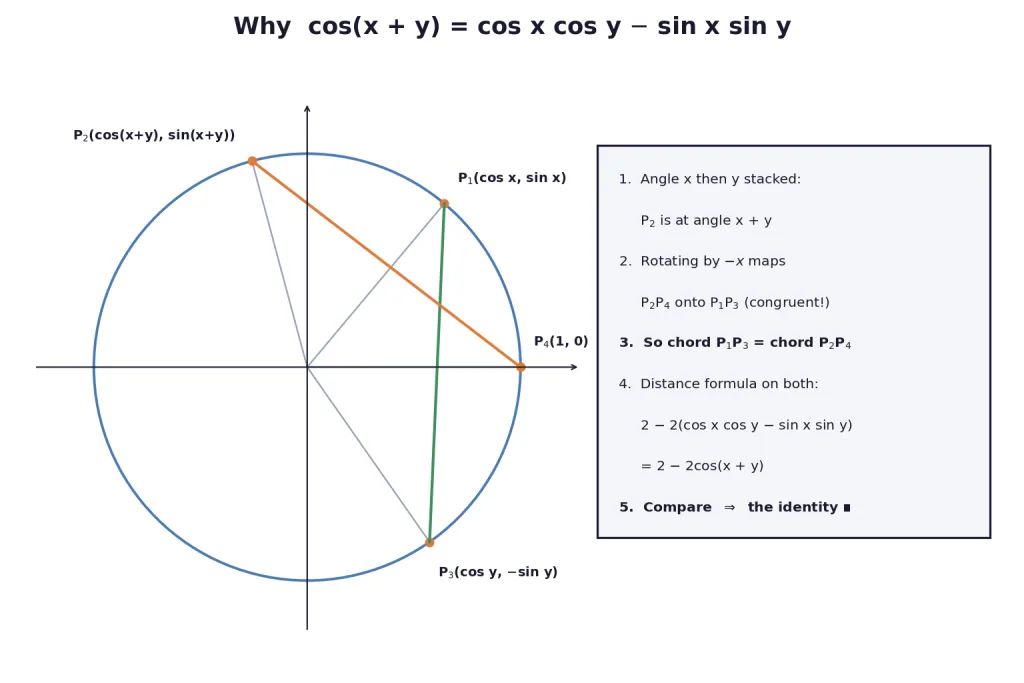
Everything in the rest of this chapter grows from one seed:
cos(x+y)=cosxcosy−sinxsiny
The proof is pure geometry. Place four points on the unit circle: P4(1,0), P1(cosx,sinx), P2(cos(x+y),sin(x+y)) and P3(cosy,−siny) (angle −y). Rotating the circle by −x carries P2 to P1 and P4 to P3, so the chords P2P4 and P1P3 are equal. Computing both by the distance formula and equating gives exactly the identity. ∎
Harvesting the family
Replace y by −y (using even-odd): cos(x−y)=cosxcosy+sinxsiny
Put x=2π in the difference formula: cos(2π−y)=siny, and swapping roles, sin(2π−y)=cosy — the co-function pair. Then
Key Point (sign pattern): cos mixes cos·cos with sin·sin and FLIPS the middle sign; sin mixes sin·cos with cos·sin and KEEPS the sign. "cos is a contrarian, sin is loyal."
[Board Important] These four formulas plus the two co-function rules generate every identity in this chapter — derivations are examinable, especially the chord proof of cos(x + y).
Allied Angles — Reducing Any Angle
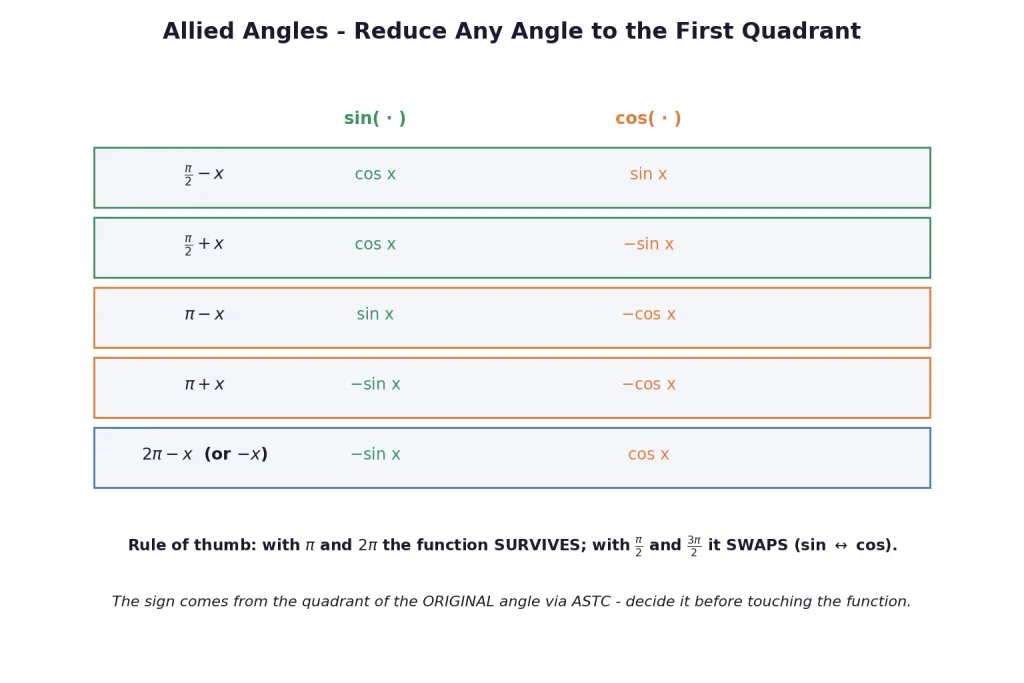
Feeding special values into the sum-difference formulas produces the allied angle (reduction) table:
cos(2π+x)=−sinx, sin(2π+x)=cosx
cos(π−x)=−cosx, sin(π−x)=sinx
cos(π+x)=−cosx, sin(π+x)=−sinx
cos(2π−x)=cosx, sin(2π−x)=−sinx
Two-step working rule:
Function: with π or 2π, the function survives; with 2π or 23π, it swaps (sin ↔ cos, tan ↔ cot, sec ↔ cosec).
Sign: taken from the quadrant of the ORIGINAL angle via ASTC (treating x as acute).
Example: sin65π — write 65π=π−6π (Q II, sine positive, function survives): =+sin6π=21.
[JEE Tip] Prefer reductions through π and 2π when you have the choice — no function swap means one less place to slip.
Sum and Difference for tan and cot
Dividing sin(x + y) by cos(x + y) and then dividing every term by cos x cos y:
(valid when none of x, y, x ± y is a multiple of π).
The 15°-75° dividend
The formulas immediately deliver new exact values:
tan15°=tan(45°−30°)=1+311−31=3+13−1=2−3
and likewise tan75°=2+3, cos75°=223−1, sin75°=223+1, sin15°=223−1.
Key Point:tan15°⋅tan75°=(2−3)(2+3)=1 — as it must be, since 15° and 75° are complementary.
[JEE Tip] The tan sum formula rearranges into tanx+tany=tan(x+y)(1−tanxtany) — the engine behind classics like proving tan3A−tan2A−tanA=tan3Atan2AtanA (write 3A=2A+A and cross-multiply).
Solved Examples
Example 1: Exact values of cos 75° and sin 15°
Evaluate cos 75° and sin 15° using sum-difference formulas.
Solution:
Step 1 — Split 75° over known angles.cos75°=cos(45°+30°)=cos45°cos30°−sin45°sin30°.
Step 2 — Substitute the standard values.=21⋅23−21⋅21=223−1.
Step 3 — Same split for sin 15°.sin15°=sin(45°−30°)=sin45°cos30°−cos45°sin30°=223−1.
Step 4 — Cross-check with co-functions. cos 75° = sin 15° — as it must be, since 75° and 15° are complementary. ✓
Takeaway: Split 75° and 15° over the 45°-30° pair; the co-function check certifies the answer.
Example 2: tan 15°
Show that tan15°=2−3.
Solution:
Step 1 — Split over 45° and 30°.tan15°=tan(45°−30°)=1+tan45°tan30°tan45°−tan30°=1+311−31.
Step 2 — Clear the inner fractions. Multiply top and bottom by 3: 3+13−1.
Step 3 — Rationalise. Multiply by 3−13−1: 3−1(3−1)2=24−23=2−3. ∎
Takeaway: Rationalising the surd quotient is the second half of the marks — do not stop at 3+13−1.
Example 3: A disguised sin(x + y)
Prove that cos(4π−x)cos(4π−y)−sin(4π−x)sin(4π−y)=sin(x+y).
Solution:
Step 1 — Recognise the pattern. The left side has the exact shape cos A cos B − sin A sin B = cos(A + B), with A=4π−x and B=4π−y.
Step 2 — Add the angles.A+B=2π−(x+y).
Step 3 — Apply the co-function rule.cos(2π−(x+y))=sin(x+y). ∎
Takeaway: Spot the addition-formula pattern BEFORE expanding anything — pattern recognition turns four terms into one line.
Example 4: Allied angle workout
Prove that cos(23π+x)cos(2π+x)[cot(23π−x)+cot(2π+x)]=1.
Solution:
Step 1 — Reduce each allied angle.cos(23π+x)=sinx (function swaps for a 23π shift; Q IV makes cosine positive, and the swap lands on +sinx); cos(2π+x)=cosx; cot(23π−x)=tanx; cot(2π+x)=cotx.
Step 2 — Substitute. The left side becomes sinxcosx(tanx+cotx).
Step 3 — Combine the bracket over one denominator.tanx+cotx=cosxsinx+sinxcosx=sinxcosxsin2x+cos2x=sinxcosx1.
Step 4 — Multiply.sinxcosx⋅sinxcosx1=1. ∎
Takeaway: Reduce every allied angle FIRST; the algebra that remains is usually one identity long.
Example 5: tan of a shifted angle
Find tan(4π+x) in terms of tan x, and evaluate tan105°.
Solution:
Step 1 — Specialise the sum formula. With tan4π=1: tan(4π+x)=1−tanx1+tanx.
Step 3 — Rationalise. Multiply by 1+31+3: 1−3(3+1)2=−24+23=−(2+3).
Step 4 — Sign check. 105° lies in Q II, where tan is negative — and the answer is negative. ✓
Takeaway: 105° sits in Q II where tan is negative — the sign of the final answer is a built-in check.
Example 6: cos(x + y) from data
If sinx=53 (x in Q I) and cosy=−1312 (y in Q II), find cos(x+y) and sin(x+y).
Solution:
Step 1 — Complete the missing values with quadrant signs. From the 3-4-5 triangle: cosx=+54 (Q I). From the 5-12-13 triangle: siny=+135 (Q II keeps sine positive).
Takeaway: Fill in the missing sin/cos values (with quadrant signs!) before touching the addition formulas — the 3-4-5 and 5-12-13 triangles do the arithmetic.
Example 7: Co-function juggling
Prove that sin(2π−x)cos(2π+x)csc(−x)sin(23π+x)sin(π+x)cos(2π+x)tan(23π−x)cot(2π−x)=1.
Solution:
Step 1 — Reduce the numerator factor by factor.sin(π+x)=−sinx; cos(2π+x)=−sinx; tan(23π−x)=cotx; cot(2π−x)=−cotx. Product: (−sinx)(−sinx)(cotx)(−cotx)=−sin2xcot2x.
Takeaway: Long allied-angle chains: reduce factor by factor, carry every minus sign separately, and only simplify at the end.
Example 8: The tan-sum rearrangement
Prove that tan3A−tan2A−tanA=tan3Atan2AtanA.
Solution:
Step 1 — Write 3A as a sum.tan3A=tan(2A+A)=1−tan2AtanAtan2A+tanA.
Step 2 — Cross-multiply.tan3A(1−tan2AtanA)=tan2A+tanA, i.e. tan3A−tan3Atan2AtanA=tan2A+tanA.
Step 3 — Rearrange. Move tan2A+tanA left and the triple product right: tan3A−tan2A−tanA=tan3Atan2AtanA. ∎
Takeaway: Whenever an identity mixes tan of angles summing conveniently (3A = 2A + A, or A + B + C = π), start from the tan-sum formula and cross-multiply.
Example 9: Reducing to the 15° family
Show that tan1213π=2−3.
Solution:
Step 1 — Strip a half-revolution.1213π=π+12π, and tan survives a π shift: tan1213π=tan12π.
Step 2 — Recognise the degree value.12π=15°, and tan15°=2−3 (Example 2).
Step 3 — Sign check.1213π lies in Q III, where tan is positive — and 2−3>0. ✓
Takeaway: Big fractional multiples of π almost always reduce to a 15°-family angle — reduce first, then recognise.
Example 10: cos(x − y) with sign care
If cosx=−31 with x in Q III, find cos(x−3π) in exact form.
Solution:
Step 1 — Complete the data.sin2x=1−91=98, and Q III makes sine negative: sinx=−322.
Step 2 — Expand with the difference formula.cos(x−3π)=cosxcos3π+sinxsin3π=−31⋅21+(−322)23.
Step 3 — Combine over one denominator.=−61−626=−61+26.
Takeaway: Surd answers are normal here — resist the urge to decimalise; exact form is what the examiner wants.
Example 11: Proving an identity with π/4 shifts
Prove that cos(4π+x)+cos(4π−x)=2cosx.
Solution:
Step 1 — Expand both terms.(cos4πcosx−sin4πsinx)+(cos4πcosx+sin4πsinx).
Step 2 — Watch the sine terms cancel. The ±sin4πsinx pair vanishes, leaving 2cos4πcosx.
Step 3 — Substitute the value.2⋅21cosx=2cosx. ∎
Takeaway: Symmetric ±x pairs make half the terms cancel — expand both and watch the collapse. (Also provable by sum-to-product next section.)
Example 12: The cot-sum formula in action
If cotx=43 and coty=71, both x and y acute, show that x+y=43π.