
Marks Lost After the Chemistry Was Right
Many marks are lost by students who knew the chemistry but wrote it in a way the scheme couldn't reward.
| Rule | What it costs |
|---|---|
| Part A: only the first attempted answer counts (paper instruction) | A changed answer gets no mark |
| Numericals need steps and a unit (paper instruction) | A bare number gets zero; a missing unit loses the third mark |
| Balanced equations and labelled diagrams (paper instruction) | The equation or label mark |
| Charges in mechanisms (scheme: strictly expected) | The mark for that step |
| Lactose gives β-D-galactose and β-D-glucose (scheme: strictly expected) | The mark for that part |
| Only 2H in the dichromate fill-in (2026 scheme) | The mark for that blank |
| VBT needs hybridisation, geometry and magnetism | One mark for each part left out |
| Named reactions: statement 1 + equation 1, or a self-explanatory equation 2 | Half the marks without the equation |
Inorganic and Physical Chemistry: Before and After
Question 1: Complete the equation: (1 mark)
A student wrote: HSO
Answer. Mistake: the equation is written in ionic form, with 2Na already on the right, so only 2H balances it. The 2026 scheme says HSO or 2HCl are not to be considered for this blank.
Full-mark answer: 2H
Tip: when you write the whole equation yourself, the schemes have also accepted , but the 2H form is right in every version of the question.
Question 2: Using VBT, explain the hybridisation, geometry and magnetic property of [Ni(CN)]. (3 marks)
A student wrote: Ni is 3d. CN pairs up the electrons, leaving one 3d orbital empty. Hybridisation dsp, square planar.
Answer. Mistake: hybridisation and geometry are there, but the magnetic property is missing, and that is a separate mark.
Full-mark answer: In [Ni(CN)], Ni is [Ar] 3d with two unpaired electrons. CN is a strong field ligand, so it pairs up the two unpaired electrons, leaving one 3d orbital empty. One 3d, one 4s and two 4p orbitals mix to form four dsp hybrid orbitals, which accept four electron pairs from four CN ions.
- Hybridisation: dsp
- Geometry: square planar
- Magnetic property: all electrons are paired, so it is diamagnetic
Question 3: Draw a labelled diagram of the standard hydrogen electrode. Write its half-cell reaction. (3 marks)
A student drew a beaker with a tube and a plate, with no labels, and wrote:
Answer. Mistake: two marks lost. The diagram has no labels, and the half-reaction is not balanced.
Full-mark answer: Draw the electrode and label its parts: platinum foil coated with platinum black, H gas at 1 bar going in, 1 M H solution, and the glass tube.
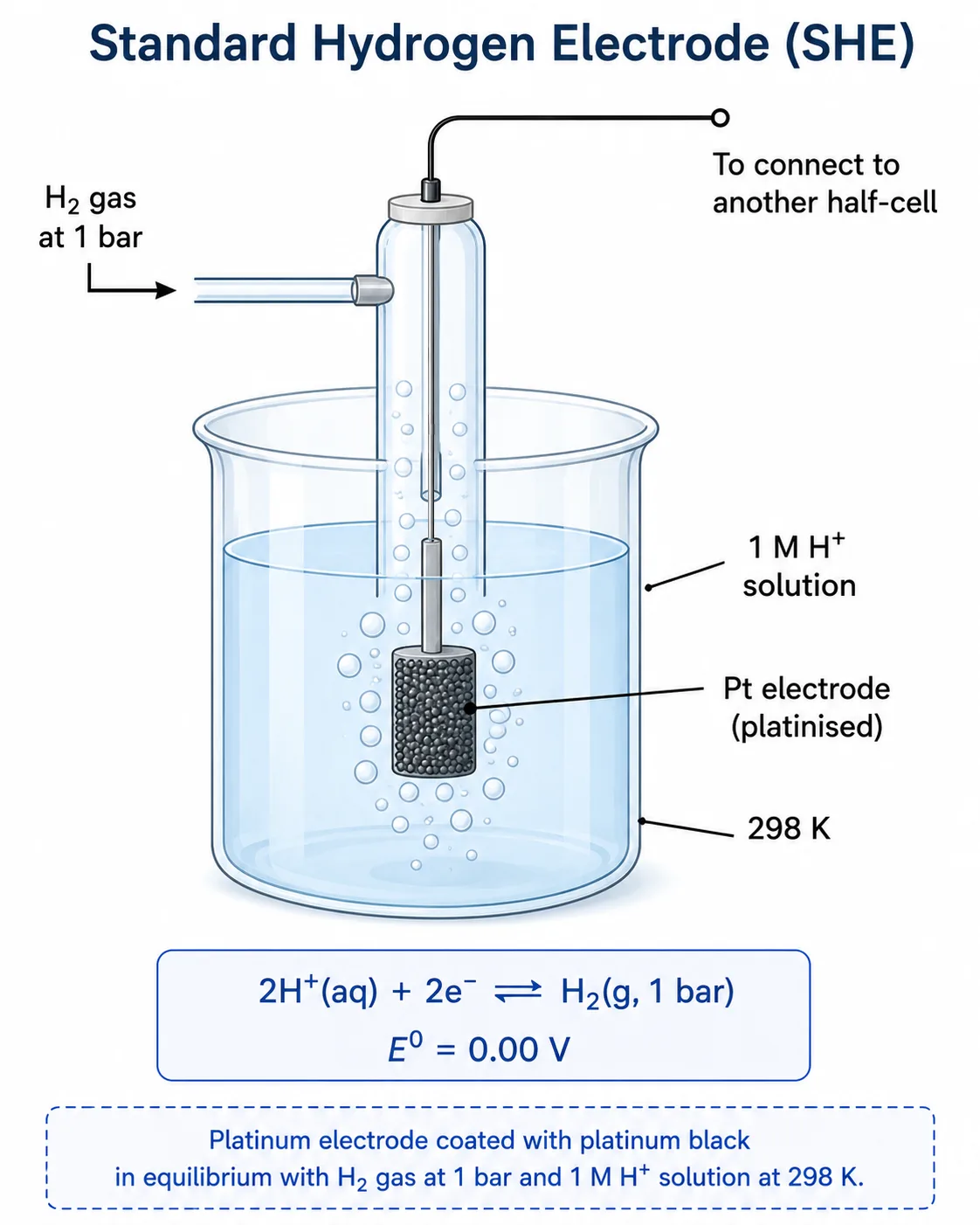
Half-cell reaction: , with = 0.00 V.
Question 4: The osmotic pressure of a solution was asked. (3 marks)
A student wrote only: = 0.49 atm.
Answer. Mistake: by the paper's instruction, a direct answer with no steps gets zero, even though the number is right.
Full-mark answer: always write the steps.
Formula:
Substitution: with C in mol L, R in L atm K mol and T in kelvin
Answer: the value with its unit, atm
Question 5: Write any three differences between ideal and non-ideal solutions. (3 marks)
A student wrote: (1) Ideal solutions obey Raoult's law. (2) . (3) They follow Raoult's law at all concentrations.
Answer. Mistake: points 1 and 3 say the same thing, so they earn one mark between them, and none of the points says anything about non-ideal solutions.
Full-mark answer:
| Ideal solutions | Non-ideal solutions |
|---|---|
| They obey Raoult's law at all concentrations. | They do not obey Raoult's law. |
Organic Chemistry and Biomolecules: Before and After
Question 6: Write the mechanism of acid-catalysed dehydration of ethanol to ethene. (3 marks)
A student wrote step 1 as:
Answer. Mistake: the scheme says charges are strictly expected. Without them this step earns nothing.
Full-mark answer:
Step 1: Formation of protonated alcohol.
Step 2: Formation of carbocation by loss of water (slow step).
Step 3: Formation of ethene by loss of a proton.
Question 7: Explain the Reimer–Tiemann reaction. (2 marks)
A student wrote: When phenol is treated with chloroform and sodium hydroxide, an –CHO group comes in at the ortho position.
Answer. Mistake: the statement earns 1 mark; the equation is the other mark.
Full-mark answer: When phenol is treated with chloroform in the presence of aqueous sodium hydroxide, and the product is acidified, a –CHO group is introduced at the ortho position of the ring. The product is salicylaldehyde. This is called the Reimer–Tiemann reaction.
Question 8: Name the products formed when lactose is hydrolysed. (1 mark)
A student wrote: glucose and galactose.
Answer. Mistake: the 2026 scheme strictly expects the D-forms.
Full-mark answer: Hydrolysis of lactose gives β-D-galactose and β-D-glucose.
Question 9: Write the IUPAC name of CH–O–CHCH. (1 mark)
A student wrote: ethyl methyl ether.
Answer. Mistake: that is the common name. In the IUPAC name, the smaller alkoxy group is the prefix on the larger alkane.
Full-mark answer: The IUPAC name is methoxyethane.
Question 10: Write the Fittig reaction. (2 marks)
A student wrote:
Answer. Mistake: the equation isn't balanced, and the paper asks for balanced equations.
Full-mark answer: When an aryl halide is treated with sodium in dry ether, two aryl groups join together to give a diaryl. This is called the Fittig reaction.
Question 11: A Part D question is printed as (a) 3 marks + (b) 2 marks. A student writes a very good answer to (a) and runs out of time before (b).
Answer. The best possible score is now 3 out of 5. Before you start a Part D question, read both parts and note the marks. If (b) is a one-line answer, such as a name or a reagent, write it first; it is the quickest mark on the page.
Question 12: In Part A, a student writes "(b) Cu and HCl" for a question on Sandmeyer's reaction, then crosses it out and writes "(c) CuCl and HCl".
Answer. Only the first attempted answer is considered, so the right second answer may get no mark. Think it through first, and write only once. In MCQs, the schemes accept the letter, the answer or both, so "(c) CuCl and HCl" written once is the safest way to answer.
Last Ten Minutes: A Checklist
Go through your script once, in this order:
- Numbering: every answer carries the question number exactly as printed, including sub-parts (a), (b), (c).
- Part A: one answer per question, nothing crossed out and rewritten.
- Counts: in Part B you need 3, group IV 3, group V 2, Part D 4 and Part E 3. Count them.
- Part D sub-parts: every (a) and (b) has something written.
- Numericals: formula, substitution and a unit on every final answer.
- Mechanisms: + and − charges on every ion and intermediate.
- Named reactions: each has an equation, not only a sentence.
- Equations: balanced, with reagents and conditions over the arrow.
- Diagrams: at least two labels on each.
- Biomolecule and IUPAC names: D- and α/β where they belong; IUPAC names where IUPAC is asked.
If something is missing, a single line in the margin of that answer is better than leaving it out.