
How Group V Is Marked
Group V (Q31–34) is physical chemistry theory: one question from Solutions, two from Electrochemistry and one from Chemical Kinetics. You answer any two. All the numericals are in Part E.
| Question type | Marks |
|---|---|
| Integrated rate equation | Rate expression 1, integration with the constant 1, final form 1; any correct method is accepted |
| Standard hydrogen electrode | Any two labels 1, representation 1, half-cell reaction 1 |
| Differences | Any three, 1 each |
| Factors deciding electrolysis products | Any three, 1 each |
| Batteries and fuel cells | Anode 1, cathode 1, overall reaction or electrolyte 1 |
Marks are usually lost by skipping steps in a derivation, leaving a diagram unlabelled, missing electrons in half-reactions, or writing the same difference twice in different words.
Chemical Kinetics
Question 1: Derive the expression for the half-life of a zero order reaction. How does it depend on the starting concentration?
Answer. For a zero order reaction, the integrated rate equation is
At , . Substituting:
So the half-life of a zero order reaction is directly proportional to the initial concentration of the reactant. If is doubled, is also doubled.
Marks: integrated equation 1, derivation 1, dependence 1.
Question 2: Show that, for a first order reaction, the time for 99.9% completion is about ten times the half-life.
Answer. For a first order reaction,
For 99.9% completion,
The half-life is
So the time for 99.9% completion is about ten times the half-life.
Marks: 1, 1, ratio 1.
Question 3: Write the Arrhenius equation and explain its terms. How does it explain the effect of temperature on rate?
Answer. The Arrhenius equation is
where k is the rate constant, A is the Arrhenius factor (frequency factor), is the activation energy, R is the gas constant and T is the absolute temperature.
The factor is the fraction of molecules having energy equal to or greater than .
When the temperature is increased, this fraction increases, so k and the rate of the reaction increase. For many reactions, a 10 K rise in temperature nearly doubles the rate.
Marks: equation with terms 1, meaning of 1, effect of temperature 1.
Question 4: How does a catalyst affect the activation energy and the Gibbs energy of a reaction? Explain with an energy diagram.
Answer. A catalyst provides a new path for the reaction with a lower activation energy. On a graph of potential energy against reaction coordinate, the catalysed path has a lower peak than the uncatalysed path.
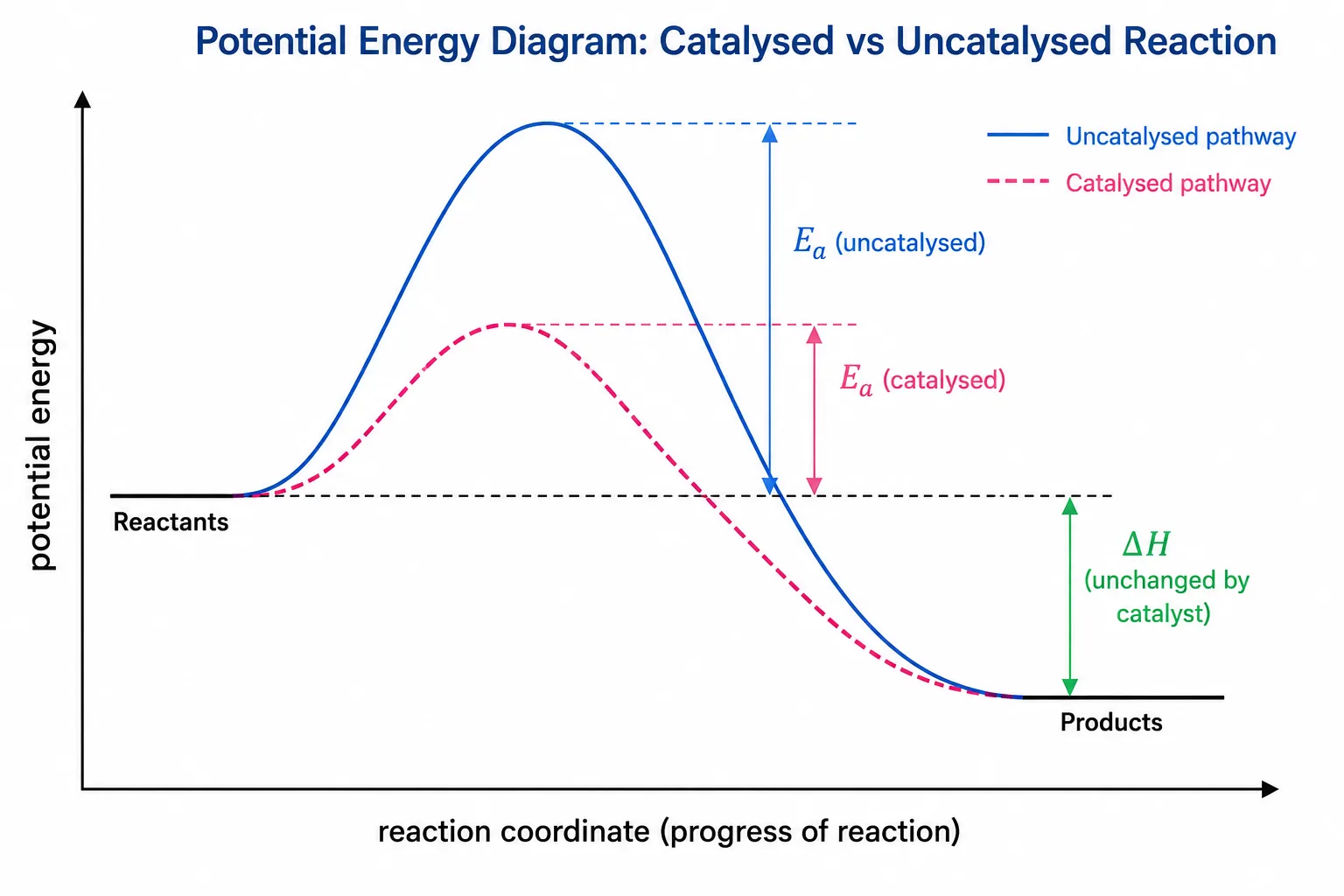
So a catalyst lowers the activation energy, more molecules can cross the energy barrier, and the reaction becomes faster.
The energies of the reactants and products are the same for both paths. So a catalyst does not change of the reaction, and it does not change the equilibrium constant.
Marks: diagram 1, effect on 1, no change in 1.
Question 5: What is chemical kinetics? Give two reasons it is important.
Answer. Chemical kinetics is the branch of chemistry which deals with the rates of chemical reactions, the factors affecting them and the mechanisms by which they take place.
It is important because:
- It helps to choose the conditions (temperature, pressure, catalyst) under which an industrial reaction goes at a useful speed.
- It helps to find the mechanism, that is, the steps by which the reactants change into products.
Marks: definition 1, each reason 1.
Electrochemistry
Question 6: Write three differences between a galvanic cell and an electrolytic cell.
Answer.
| Galvanic cell | Electrolytic cell |
|---|---|
| It converts chemical energy into electrical energy. | It uses electrical energy to bring about a chemical change. |
| The cell reaction is spontaneous. | The cell reaction is non-spontaneous. |
| The anode is negative and the cathode is positive. | The anode is positive and the cathode is negative. |
Marks: 1 for each difference.
Question 7: Describe the dry cell, with its electrode reactions.
Answer. The dry cell (Leclanché cell) has a zinc container which acts as the anode. The cathode is a carbon (graphite) rod surrounded by powdered MnO and carbon. The space between them is filled with a moist paste of NHCl and ZnCl, which acts as the electrolyte. It gives a potential of about 1.5 V.
Reaction at the anode:
Reaction at the cathode:
Marks: description 1, anode reaction 1, cathode reaction 1.
Question 8: State Kohlrausch's law. Give two applications.
Answer. Kohlrausch's law of independent migration of ions states that the limiting molar conductivity of an electrolyte is the sum of the limiting molar conductivities of its cation and anion.
Applications:
- It is used to find of weak electrolytes, which cannot be found by extrapolating the graph. For example, .
- It is used to find the degree of dissociation, , and from it the dissociation constant of a weak electrolyte.
Marks: statement 1, each application 1.
Question 9: Why does conductivity decrease while molar conductivity increases when a solution is diluted?
Answer. Conductivity is the conductance of 1 cm of the solution. On dilution, the number of ions in each cm decreases, so conductivity decreases.
Molar conductivity is the conductance of the whole volume of solution containing 1 mole of the electrolyte. On dilution, this volume increases and the ions move more freely, so molar conductivity increases.
For a weak electrolyte, dilution also increases the degree of dissociation, so its molar conductivity increases sharply. For a strong electrolyte, it increases only slowly.
Marks: conductivity 1, molar conductivity 1, strong and weak electrolytes 1.
Question 10: State Faraday's second law of electrolysis with an example.
Answer. Faraday's second law of electrolysis states that when the same quantity of electricity is passed through solutions of different electrolytes connected in series, the masses of the substances liberated at the electrodes are proportional to their equivalent masses.
Example: when the same quantity of electricity is passed through CuSO and AgNO solutions in series, copper and silver are deposited in the ratio 31.75 : 108, which is the ratio of their equivalent masses.
Marks: statement 1, formula 1, example 1.
Solutions
Question 11: State Henry's law. Give two applications. How does temperature affect the solubility of a gas?
Answer. Henry's law states that at a constant temperature, the partial pressure of a gas in the vapour phase is proportional to the mole fraction of the gas in the solution.
Applications:
- Soft drink bottles are sealed under high pressure of CO to increase the solubility of CO.
- Scuba divers use air diluted with helium in their tanks to avoid the bends.
The solubility of a gas in a liquid decreases when the temperature increases, because increases with temperature.
Marks: statement 1, applications 1, effect of temperature 1.
Question 12: What is meant by positive deviation from Raoult's law? Give an example and the signs of and .
Answer. When the vapour pressure of a solution is higher than the value predicted by Raoult's law, the solution shows positive deviation. This happens when the A–B attractive forces are weaker than the A–A and B–B attractive forces.
Example: a mixture of ethanol and acetone (or carbon disulphide and acetone).
For such solutions, and .
Marks: meaning 1, example 1, signs 1.
Question 13: Define the van't Hoff factor. What are its values for association and dissociation? How is it used?
Answer. The van't Hoff factor (i) is the ratio of the normal molar mass to the abnormal (observed) molar mass of the solute.
For dissociation, (for KCl, i is about 2). For association, (for ethanoic acid dimerising in benzene, i is about 0.5).
It is used to correct the colligative property formulae: , and .
Marks: definition 1, values 1, use 1.
Question 14: State Raoult's law for a solution of volatile liquids. Show that Raoult's law is a special case of Henry's law.
Answer. Raoult's law states that for a solution of volatile liquids, the partial vapour pressure of each component is equal to the vapour pressure of the pure component multiplied by its mole fraction in the solution.
According to Henry's law, for a gas dissolved in a liquid, .
In both laws, the partial pressure of the volatile component is directly proportional to its mole fraction in the solution. Only the proportionality constant is different. When , Henry's law becomes Raoult's law. So Raoult's law is a special case of Henry's law.
Marks: Raoult's law 1, Henry's law 1, comparison 1.