
How Part D Is Marked
Part D (Q35–40) has six 5-mark questions, and you answer any four. They always come from Haloalkanes (1), Alcohols (1), Aldehydes and Acids (2), Amines (1) and Biomolecules (1). Each question is split, (3+2), (2+2+1) or (3+1+1), and each part is marked on its own.
What the schemes look for:
- Named reactions: statement 1 + equation 1, or a self-explanatory equation 2. A sentence with no equation earns half.
- Mechanisms: 1 per step, with charges strictly expected.
- Biomolecule names: D-forms where they belong (β-D-galactose and β-D-glucose).
- Identify A, B, C: each compound and each equation is a separate mark, so write them all.
Pick the four questions where you're surest of the marks, and write those first.
Haloalkanes and Haloarenes
Question 1 (3+2): (a) How is ethyl chloride converted into (i) ethyl iodide, (ii) ethene and (iii) ethanol? (b) Give two reasons why the C–Cl bond in chlorobenzene is shorter than in methyl chloride.
Answer.
(a)
(i) Ethyl chloride is heated with NaI in dry acetone (Finkelstein reaction) to give ethyl iodide.
(ii) Ethyl chloride is heated with alcoholic KOH (dehydrohalogenation) to give ethene.
(iii) Ethyl chloride is heated with aqueous KOH (substitution) to give ethanol.
(b) The C–Cl bond in chlorobenzene is shorter because:
- In chlorobenzene, the carbon attached to chlorine is sp hybridised. It has more s-character than the sp carbon in CHCl, so it holds the bonding electrons closer.
- Due to resonance, the C–Cl bond in chlorobenzene gets a partial double bond character.
Marks: (a) 1 for each conversion; (b) 1 for each reason.
Question 2 (2+2+1): (a) Prepare ethylbenzene by the Wurtz–Fittig reaction. (b) Arrange 1-bromobutane, 2-bromobutane and 2-bromo-2-methylpropane in increasing order of SN2 reactivity, and give the reason. (c) Name the main product of chlorobenzene with Cl and anhydrous FeCl.
Answer.
(a) When a mixture of bromobenzene and ethyl bromide is treated with sodium in dry ether, ethylbenzene is formed (Wurtz–Fittig reaction).
(b) Increasing order of SN2 reactivity: 2-bromo-2-methylpropane < 2-bromobutane < 1-bromobutane
Reason: in SN2, the nucleophile attacks the carbon from the back side. The more alkyl groups there are around that carbon, the more they block the attack (steric hindrance), so the reaction becomes slower.
(c) The main product is 1,4-dichlorobenzene (p-dichlorobenzene), along with some 1,2-dichlorobenzene, because Cl is ortho and para directing.
Marks: (a) statement 1, equation 1; (b) order 1, reason 1; (c) 1.
Alcohols, Phenols and Ethers
Question 3 (3+2): (a) Write the mechanism of acid-catalysed dehydration of propan-2-ol to propene. (b) What are the products when phenol reacts with bromine in CS at low temperature?
Answer.
(a) The acid-catalysed dehydration of propan-2-ol takes place in three steps.
Step 1: Formation of protonated alcohol.
Step 2: Formation of a secondary carbocation by loss of water. This is the slow step.
Step 3: Formation of propene by loss of a proton.
(b) When phenol reacts with bromine in CS at low temperature, monobromophenols are formed: o-bromophenol and p-bromophenol. p-Bromophenol is the main product.
Marks: (a) 1 for each step, with the + charges shown (the scheme marks charges strictly); (b) 1 for each product.
Question 4 (2+2+1): (a) How is phenol converted to picric acid? (b) Why is o-nitrophenol more acidic than o-methoxyphenol? (c) Write the IUPAC name of CH–O–CHCH.
Answer.
(a) When phenol is treated with concentrated nitric acid, it is converted to 2,4,6-trinitrophenol, which is called picric acid.
(b) The –NO group is electron withdrawing. It spreads the negative charge of the phenoxide ion and stabilises it, so o-nitrophenol is more acidic. The –OCH group is electron releasing. It makes the phenoxide ion less stable, so o-methoxyphenol is less acidic.
(c) The IUPAC name is methoxyethane.
Marks: (a) statement 1, equation 1; (b) –NO effect 1, –OCH effect 1; (c) 1.
Aldehydes, Ketones and Carboxylic Acids
Question 5 (3+2): (a) Ethanal and propanal are mixed and treated with dilute NaOH. Name the four products formed on heating. (b) Write the Clemmensen reduction of acetophenone.
Answer.
(a) When a mixture of ethanal and propanal is treated with dilute NaOH, each aldehyde can react with itself and with the other, so four aldol products are formed. On heating, they lose water to give four products:
- But-2-enal (from ethanal + ethanal)
- 2-Methylpent-2-enal (from propanal + propanal)
- 2-Methylbut-2-enal (cross product)
- Pent-2-enal (cross product)
(b) When acetophenone is heated with zinc amalgam and concentrated HCl, the C=O group is reduced to CH and ethylbenzene is formed.
Marks: (a) 3 for the four products; (b) reagents 1, product 1.
Question 6 (5): Compound A (CHO) gives an orange-red precipitate with 2,4-DNP reagent and a yellow precipitate when heated with iodine and NaOH. It doesn't reduce Tollens' reagent. Strong oxidation gives benzoic acid. Identify A and write the reactions.
Answer.
A gives an orange-red precipitate with 2,4-DNP, so it has a C=O group. It does not reduce Tollens' reagent, so it is a ketone, not an aldehyde.
A gives the iodoform test, so it has a CHCO– group. On oxidation it gives benzoic acid, so it has a CH– group.
So compound A is acetophenone, CHCOCH.
Reactions:
With 2,4-DNP:
Iodoform reaction:
Oxidation:
Marks: reasoning for ketone 1, identity of A 1, each of the three reactions 1.
Question 7 (2+2+1): (a) Write the HVZ reaction of propanoic acid. (b) What happens when sodium propanoate is heated with soda lime? (c) Why is formic acid a stronger acid than acetic acid?
Answer.
(a) When propanoic acid is treated with chlorine in the presence of red phosphorus and then with water, the α-hydrogen is replaced by chlorine and 2-chloropropanoic acid is formed.
(b) When sodium propanoate is heated with soda lime, it loses CO (decarboxylation) and ethane is formed.
(c) In acetic acid, the –CH group is electron releasing. It pushes electrons towards the carboxylate ion and makes it less stable. Formic acid has no such group, so it is a stronger acid.
Marks: (a) statement 1, equation 1; (b) statement 1, equation 1; (c) 1.
Amines
Question 8 (3+2): (a) Convert nitrobenzene to phenol. (b) Why is aniline a weaker base than ethylamine?
Answer.
(a) Nitrobenzene is converted to phenol in three steps.
Step 1: Nitrobenzene is reduced with Fe and HCl to give aniline.
Step 2: Aniline is diazotised with NaNO and HCl at 273–278 K.
Step 3: The diazonium salt is warmed with water to give phenol.
(b) In aniline, the lone pair of electrons on nitrogen is delocalised into the benzene ring by resonance, so it is less available to accept a proton. In ethylamine, the ethyl group is electron releasing and pushes electrons towards nitrogen, so the lone pair is more available. So aniline is a weaker base than ethylamine.
Marks: (a) 1 for each step; (b) aniline 1, ethylamine 1.
Question 9 (2+2+1): (a) Convert benzamide to aniline. (b) Write the products when benzene diazonium chloride reacts with (i) CuCN/KCN and (ii) KI. (c) Why are aromatic diazonium salts more stable than aliphatic ones?
Answer.
(a) Benzamide is heated with bromine and aqueous NaOH (Hofmann bromamide degradation) to give aniline.
(b)
(i) With CuCN/KCN, benzene diazonium chloride gives benzonitrile, CHCN.
(ii) With KI, it gives iodobenzene, CHI.
(c) In aromatic diazonium salts, the positive charge of the diazonium group is spread over the benzene ring by resonance. So they are more stable than aliphatic diazonium salts.
Marks: (a) statement 1, equation 1; (b) 1 for each product; (c) 1.
Biomolecules
Question 10 (3+2): (a) Write the reactions of glucose with (i) HI, (ii) hydroxylamine and (iii) nitric acid, and say what each shows. (b) How does a nucleoside differ from a nucleotide?
Answer.
(a)
(i) On prolonged heating with HI, glucose gives n-hexane. This shows that the six carbon atoms in glucose are linked in a straight chain.
(ii) Glucose reacts with hydroxylamine to form an oxime. This shows that glucose has a carbonyl group.
(iii) On oxidation with nitric acid, glucose gives saccharic acid, a dicarboxylic acid. This shows that glucose has a primary alcohol (–CHOH) group.
(b) A nucleoside is made of a nitrogenous base and a pentose sugar (base + sugar). A nucleotide is a nucleoside joined to a phosphate group (base + sugar + phosphate).
Marks: (a) 1 for each reaction with what it shows; (b) nucleoside 1, nucleotide 1.
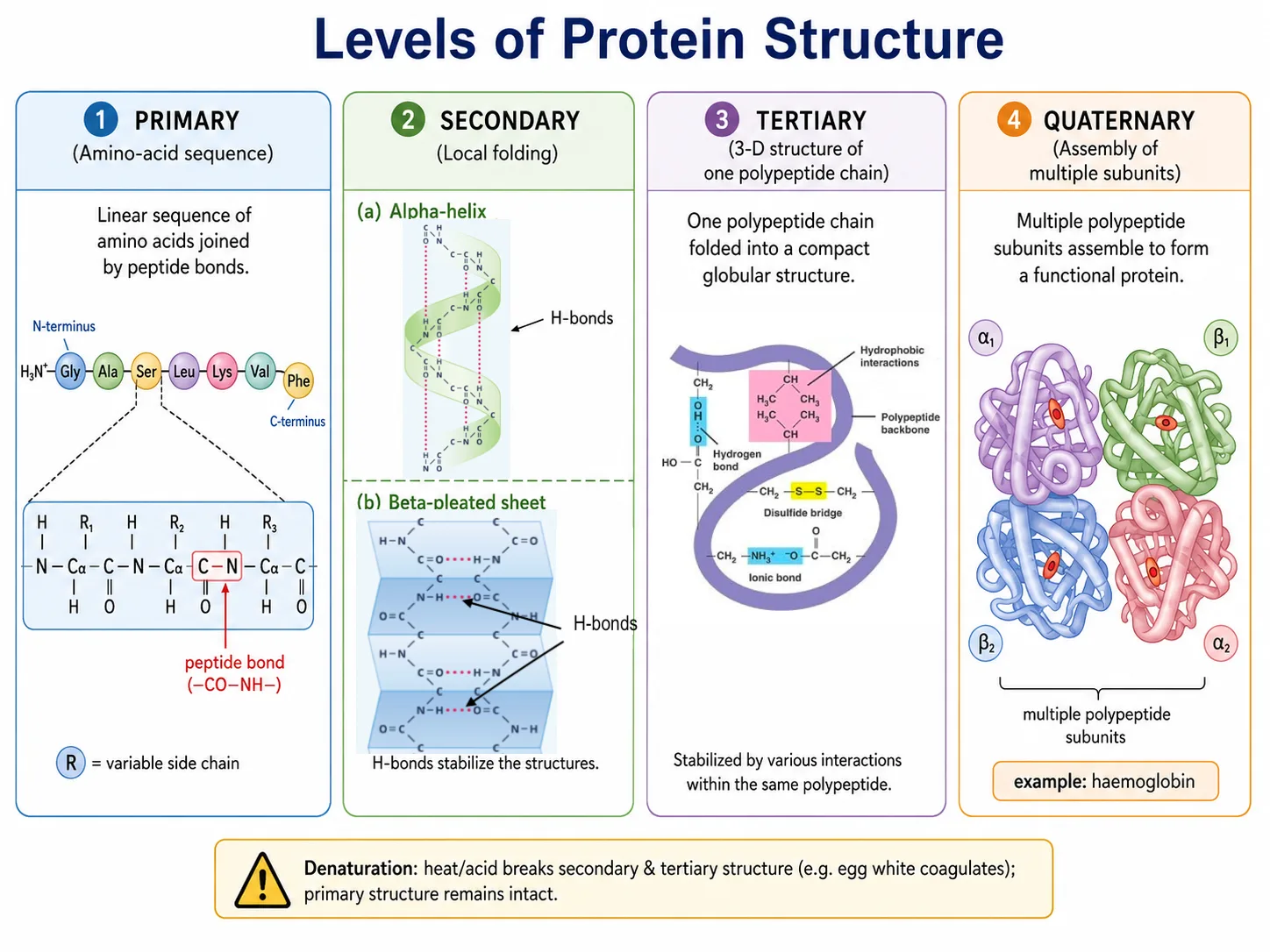
Question 11 (2+2+1): (a) Explain the primary and secondary structures of proteins. (b) Name the deficiency diseases of vitamin A and vitamin D. (c) Which sugar is called milk sugar?
Answer.
(a) Primary structure: the specific sequence in which the amino acids are linked to each other in a polypeptide chain is called the primary structure of the protein.
Secondary structure: the shape in which the long polypeptide chain can exist is called the secondary structure. It is either an α-helix or a β-pleated sheet. It is held by hydrogen bonds between the –CO– and –NH– groups of the peptide bonds.
(b) Deficiency of vitamin A causes xerophthalmia (hardening of the cornea) and night blindness. Deficiency of vitamin D causes rickets in children and osteomalacia in adults.
(c) Lactose is called milk sugar.
Marks: (a) primary 1, secondary 1; (b) 1 for each vitamin; (c) 1.