
How Group IV Is Marked
Group IV (Q26–30) is always inorganic: about three questions from Coordination Compounds and two from d- and f-Block Elements. You answer any three. The 2025 and 2026 schemes mark the common types like this:
| Question type | Marks |
|---|---|
| VBT (hybridisation, geometry, magnetism) | Explanation with configuration and pairing 1, geometry 1, magnetic property 1 |
| KCrO from chromite | 1 per step; in the fill-in, only 2H is accepted |
| "Complete the equations" | 1 per blank |
| Lanthanoid contraction | Definition 1, each consequence 1 |
| Werner's postulates | Any three, 1 each |
| Geometrical isomers | 1 per structure (show which ligands are next to and opposite each other), 1 for the follow-up |
| Co(CO) | Name 1, structure 1, number of bridging CO 1 |
| Catalytic properties | Any two reasons, 1 each, plus the named catalyst |
In VBT, "octahedral" or "diamagnetic" alone doesn't earn the explanation mark. Show the ion's configuration and what the ligand does to its electrons.
VBT Variants
Question 1: Using VBT, explain the hybridisation, geometry and magnetic property of [Fe(CN)]. (Fe = 26)
Answer. In [Fe(CN)], iron is in the +3 state. Fe is [Ar] 3d 4s, so Fe is [Ar] 3d with five unpaired electrons.
CN is a strong field ligand, so it pairs up the 3d electrons into three 3d orbitals. This leaves one unpaired electron and two empty 3d orbitals. Two 3d, one 4s and three 4p orbitals mix to form six dsp hybrid orbitals, which accept six electron pairs from six CN ions.
| 3d | 4s | 4p | |
|---|---|---|---|
| Fe ion | ↑ ↑ ↑ ↑ ↑ | [ ] | [ ] [ ] [ ] |
| In [Fe(CN)] | ↑↓ ↑↓ ↑ xx xx | xx | xx xx xx |
(xx = electron pair donated by CN)
- Hybridisation: dsp (inner orbital complex)
- Geometry: octahedral
- Magnetic property: one unpaired electron, so it is paramagnetic
Marks: explanation with hybridisation 1, geometry 1, magnetic property 1.
Question 2: Using VBT, explain the hybridisation, geometry and magnetic property of [Cr(NH)]. (Cr = 24)
Answer. In [Cr(NH)], chromium is in the +3 state, so Cr is [Ar] 3d.
The three electrons stay unpaired in three 3d orbitals, and two 3d orbitals are already empty, so no pairing is needed. Two 3d, one 4s and three 4p orbitals mix to form six dsp hybrid orbitals, which accept six electron pairs from six NH molecules.
| 3d | 4s | 4p | |
|---|---|---|---|
| Cr ion | ↑ ↑ ↑ [ ] [ ] | [ ] | [ ] [ ] [ ] |
| In [Cr(NH)] | ↑ ↑ ↑ xx xx | xx | xx xx xx |
(xx = electron pair donated by NH)
- Hybridisation: dsp
- Geometry: octahedral
- Magnetic property: three unpaired electrons, so it is paramagnetic ( = 3.87 BM)
Marks: explanation with hybridisation 1, geometry 1, magnetic property 1.
Question 3: Using VBT, explain the hybridisation, geometry and magnetic property of [Ni(NH)]. (Ni = 28)
Answer. In [Ni(NH)], nickel is in the +2 state, so Ni is [Ar] 3d with two unpaired electrons.
Even if the two electrons paired up, only one 3d orbital would be free, but dsp needs two. So the outer 4d orbitals are used. One 4s, three 4p and two 4d orbitals mix to form six spd hybrid orbitals, which accept six electron pairs from six NH molecules.
| 3d | 4s | 4p | 4d | |
|---|---|---|---|---|
| Ni ion | ↑↓ ↑↓ ↑↓ ↑ ↑ | [ ] | [ ] [ ] [ ] | [ ] [ ] [ ] [ ] [ ] |
| In [Ni(NH)] | ↑↓ ↑↓ ↑↓ ↑ ↑ | xx | xx xx xx | xx xx [ ] [ ] [ ] |
(xx = electron pair donated by NH)
- Hybridisation: spd (outer orbital complex)
- Geometry: octahedral
- Magnetic property: two unpaired electrons, so it is paramagnetic
Marks: explanation with hybridisation 1, geometry 1, magnetic property 1.
Question 4: [Co(CO)] is diamagnetic. Explain its hybridisation and geometry using VBT. (Co = 27)
Answer. In [Co(CO)], cobalt is in the +3 state, so Co is [Ar] 3d.
Since the complex is diamagnetic, all six 3d electrons must be paired in three 3d orbitals, leaving two 3d orbitals empty. These two 3d orbitals, one 4s and three 4p orbitals mix to form six dsp hybrid orbitals. The three didentate oxalate ions supply six electron pairs.
| 3d | 4s | 4p | |
|---|---|---|---|
| Co ion | ↑↓ ↑ ↑ ↑ ↑ | [ ] | [ ] [ ] [ ] |
| In [Co(CO)] | ↑↓ ↑↓ ↑↓ xx xx | xx | xx xx xx |
(xx = electron pair donated by oxalate)
- Hybridisation: dsp
- Geometry: octahedral (inner orbital, low spin complex)
Marks: pairing explained 1, hybridisation 1, geometry 1.
Question 5: Calculate the spin-only magnetic moments of Mn, Cr and Cu. Which is the most paramagnetic? (Mn = 25, Cr = 24, Cu = 29)
Answer.
Formula: BM, where n is the number of unpaired electrons.
Mn is 3d, so n = 5: = 5.92 BM
Cr is 3d, so n = 3: = 3.87 BM
Cu is 3d, so n = 1: = 1.73 BM
Mn has the most unpaired electrons, so it is the most paramagnetic.
Marks: Mn 1, Cr and Cu 1, conclusion 1.
Werner's Theory, Naming and Isomers
Question 6: PtCl·4NH gives 2 moles of AgCl with excess AgNO. Write the formula of the complex, its primary and secondary valencies, and its IUPAC name.
Answer. Since 2 moles of AgCl are formed, two Cl ions are outside the coordination sphere.
Formula of the complex: [Pt(NH)Cl]Cl
Primary valency = 4 (the oxidation state of Pt is +4). Secondary valency = 6 (four NH and two Cl).
IUPAC name: tetraamminedichloridoplatinum(IV) chloride
Marks: formula 1, valencies 1, name 1.
Question 7: Draw the geometrical isomers of [Pt(NH)Cl]. Which one is used as an anticancer drug?
Answer. [Pt(NH)Cl] is square planar and shows two geometrical isomers:
- cis isomer: the two NH groups are next to each other, and the two Cl groups are next to each other.
- trans isomer: the two NH groups are opposite each other, and the two Cl groups are opposite each other.
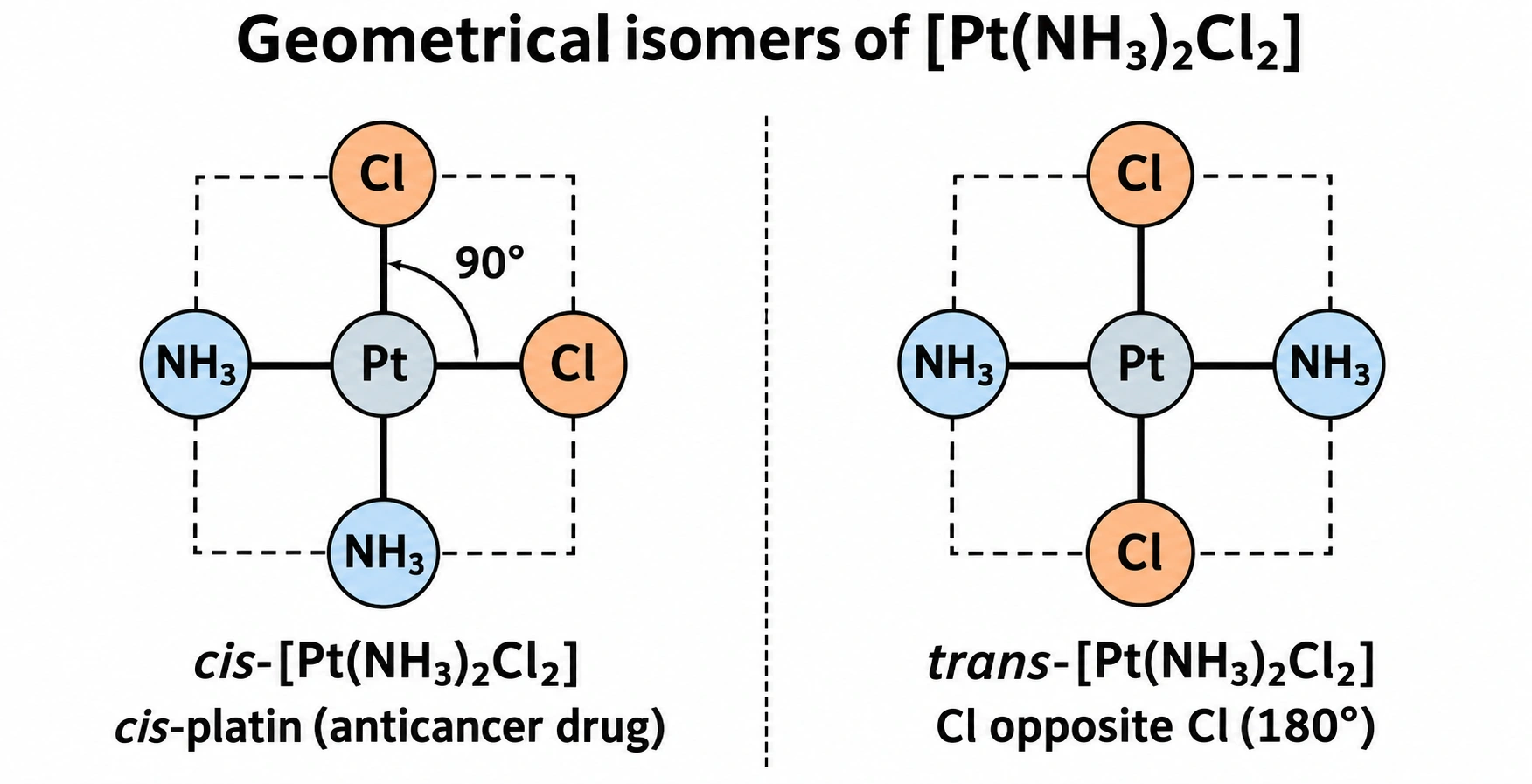
The cis isomer, called cis-platin, is used as an anticancer drug.
Marks: cis 1, trans 1, cis-platin 1.
Question 8: Write the IUPAC name of [Co(en)]. What type of isomerism does it show, and why?
Answer. IUPAC name: tris(ethane-1,2-diamine)cobalt(III) ion
It shows optical isomerism, that is, it exists as d and l forms.
Reason: the three chelate rings are arranged like a propeller, so the complex has no plane of symmetry. The complex and its mirror image cannot be superimposed.
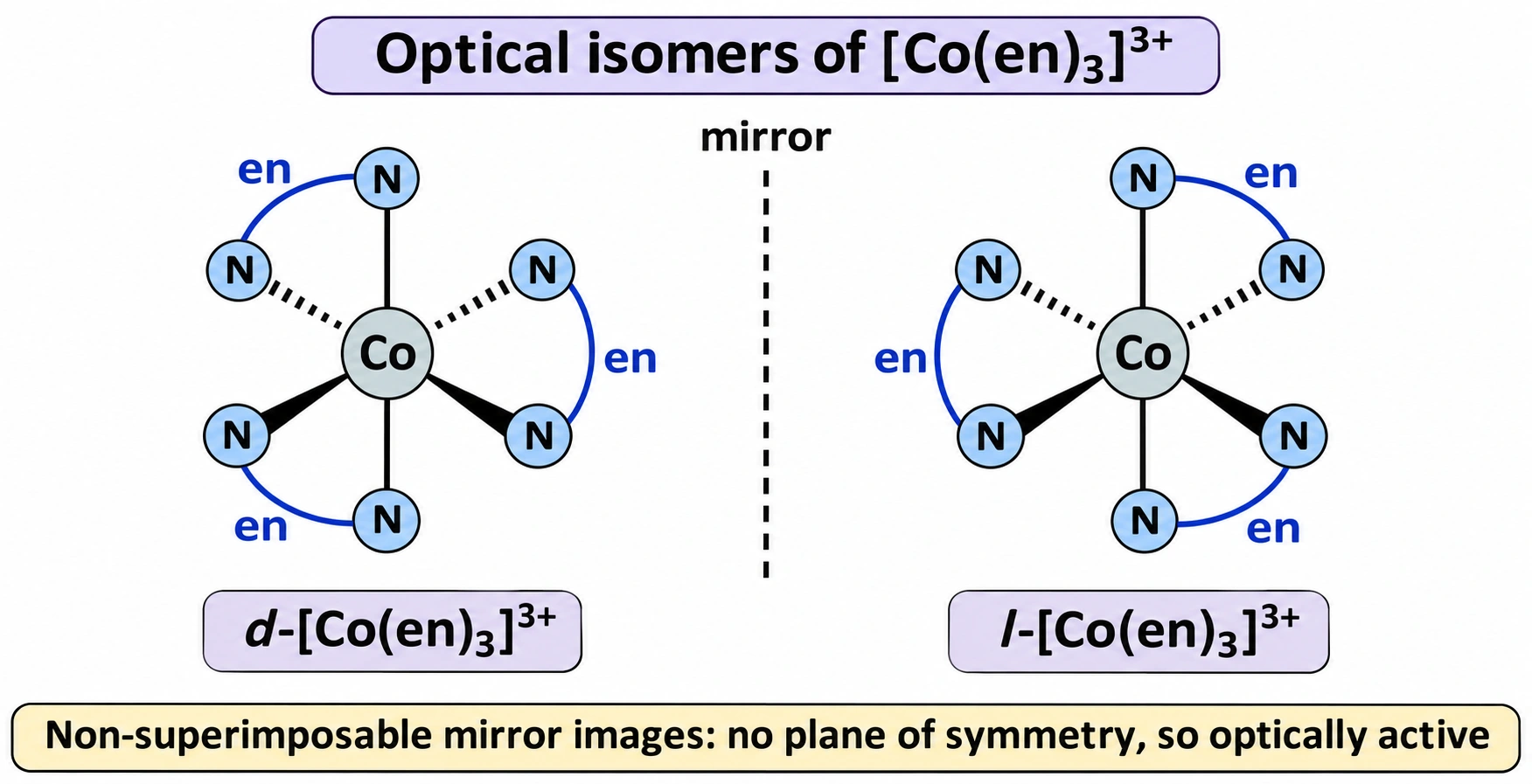
Marks: name 1, type of isomerism 1, reason 1.
Question 9: [Co(NH)SO]Br and [Co(NH)Br]SO are isomers. Name the type, and say how you would tell them apart.
Answer. They are ionisation isomers, because SO and Br exchange places between the coordination sphere and the outside.
[Co(NH)SO]Br gives a pale yellow precipitate of AgBr with AgNO solution, because Br is free in solution.
[Co(NH)Br]SO gives a white precipitate of BaSO with BaCl solution, because SO is free in solution.
Marks: type 1, test for each isomer 1 + 1.
Question 10: For a d ion in an octahedral field, write the configurations in a strong field and a weak field. How do their magnetic properties differ?
Answer. In a strong field (), the configuration is t e. All the electrons are paired.
In a weak field (), the configuration is t e. There are four unpaired electrons.
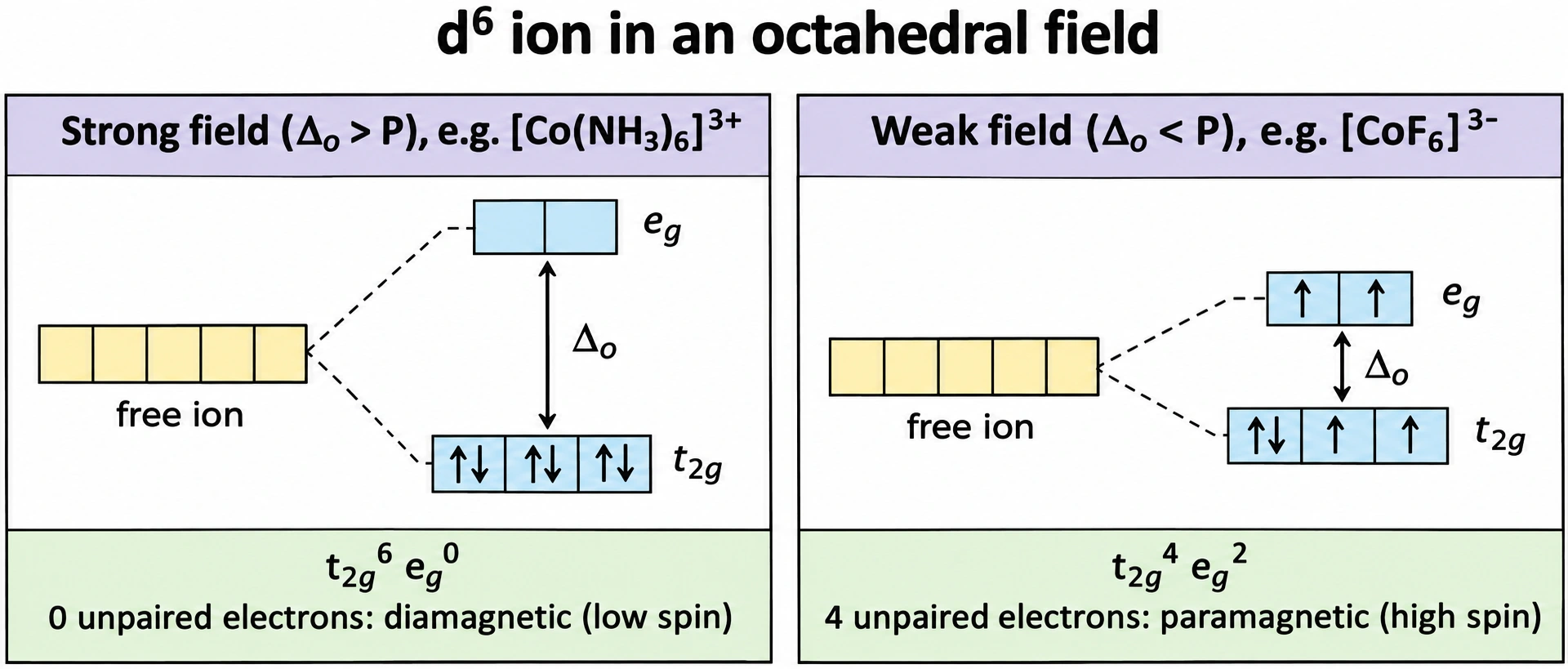
So the strong field complex (like [Co(NH)]) is diamagnetic, and the weak field complex (like [CoF]) is paramagnetic.
Marks: strong field 1, weak field 1, magnetic property 1.
d- and f-Block Equations and Reasons
Question 11: Write ionic equations for acidified dichromate oxidising (i) Fe, (ii) HS and (iii) Sn.
Answer. Acidified dichromate is a strong oxidising agent. In each reaction, Cr changes from +6 to +3.
(i) Iron(II) to iron(III):
(ii) Hydrogen sulphide to sulphur:
(iii) Tin(II) to tin(IV):
Marks: 1 for each balanced equation. Check that the charges balance on both sides.
Question 12: Write ionic equations for acidified permanganate oxidising (i) Fe, (ii) oxalate ion and (iii) HS.
Answer. In acidic medium, permanganate is reduced to Mn (Mn changes from +7 to +2).
(i) Iron(II) to iron(III):
(ii) Oxalate to carbon dioxide:
(iii) Hydrogen sulphide to sulphur:
Marks: 1 for each balanced equation.
Question 13: Give three reasons why transition metals form a large number of complexes.
Answer. Transition metals form a large number of complex compounds because:
- Their ions are small in size.
- Their ions carry a high charge.
- They have vacant d orbitals of suitable energy, which can accept lone pairs of electrons from the ligands.
Marks: 1 for each reason.
Question 14: Give three uses of coordination compounds.
Answer. Uses of coordination compounds:
- EDTA is used to estimate the hardness of water, because it forms stable complexes with Ca and Mg ions.
- Silver and gold are extracted as soluble cyanide complexes, [Ag(CN)] and [Au(CN)].
- cis-Platin is used in the treatment of cancer. (Also accepted: Wilkinson's catalyst, [(PhP)RhCl], is used for the hydrogenation of alkenes.)
Marks: 1 for each use.