
What a Cloning Vector Does
Plasmids and bacteriophages share a useful ability: they can replicate within bacterial cells independently of the chromosomal DNA. That is precisely why they make good carriers, or vectors, for alien DNA.
How many copies they make varies. Bacteriophages, because of their high number per cell, carry very high copy numbers of their genome. Plasmids differ widely — some have only one or two copies per cell, others 15 to 100 or more. The point is that if we link an alien piece of DNA to a plasmid or a phage, that alien DNA gets multiplied up to the copy number of its carrier. A well-designed vector is engineered to make two things easy: linking foreign DNA, and telling recombinants apart from non-recombinants.
Origin of Replication and Copy Number
The first feature every vector must have is an origin of replication (ori) — the sequence from where replication starts. Any piece of DNA linked to this sequence can be made to replicate inside the host cell.
The ori does more than just start replication: it also controls the copy number of the linked DNA. This has a practical consequence. If you want to recover many copies of your target DNA, you should clone it in a vector whose origin supports a high copy number.
Selectable Markers
The second feature is a selectable marker. Its job is to help identify and eliminate non-transformants while selectively allowing the transformants to grow. Here transformation means the procedure by which a piece of DNA is introduced into a host bacterium.
The genes usually used as selectable markers encode resistance to antibiotics such as ampicillin, chloramphenicol, tetracycline or kanamycin. These work well because normal E. coli cells carry no resistance to any of these antibiotics — so any cell that survives on the antibiotic must have taken up the vector carrying the resistance gene.
Cloning Sites and the Example of pBR322
The third feature is cloning sites. To link alien DNA, the vector needs very few — preferably single — recognition sites for the commonly used restriction enzymes. If more than one site is present, cutting the vector generates several fragments and complicates the whole cloning process.
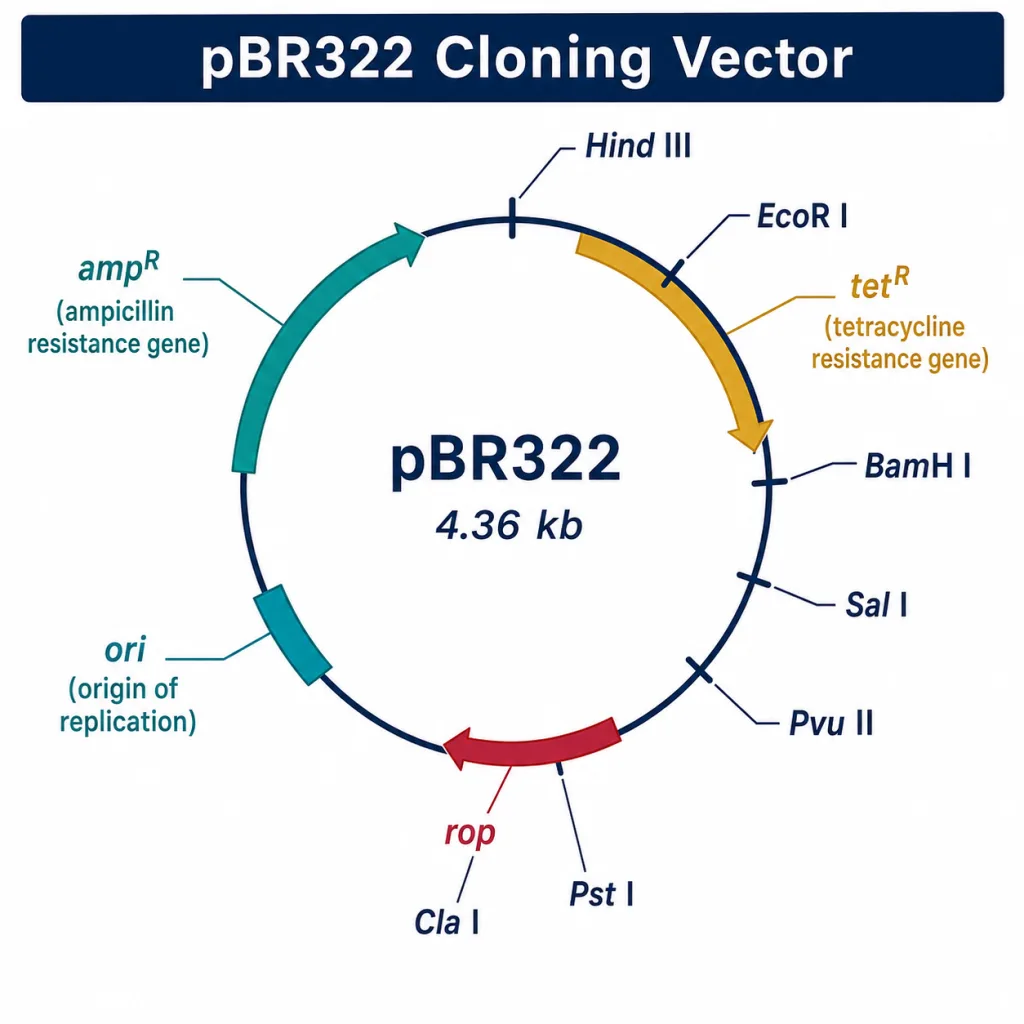
A classic example is pBR322, an E. coli cloning vector. It carries two antibiotic resistance genes — ampR (ampicillin resistance) and tetR (tetracycline resistance) — along with an ori and several restriction sites such as Hind III, EcoRI, BamHI, SalI, PvuII, PstI and ClaI, and rop, which codes for the proteins involved in the replication of the plasmid. pBR322 was among the first artificial cloning vectors to be constructed. Ligation of alien DNA is done at a site within one of these resistance genes. For instance, if a foreign DNA is ligated at the BamHI site of the tetracycline resistance gene, the recombinant loses tetracycline resistance — but it can still be selected out because it remains resistant to ampicillin.
Quick Recap
- Plasmids and bacteriophages replicate within bacteria independent of chromosomal DNA; phages have very high copy numbers, plasmids from 1-2 up to 15-100 or more per cell.
- Alien DNA linked to a vector multiplies up to the vector's copy number.
- Origin of replication (ori): where replication starts; also controls copy number — use a high-copy-number ori to recover many copies.
- Selectable marker: identifies and eliminates non-transformants and selects transformants; usually antibiotic-resistance genes (ampicillin, chloramphenicol, tetracycline, kanamycin), since normal E. coli has no such resistance. Transformation = introducing DNA into a host bacterium.
- Cloning sites: few, preferably single, restriction sites; more than one complicates cloning.
- pBR322 (E. coli vector): has ampR and tetR, an ori and several restriction sites; foreign DNA at the BamHI site of tetR makes the recombinant lose tetracycline resistance but still selectable on ampicillin.
Solved Examples — Section 7
Q1. Why are plasmids and bacteriophages suitable as cloning vectors?
Answer: Because they can replicate within bacterial cells independently of the chromosomal DNA, so any alien DNA linked to them is also multiplied.
Q2. What are the two roles of the origin of replication in a vector?
Answer: It is the sequence where replication starts, and it also controls the copy number of the linked DNA.
Q3. What is a selectable marker used for?
Answer: It helps identify and eliminate non-transformants and selectively permits the growth of transformants.
Q4. Name two antibiotics whose resistance genes serve as selectable markers for E. coli.
Answer: Any two of ampicillin, chloramphenicol, tetracycline and kanamycin — normal E. coli has no resistance to these.
Q5. Why should a vector have very few, preferably single, restriction sites?
Answer: More than one recognition site would generate several fragments on cutting, which complicates gene cloning.
Q6. If foreign DNA is ligated at the BamHI site of the tetracycline resistance gene of pBR322, what happens to the recombinant?
Answer: It loses tetracycline resistance due to the insertion, but can still be selected because it remains resistant to ampicillin.