
Why Alien DNA Needs a Replication Signal
Consider a piece of DNA that has somehow been transferred into an unrelated, alien organism. On its own, that fragment normally cannot multiply in the progeny cells. It gets copied and passed on only if one of two things happens: either it becomes integrated into the host genome (and so rides along as part of a chromosome), or it is linked to a specific sequence called the origin of replication, which is the sequence responsible for initiating replication.
Once the alien DNA carries an origin of replication, it can replicate and produce many identical copies of itself inside the host. Making such identical copies of any template DNA is exactly what we mean by cloning. This single idea — attach the gene to something that can replicate — is the foundation on which the whole of genetic engineering is built.
Constructing the First Recombinant DNA
The first artificial recombinant DNA molecule was built by Stanley Cohen and Herbert Boyer in 1972. Their idea was to link a gene for antibiotic resistance with a native plasmid of Salmonella typhimurium. A plasmid is an autonomously replicating, circular, extra-chromosomal piece of DNA found floating in the cytoplasm of many bacteria.
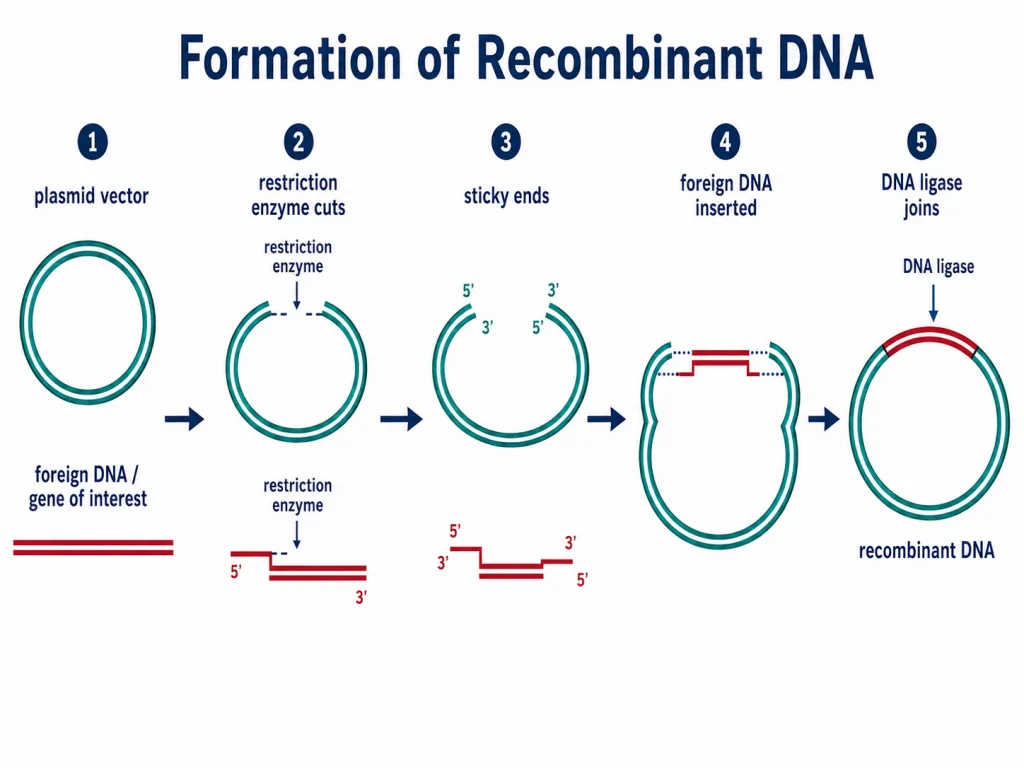
The antibiotic-resistance gene was isolated by cutting out the relevant piece of DNA from a plasmid that carried it. Cutting DNA at such specific locations became possible only with the discovery of the so-called molecular scissors — the restriction enzymes.
Vectors and the Role of DNA Ligase
The cut piece of DNA was then linked to the plasmid DNA, and here the plasmid plays a special part: it acts as a vector, a carrier that ferries the attached DNA into the host. The comparison often made is with a mosquito, which acts as an insect vector to carry the malarial parasite into the human body; in the same way a plasmid carries an alien piece of DNA into a host cell.
The actual joining of the antibiotic-resistance gene to the plasmid vector was done using the enzyme DNA ligase, which acts on cut DNA molecules and joins their ends. The result is a new combination of circular, autonomously replicating DNA, assembled in vitro — and this is what we call recombinant DNA.
Cloning in E. coli and the Three Basic Steps
When this recombinant DNA was transferred into Escherichia coli, a bacterium closely related to Salmonella, it could replicate using the new host's DNA polymerase and make many copies. This ability to multiply copies of the antibiotic-resistance gene in E. coli was called cloning of the antibiotic-resistance gene.
From this first success we can draw out the three basic steps involved in genetically modifying any organism:
- Identification of DNA carrying the desirable gene(s).
- Introduction of the identified DNA into the host.
- Maintenance of the introduced DNA in the host and its transfer to the progeny.
Quick Recap
- A piece of DNA moved into an alien organism normally cannot multiply in the progeny unless it integrates into the host genome or is linked to an origin of replication (the sequence that initiates replication).
- Making identical copies of a template DNA is cloning.
- The first recombinant DNA was made by Cohen and Boyer in 1972, linking a gene for antibiotic resistance with a native plasmid of Salmonella typhimurium.
- A plasmid is an autonomously replicating, circular, extra-chromosomal DNA; here it serves as a vector (like a mosquito carrying the malarial parasite).
- DNA ligase joins the cut ends to form a circular, autonomously replicating recombinant DNA in vitro.
- Transferred into E. coli, it replicated using the host's DNA polymerase, cloning the resistance gene. The three basic steps of genetic modification: identify the DNA, introduce it into the host, maintain and transfer it to progeny.
Solved Examples — Section 3
Q1. Why can a piece of alien DNA usually not multiply in a new organism on its own?
Answer: Because it is not part of a replicating chromosome. It multiplies only if it integrates into the host genome or is linked to an origin of replication.
Q2. Who constructed the first recombinant DNA, and in which year?
Answer: Stanley Cohen and Herbert Boyer, in 1972.
Q3. With which organism's native plasmid was the antibiotic-resistance gene linked in the first recombinant DNA?
Answer: With a native plasmid of Salmonella typhimurium.
Q4. What is the role of DNA ligase in making recombinant DNA?
Answer: It acts on cut DNA molecules and joins their ends, linking the gene of interest to the vector to form the recombinant DNA.
Q5. Why is a plasmid described as a vector?
Answer: Because it carries an alien piece of DNA into the host cell, much as a mosquito acts as a vector carrying the malarial parasite into the human body.
Q6. List the three basic steps in genetically modifying an organism.
Answer: (i) Identification of DNA with desirable genes; (ii) introduction of the identified DNA into the host; (iii) maintenance of the introduced DNA in the host and transfer to the progeny.