
What a DNA Palindrome Is
Every restriction endonuclease recognises a specific palindromic nucleotide sequence in the DNA. In everyday language a palindrome is a group of letters that reads the same forwards and backwards, like the word MALAYALAM. A DNA palindrome is a little different: it is a sequence of base pairs that reads the same on the two strands when the orientation of reading is kept the same, that is, in the 5' to 3' direction.
A common example is the sequence recognised by EcoRI:
5' —— GAATTC —— 3'
3' —— CTTAAG —— 5'
Read 5' to 3', the top strand gives GAATTC; read 5' to 3', the bottom strand also gives GAATTC. That symmetry is the hallmark of a DNA palindrome.
Where the Enzyme Cuts and Why It Leaves Overhangs
A restriction enzyme does not slice straight through the middle of its palindrome. Instead it cuts each strand a little away from the centre of the palindromic site, but between the same two bases on the opposite strands — EcoRI, for example, cuts between G and A on each strand. Because the two cuts are staggered, the double helix is left with short single-stranded portions hanging off each end.
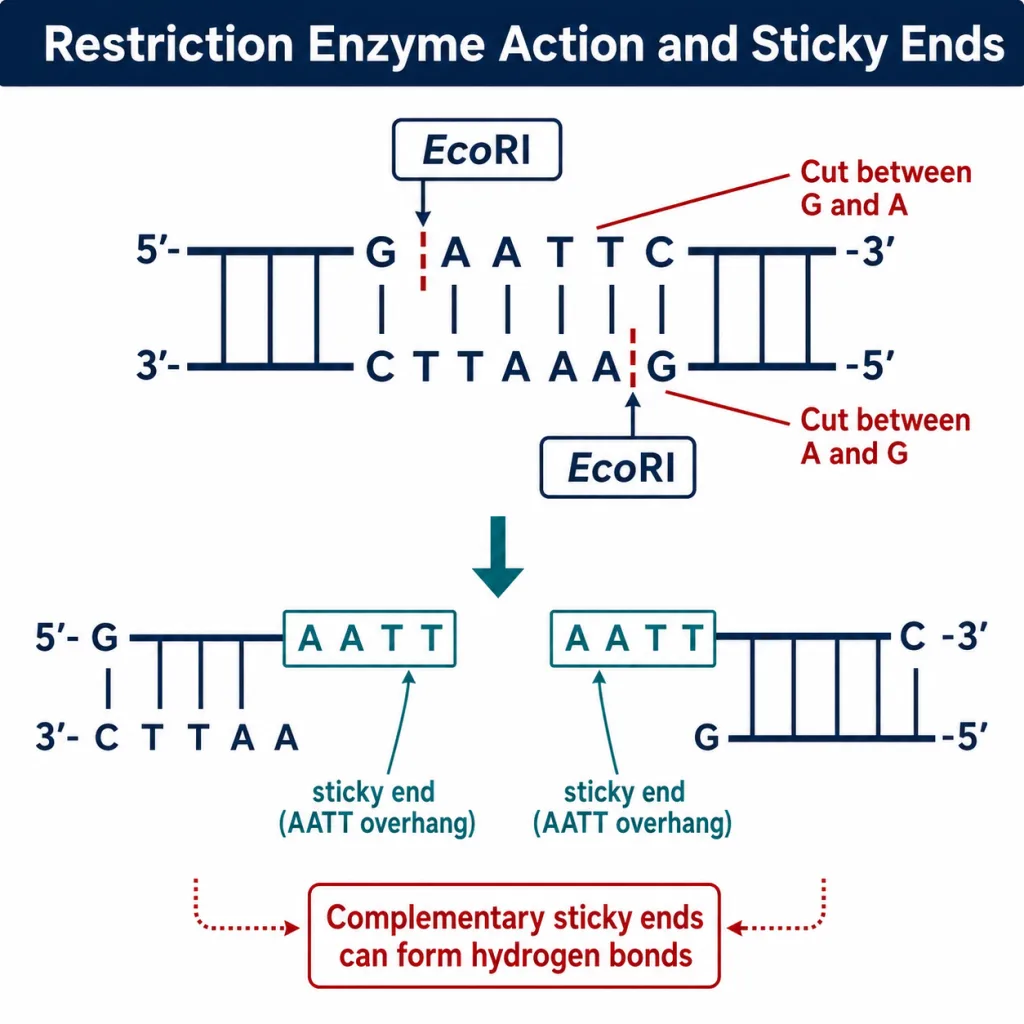
These overhanging single-stranded stretches are called sticky ends.
Why They Are Called Sticky Ends
The overhangs are named sticky ends for a good reason: they can form hydrogen bonds with their complementary cut counterparts. A single-stranded overhang will pair up with any other single-stranded stretch that has the matching, complementary bases — and this readiness to pair is exactly what makes the ends 'sticky'.
This stickiness is not just a curiosity. It facilitates the action of DNA ligase, the enzyme that seals the joined ends together. The sticky ends first hold the two pieces of DNA in place by hydrogen bonding, and DNA ligase then joins their sugar-phosphate backbones to make the join permanent.
Joining Pieces to Make Recombinant DNA
The real usefulness of sticky ends appears when two different DNA molecules are cut by the same restriction enzyme. Because they were cut at the same recognition sequence, both fragments end up with the same kind of sticky ends. Their complementary overhangs pair up, and DNA ligase joins them end-to-end — and this is precisely how a recombinant DNA molecule is built from DNA of different sources.
This leads to an important practical rule: normally, unless one cuts the vector and the source DNA with the same restriction enzyme, the recombinant vector molecule cannot be created. Matching sticky ends are what allow the two pieces to fit together at all.
Quick Recap
- A restriction endonuclease recognises a specific palindromic sequence — one that reads the same on both strands in the 5' to 3' direction, e.g. 5'-GAATTC-3' paired with 3'-CTTAAG-5'.
- The enzyme cuts a little away from the centre of the palindrome, but between the same two bases on opposite strands, leaving single-stranded overhangs called sticky ends.
- Sticky ends are so named because they form hydrogen bonds with their complementary cut counterparts, and this stickiness facilitates the action of DNA ligase.
- Two DNA pieces cut by the same restriction enzyme have the same sticky ends and can be joined end-to-end by DNA ligase to make recombinant DNA.
- Normally the vector and the source DNA must be cut with the same restriction enzyme, or the recombinant vector cannot form.
Solved Examples — Section 5
Q1. What kind of nucleotide sequence does a restriction endonuclease recognise?
Answer: A specific palindromic nucleotide sequence.
Q2. How does a DNA palindrome differ from a word palindrome?
Answer: A word palindrome reads the same in both directions of the same line, while a DNA palindrome reads the same on the two strands when the orientation of reading (5' to 3') is kept the same.
Q3. Where does a restriction enzyme cut relative to the centre of a palindrome?
Answer: A little away from the centre, but between the same two bases on the opposite strands, so the cuts are staggered.
Q4. What are sticky ends, and why are they called so?
Answer: They are the single-stranded overhangs left after a staggered cut; they are called sticky because they form hydrogen bonds with their complementary cut counterparts.
Q5. How does the stickiness of the ends help in making recombinant DNA?
Answer: It facilitates the action of DNA ligase; the complementary ends hold the pieces together by hydrogen bonds so that ligase can join their backbones.
Q6. Why must the vector and the source DNA usually be cut with the same restriction enzyme?
Answer: So that both have the same kind of sticky ends; only then can their complementary ends pair and be joined to form the recombinant vector.