
What PCR Does
PCR stands for Polymerase Chain Reaction. It is a way of making many copies of a gene, or any DNA of interest, entirely in vitro — in a test tube, without needing a living cell to do the copying.
To run the reaction you need three things working together: two sets of primers, the enzyme DNA polymerase, and a supply of free nucleotides. The primers are small, chemically synthesised oligonucleotides whose sequences are complementary to the regions of DNA flanking the stretch you want to copy. They mark out exactly where copying should begin, and the polymerase does the rest, building new strands along the template.
The Three Steps of One Cycle
Every round of PCR runs through the same three steps.
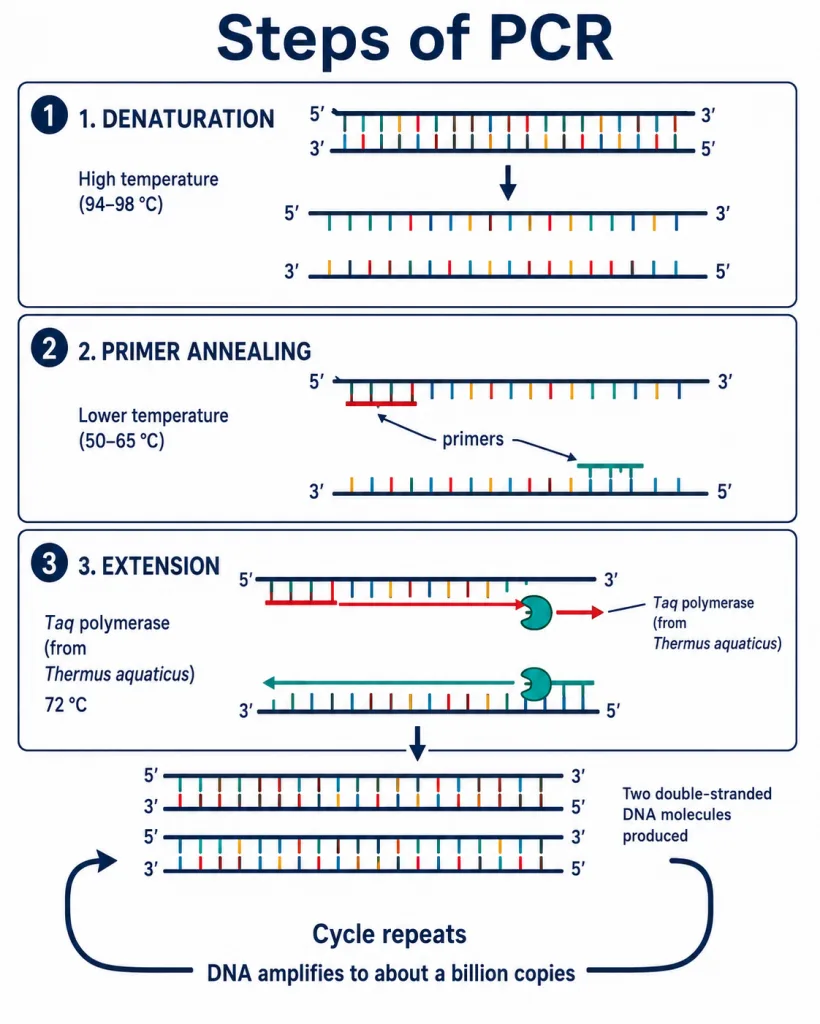
The first is denaturation, in which the double-stranded DNA is separated into two single strands by a high temperature. The second is primer annealing, where the two primers bind to their complementary regions on the now-separated strands. The third is extension of primers, in which DNA polymerase extends each primer using the supplied nucleotides, reading the genomic DNA as its template. At the end of one cycle, one molecule has become two.
Why a Heat-Stable Enzyme Is Essential
The power of PCR comes from repetition. Because each cycle roughly doubles the amount of DNA, repeating the cycle many times amplifies the segment to about a billion (1,000,000,000) copies.
But there is a catch. Every cycle begins with denaturation at a high temperature, which would destroy an ordinary enzyme. The reaction therefore uses a thermostable DNA polymerase — Taq polymerase, isolated from the bacterium Thermus aquaticus, which lives in hot springs. Taq polymerase stays active right through the high-temperature denaturation step, so it does not have to be replaced after every cycle. This single property is what makes automated, repeated amplification practical.
From Amplified DNA to Cloning
Once PCR has produced a large amount of the gene of interest, that amplified fragment does not have to be the end of the story. If desired, it can be ligated with a vector for further cloning — the same route we follow when preparing any recombinant DNA.
This links PCR neatly to the earlier steps of the process. Instead of starting cloning with a single, hard-to-find copy of a gene buried in a whole genome, PCR first hands us a billion clean copies to work with. That is why amplification by PCR sits at the heart of so many recombinant DNA experiments and diagnostic tests.
Quick Recap
- PCR = Polymerase Chain Reaction, which makes many copies of a gene or DNA of interest in vitro.
- It uses two sets of primers — small, chemically synthesised oligonucleotides complementary to regions of the DNA — plus the enzyme DNA polymerase and free nucleotides.
- Each cycle has three steps: denaturation (strands separated by high temperature), primer annealing (primers bind their complementary regions), and extension of primers (polymerase extends the primers using the template).
- Repeating the cycle many times amplifies the DNA to about a billion (1,000,000,000) copies.
- Repeated amplification needs a thermostable DNA polymerase — Taq polymerase, from the bacterium Thermus aquaticus, which survives the high-temperature denaturation.
- The amplified fragment can then be ligated with a vector for further cloning.
Solved Examples — Section 12
Q1. What does PCR stand for, and what does it achieve?
Answer: Polymerase Chain Reaction. It synthesises multiple copies of a gene or DNA of interest in vitro.
Q2. Name the two kinds of molecules and the enzyme required in a PCR reaction.
Answer: Two sets of primers (small chemically synthesised oligonucleotides complementary to regions of the DNA) and the enzyme DNA polymerase.
Q3. List, in order, the three steps of one PCR cycle.
Answer: Denaturation, primer annealing, and extension of primers.
Q4. Approximately how many copies can PCR make after many cycles?
Answer: About a billion, i.e. 1,000,000,000 copies.
Q5. Which enzyme is used in PCR and why is it suitable?
Answer: Taq polymerase, a thermostable DNA polymerase isolated from Thermus aquaticus; it stays active during the high-temperature denaturation step.
Q6. What can be done with the amplified fragment after PCR?
Answer: It can be ligated with a vector for further cloning.