
Why the Gene Must Be Expressed
Cloning a gene is only half the job. In almost all recombinant technologies the ultimate aim is to make a desirable protein, so the recombinant DNA must actually be expressed — switched on to produce its product under the right conditions.
When a protein-coding gene is expressed in a heterologous host — a host different from the organism the gene came from — the protein it yields is called a recombinant protein. Cells carrying the cloned gene can be grown on a small scale in the laboratory, and the culture used to extract and then purify the protein. But a small flask can only give small amounts, which is rarely enough for real use.
Continuous Culture and the Need for Scale
To get more biomass, cells can be grown in a continuous culture system. Here the used medium is drained out from one side while fresh medium is added from the other, which keeps the cells supplied and holds them in their physiologically most active log (exponential) phase. Because the cells never run short of nutrients, this method produces a larger biomass and therefore a higher yield of the desired protein.
Even so, small-volume cultures cannot yield the quantities industry needs. Producing proteins in bulk called for a purpose-built vessel — the bioreactor — able to handle far larger volumes than any laboratory flask.
Bioreactors and the Stirred-Tank Design
A bioreactor is a vessel in which large volumes — typically 100 to 1000 litres — of culture can be processed, so that raw materials are biologically converted into products using microbial, plant, animal or human cells. Its whole purpose is to provide optimum conditions: the right temperature, pH, substrate, salts, vitamins and oxygen for the cells to grow and make their product.
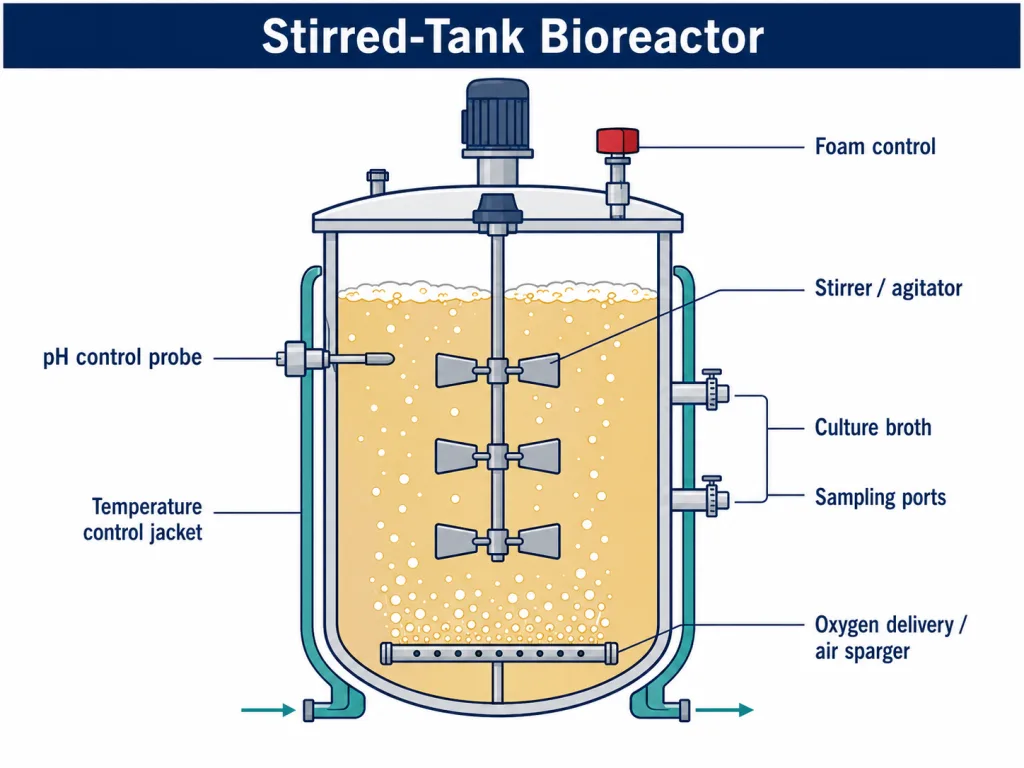
The most commonly used type is the stirred-tank reactor, usually cylindrical or with a curved base to help mix the contents. A stirrer, or agitator, ensures even mixing and spreads oxygen throughout the vessel; alternatively, air is bubbled (sparged) through, giving the sparged stirred-tank design.
Control Systems and Downstream Processing
Look closely at a bioreactor and you find several built-in control systems: an agitator system, an oxygen delivery system, a foam control system, a temperature control system, a pH control system, and sampling ports through which small volumes of culture can be withdrawn from time to time to check on progress.
Once the biosynthetic stage is complete, the product is not yet ready to sell. It must first go through separation and purification, together called downstream processing. The product is then formulated with suitable preservatives, undergoes thorough clinical trials (as required for drugs) and strict quality control testing. Both the downstream processing and the quality-control steps vary from one product to another.
Quick Recap
- The aim of most recombinant technologies is a protein, so the recombinant DNA must be expressed; a protein-coding gene expressed in a heterologous host gives a recombinant protein.
- Cells can be grown on a small scale, or in a continuous culture system (used medium out, fresh medium in) that keeps them in the active log/exponential phase for higher biomass and yield.
- For large quantities, bioreactors process large volumes (100-1000 litres), biologically converting raw materials into products and providing optimum temperature, pH, substrate, salts, vitamins and oxygen.
- The common type is the stirred-tank reactor; the stirrer/agitator ensures mixing and oxygen, or air is sparged through.
- A bioreactor has an agitator system, oxygen delivery system, foam control system, temperature control system, pH control system and sampling ports.
- Downstream processing = separation and purification; the product is then formulated with preservatives, put through clinical trials and strict quality control, varying from product to product.
Solved Examples — Section 13
Q1. Why must a cloned gene be expressed?
Answer: Because the ultimate aim of most recombinant technologies is to produce a desirable protein, and the protein is made only when the recombinant DNA is expressed.
Q2. What is a recombinant protein?
Answer: A protein produced when a protein-coding gene is expressed in a heterologous host.
Q3. How does a continuous culture system keep cells highly productive?
Answer: Used medium is drained out while fresh medium is added, keeping the cells in their most active log/exponential phase, which gives larger biomass and higher yield.
Q4. What volumes of culture can a bioreactor typically process, and what does it provide?
Answer: About 100 to 1000 litres. It provides optimum growth conditions — temperature, pH, substrate, salts, vitamins and oxygen.
Q5. List the systems present in a stirred-tank bioreactor.
Answer: An agitator system, an oxygen delivery system, a foam control system, a temperature control system, a pH control system, and sampling ports.
Q6. What is downstream processing?
Answer: The separation and purification of the product after the biosynthetic stage; the product is then formulated with preservatives and undergoes clinical trials and quality-control testing.