
Selecting Recombinants by Inactivating an Antibiotic Gene
One way to pick out recombinants uses the two antibiotic resistance genes of a vector. Alien DNA is inserted into one of them — say the tetracycline resistance gene (tetR). The insertion inactivates that gene, so the recombinant behaves differently from a non-recombinant on antibiotic plates.
The recombinant grows on ampicillin but not on tetracycline, because its tetR gene has been disrupted. A non-recombinant, whose genes are both intact, grows on both antibiotics. Comparing the two plates tells you which colonies are recombinant.
Why the Antibiotic Method Is Cumbersome
Useful as it is, this method has a real drawback. It requires simultaneous plating on two plates carrying different antibiotics, and then comparing growth on each. Handling and matching colonies across two plates is fiddly and time-consuming — in short, the procedure is cumbersome.
Because of this, biotechnologists looked for a better, simpler selectable marker that could distinguish recombinants from non-recombinants on a single plate.
A Better Alternative — Insertional Inactivation of beta-galactosidase
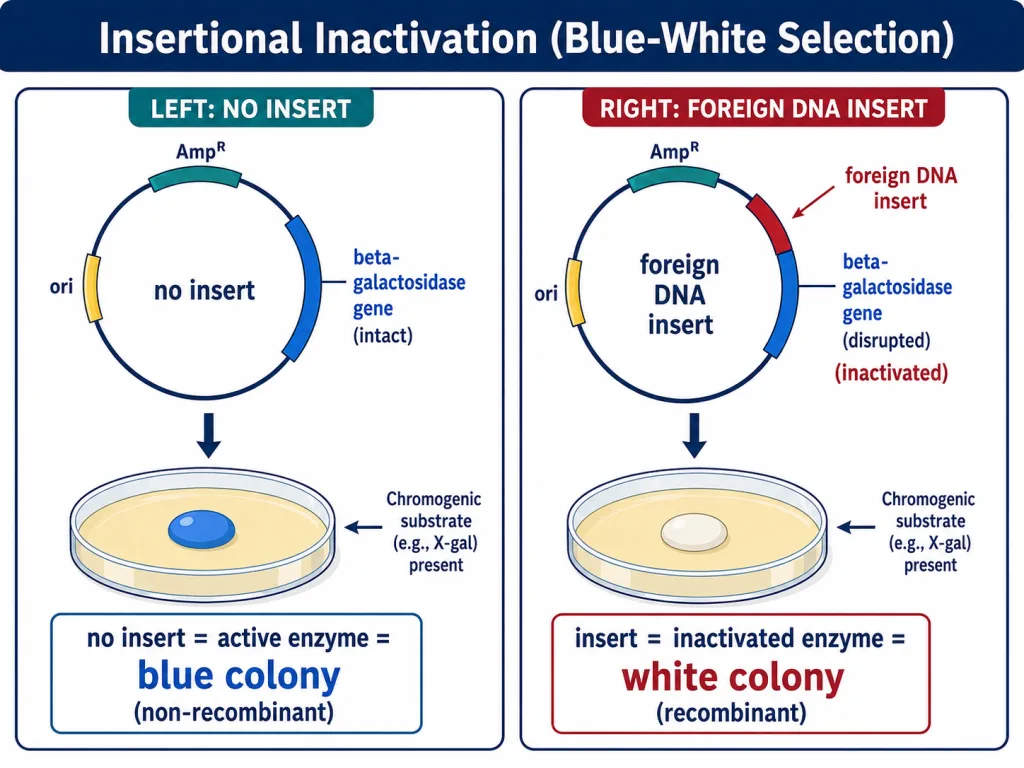
The improved approach relies on insertional inactivation of the enzyme beta-galactosidase. Here the recombinant DNA is inserted within the coding sequence of beta-galactosidase. This insertion inactivates the gene, so the enzyme can no longer be made.
The trick is to read out this inactivation as a colour change using a chromogenic substrate — a substrate that yields a colour when acted upon by active beta-galactosidase.
Blue-White Selection
On a plate with the chromogenic substrate, the result is easy to read:
- If the plasmid has no insert, the beta-galactosidase gene is intact and active. The enzyme acts on the substrate and the colonies turn blue.
- If there is an insert, the gene is inactivated, no active enzyme is made, and the colonies stay colourless (white). These colourless colonies are the recombinant ones.
So recombinants are simply the white colonies and non-recombinants are blue — all told on one plate, without the double-plating the antibiotic method needed. This is why blue-white selection is preferred.
Quick Recap
- Antibiotic-inactivation method: insert alien DNA into one resistance gene (e.g. tetR); recombinants grow on ampicillin but not tetracycline, while non-recombinants grow on both.
- This needs plating on two plates with different antibiotics — a cumbersome procedure.
- Better alternative: insertional inactivation of beta-galactosidase — recombinant DNA inserted within its coding sequence inactivates the gene.
- With a chromogenic substrate: no insert gives active enzyme and blue colonies; insert present inactivates the gene and gives colourless (white) recombinant colonies.
- Blue-white selection identifies recombinants easily on a single plate.
Solved Examples — Section 8
Q1. In the antibiotic method, how does a recombinant behave on tetracycline and ampicillin plates?
Answer: It grows on ampicillin but not on tetracycline, because inserting alien DNA into the tetracycline resistance gene inactivates that gene.
Q2. How does a non-recombinant behave on the same two plates?
Answer: It grows on both antibiotics, because both of its resistance genes are intact.
Q3. Why is selection based on antibiotic inactivation described as cumbersome?
Answer: Because it requires simultaneous plating on two plates with different antibiotics and comparing the growth, which is fiddly and time-consuming.
Q4. What is insertional inactivation of beta-galactosidase?
Answer: Inserting recombinant DNA within the coding sequence of beta-galactosidase, which inactivates the gene so the enzyme is no longer made.
Q5. On a plate with a chromogenic substrate, what colour are colonies with no insert, and why?
Answer: They are blue, because the intact, active beta-galactosidase acts on the chromogenic substrate to produce colour.
Q6. Which colonies are the recombinants in blue-white selection?
Answer: The colourless (white) colonies, because the insert has inactivated the beta-galactosidase gene so no colour is produced.