
What an Antibiotic Is
Antibiotics are regarded as one of the most significant discoveries of the twentieth century, and they have contributed enormously to human welfare. The name itself explains their job. "Anti" is a Greek word meaning "against", and "bio" means "life" — put together they mean "against life". That sounds alarming until you see the context: they are against the life of disease-causing organisms, while for human beings they are very much pro-life, not against.
Put plainly, antibiotics are chemical substances produced by some microbes that can kill or retard the growth of other, disease-causing microbes. So the microbes are helping us fight other microbes.
Penicillin — A Chance Discovery
The most familiar antibiotic is Penicillin, and it holds a special place: Penicillin was the first antibiotic to be discovered, and it was discovered entirely by chance.
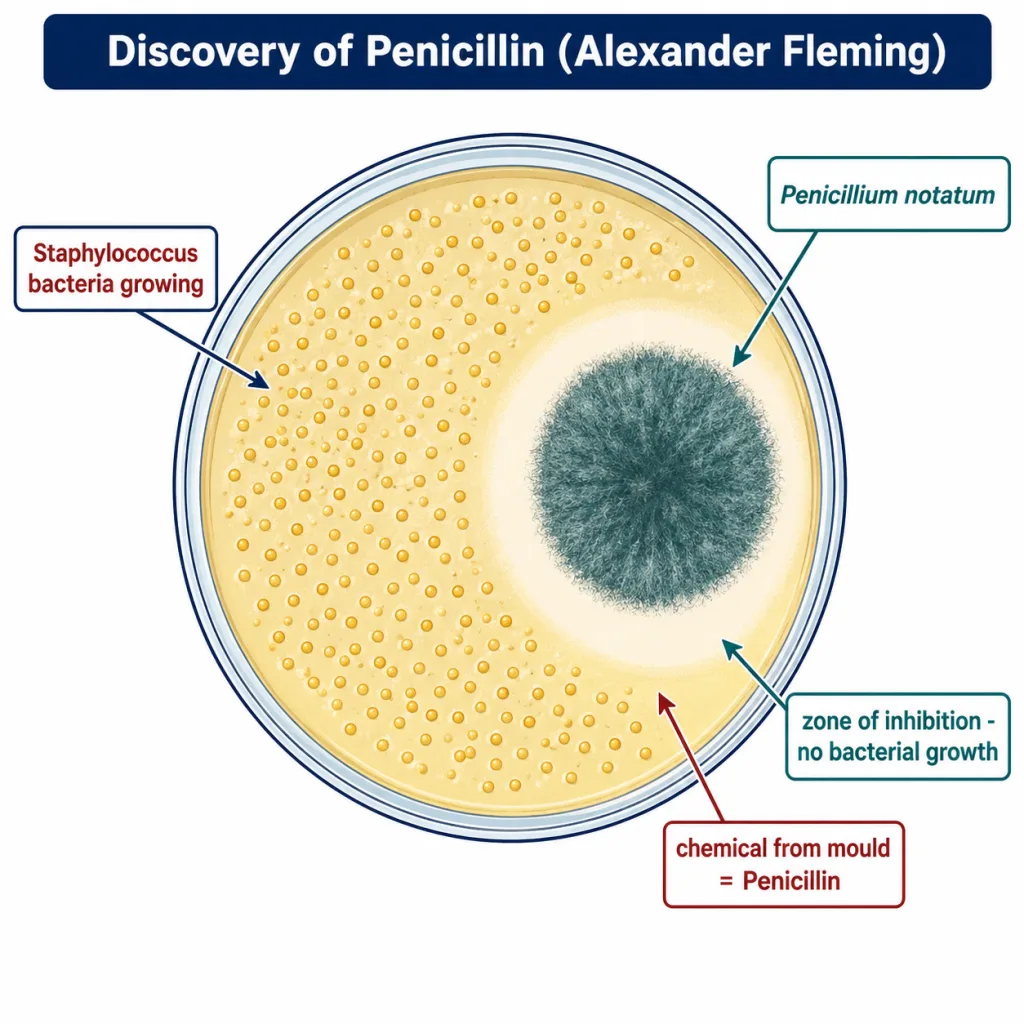
Alexander Fleming, while working on Staphylococci bacteria, once noticed a mould growing on one of his unwashed culture plates. Around this mould the Staphylococci could not grow. He worked out that a chemical produced by the mould was responsible, and he named that chemical Penicillin after the mould, Penicillium notatum.
From Discovery to Life-Saving Drug
Fleming had found the effect, but the full potential of Penicillin as an effective antibiotic was established much later by Ernest Chain and Howard Florey. Their work turned an interesting observation into a usable medicine.
The timing mattered. Penicillin was used extensively to treat American soldiers wounded in World War II, saving many lives that infection would otherwise have claimed. For this discovery, Fleming, Chain and Florey were awarded the Nobel Prize in 1945. After Penicillin, many other antibiotics were purified from other microbes, widening the range of infections that could be treated.
Why Antibiotics Matter
Antibiotics have dramatically improved our ability to treat deadly diseases that once killed millions across the globe. Among them are plague, whooping cough (kali khansi), diphtheria (gal ghotu) and leprosy (kusht rog). Before antibiotics these illnesses were often a death sentence; afterwards they became treatable.
It is hard now to imagine a world without antibiotics. They stand as a striking example of how microbes, which we usually associate with disease, can instead be turned into one of the most powerful tools for protecting human health.
Quick Recap
- Antibiotics are among the most significant discoveries of the twentieth century; "anti" (against) + "bio" (life) = "against life" — against disease-causing organisms, but pro-life for humans.
- Antibiotics are chemical substances produced by some microbes that can kill or retard the growth of other, disease-causing microbes.
- Penicillin was the first antibiotic discovered, a chance discovery by Alexander Fleming, who saw a mould stopping Staphylococci from growing and named the chemical after the mould Penicillium notatum.
- Its full potential was established by Ernest Chain and Howard Florey; Penicillin treated soldiers wounded in World War II; the three received the Nobel Prize in 1945.
- Antibiotics greatly improved treatment of deadly diseases like plague, whooping cough, diphtheria and leprosy.
Solved Examples — Section 4
Q1. Define antibiotics.
Answer: Antibiotics are chemical substances produced by some microbes that can kill or retard the growth of other, disease-causing microbes.
Q2. What is the literal meaning of the word "antibiotic", and why are antibiotics pro-life for humans?
Answer: "Anti" means against and "bio" means life, so the word means "against life" — against disease-causing organisms. For human beings they are pro-life, because they help fight disease.
Q3. Which was the first antibiotic to be discovered, and who discovered it?
Answer: Penicillin was the first antibiotic discovered, by Alexander Fleming, as a chance discovery.
Q4. After which mould was Penicillin named, and what did Fleming observe?
Answer: It was named after the mould Penicillium notatum. Fleming observed the mould growing on an unwashed culture plate, around which Staphylococci bacteria could not grow.
Q5. Who established the full potential of Penicillin, and what recognition did the discoverers receive?
Answer: Ernest Chain and Howard Florey established its full potential. Fleming, Chain and Florey were awarded the Nobel Prize in 1945.
Q6. Name some deadly diseases whose treatment was greatly improved by antibiotics.
Answer: Plague, whooping cough (kali khansi), diphtheria (gal ghotu) and leprosy (kusht rog).