
What Is Sewage
Cities and towns generate huge quantities of waste water every single day. A major component of this waste water is human excreta. This municipal waste water is called sewage, and it carries large amounts of organic matter along with many microbes — a good number of them pathogenic.
Because of those pathogens and that heavy load of organic matter, sewage cannot simply be discharged into natural water bodies like rivers and streams. Doing so would spread disease and pollute the water. Instead, sewage is first cleaned up in sewage treatment plants (STPs) to make it far less polluting before it is released.
Microbes Do the Work in Two Stages
The striking thing about sewage treatment is that we do not add a special cleaning organism. The treatment is carried out by the heterotrophic microbes naturally present in the sewage itself. These microbes feed on the organic matter and, in doing so, clean the water.
The whole process is carried out in two stages — a physical primary treatment followed by a biological secondary treatment.
Primary Treatment — Physical Removal
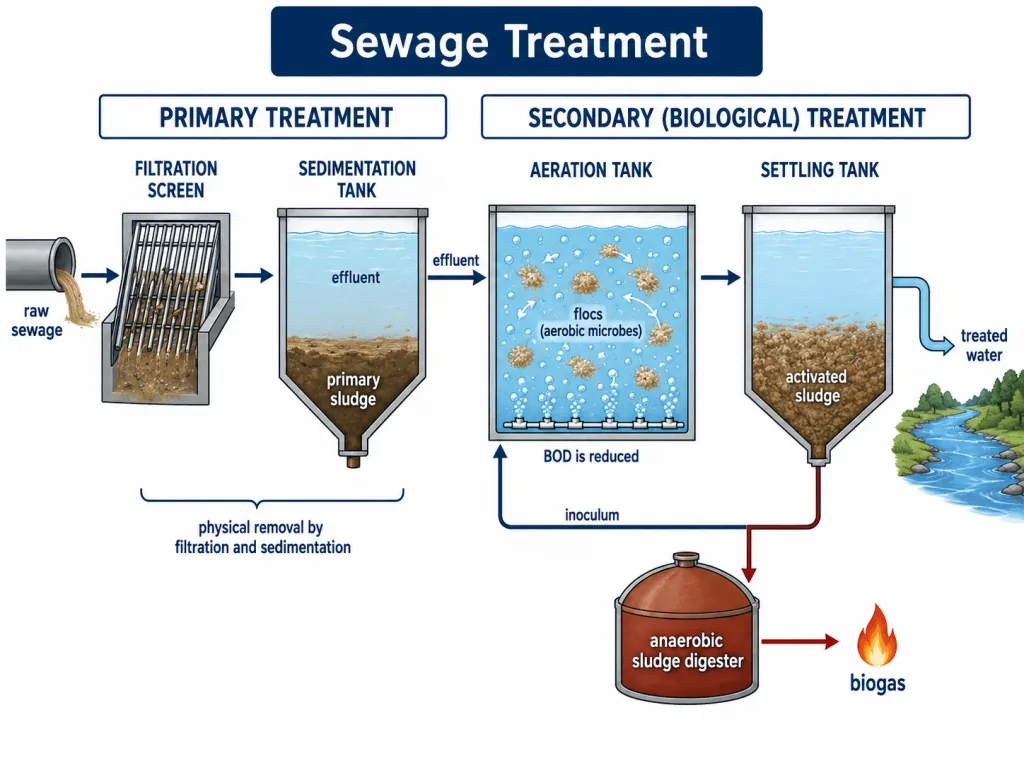
Primary treatment is essentially a physical clean-up. It removes particles, large and small, from the sewage through filtration and sedimentation, and it happens in stages.
First, the floating debris is removed by sequential filtration. Then the grit — soil and small pebbles — is removed by sedimentation, where the heavier solids settle out. All the solids that settle down form the primary sludge, while the liquid left on top, the supernatant, forms the effluent.
This primary effluent still holds a lot of dissolved and fine organic matter, so it is taken forward for the next stage.
Secondary Treatment and BOD
In secondary (biological) treatment, the primary effluent is passed into large aeration tanks. There it is constantly agitated mechanically while air is pumped in. This oxygen-rich, well-mixed environment lets useful aerobic microbes grow vigorously into flocs — masses of bacteria held together with fungal filaments to form mesh-like structures.
As these microbes grow, they consume the major part of the organic matter in the effluent. This greatly reduces the BOD (biochemical oxygen demand) — the amount of oxygen that would be consumed if all the organic matter in one litre of water were oxidised by bacteria. BOD is therefore an indirect measure of how much organic matter the water holds: the greater the BOD, the more polluting the water.
Once the BOD has fallen significantly, the effluent moves on to a settling tank, where the flocs sediment down as activated sludge. A small part of this activated sludge is pumped back into the aeration tank to serve as the inoculum, keeping the process going. The remaining major part is pumped into large anaerobic sludge digesters, where anaerobic bacteria digest the bacteria and fungi in the sludge, producing a mixture of gases — methane, hydrogen sulphide and carbon dioxide — together called biogas. The final treated effluent is then released into rivers and streams.
Quick Recap
- Sewage is municipal waste water rich in organic matter and microbes, many of them pathogenic; it must be treated in sewage treatment plants (STPs) before release.
- Treatment is done by heterotrophic microbes naturally present in the sewage, in two stages.
- Primary treatment physically removes particles by filtration and sedimentation; settled solids form the primary sludge and the supernatant is the effluent.
- Secondary (biological) treatment grows aerobic microbes into flocs in aeration tanks; they consume organic matter and reduce the BOD (oxygen needed to oxidise organic matter in one litre of water — higher BOD means more polluting water).
- Flocs settle as activated sludge; part is returned as inoculum, the rest goes to anaerobic sludge digesters producing biogas (methane, hydrogen sulphide, carbon dioxide).
- The Ganga Action Plan and Yamuna Action Plan, launched by the Ministry of Environment and Forests, aim to build more STPs and reduce river pollution.
Solved Examples — Section 6
Q1. What is sewage, and why can it not be discharged directly into rivers?
Answer: Sewage is municipal waste water whose major component is human excreta. It contains large amounts of organic matter and microbes, many of them pathogenic, so discharging it directly would pollute the water and spread disease.
Q2. Which microbes carry out sewage treatment?
Answer: The heterotrophic microbes naturally present in the sewage itself carry out the treatment; no special organism is added.
Q3. What is the key difference between primary and secondary treatment?
Answer: Primary treatment is a physical process that removes particles by filtration and sedimentation. Secondary (biological) treatment uses aerobic microbes growing as flocs in aeration tanks to consume organic matter and reduce the BOD.
Q4. Define BOD and state how it relates to pollution.
Answer: BOD (biochemical oxygen demand) is the amount of oxygen that would be consumed if all the organic matter in one litre of water were oxidised by bacteria. The greater the BOD, the more polluting the water.
Q5. What is activated sludge, and what happens to it?
Answer: Activated sludge is the sediment of bacterial flocs that settles in the settling tank after secondary treatment. A small part is pumped back into the aeration tank as inoculum, and the rest is sent to anaerobic sludge digesters, where anaerobic bacteria digest it and produce biogas.
Q6. Which government programmes were launched to reduce river pollution, and by whom?
Answer: The Ganga Action Plan and Yamuna Action Plan, launched by the Ministry of Environment and Forests, aim to build more sewage treatment plants so that only treated sewage is discharged into these rivers.