
What Biogas Is
Biogas is a mixture of gases produced by microbial activity that can be used as a fuel. Its most important component is methane, along with smaller amounts of carbon dioxide and hydrogen. The reason biogas is inflammable, and therefore useful as an energy source, is precisely this methane content.
The kind of gas that microbes release is not fixed. It depends on which microbes are at work and on the organic substrate they are feeding on. In the fermentations you have already met — the dough for idli and dosa, cheese-making, the production of beverages — the main gas given off was carbon dioxide. Biogas is different because a particular set of bacteria, working under particular conditions, tips the balance heavily towards methane.
Methanogens — the Methane Makers
Certain bacteria grow anaerobically (in the absence of oxygen) on cellulosic material, and as they do so they produce a large amount of methane along with CO2 and H2. Because methane is their signature product, these bacteria are collectively called methanogens. A common example is Methanobacterium.
Where do we find them at work? Two familiar places. First, they are present in the anaerobic sludge produced during sewage treatment — the leftover sludge that is digested in closed tanks, releasing biogas. Second, they live in the rumen, a part of the stomach of cattle. The food of cattle is rich in cellulose, and the rumen is full of it, so the methanogens have plenty to feed on.
From Rumen to Gobar Gas
Inside the rumen, methanogens do more than just make methane. They help break down the cellulose that cattle eat, and in this way they play an important part in the nutrition of the animal — something worth noting, since we humans cannot digest the cellulose in our own food.
Because the rumen is packed with these bacteria, the excreta of cattle, commonly called dung or gobar, is naturally rich in methanogens. That single fact is the whole basis of the technology: dung already carries the microbes needed to make methane, so it can be used directly to generate biogas. Biogas made this way is popularly known as gobar gas.
Inside a Biogas Plant
A biogas plant is a simple but clever piece of engineering. At its heart is a concrete tank, about 10 to 15 feet deep, into which bio-wastes are collected and a slurry of dung is fed. As the methanogens act on the slurry, gas builds up inside the tank. A floating cover sits over the slurry and keeps rising as more gas collects beneath it.
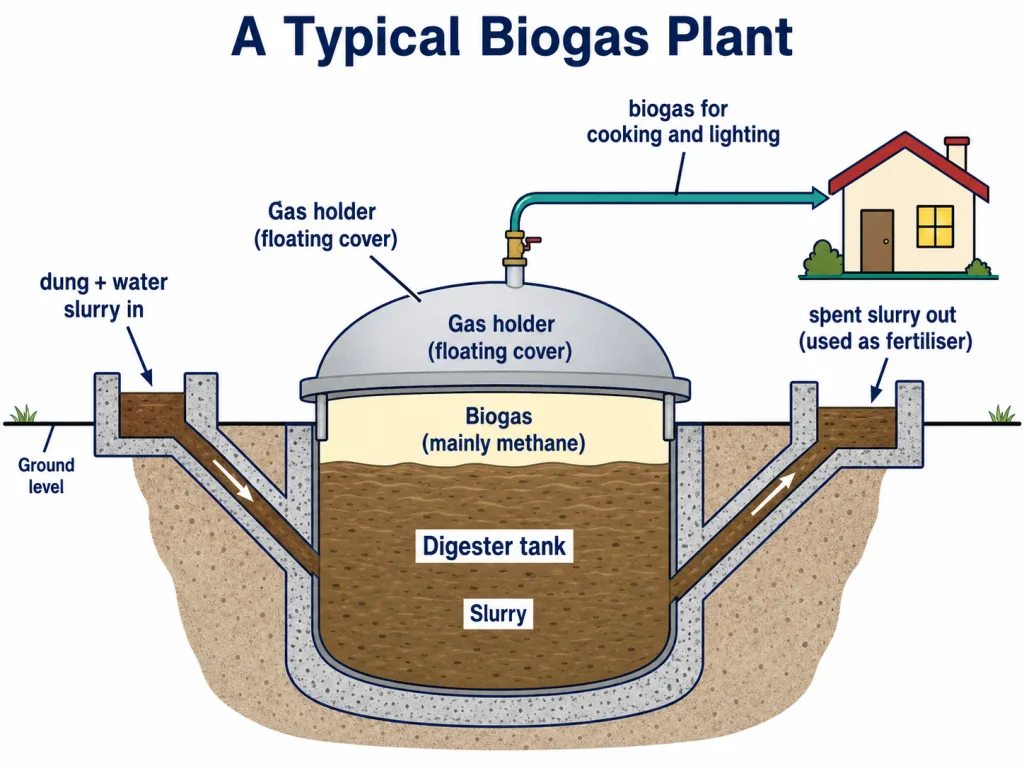
An outlet on the plant is connected to a pipe that carries the biogas to nearby houses, where it is used for cooking and lighting. Nothing is wasted: the spent slurry left behind after the gas is drawn off is removed through a second outlet and used as fertiliser for the fields.
Where and by Whom
Cattle dung is available in large quantities in rural areas, where cattle are kept for many purposes, so biogas plants are most often built in villages. For a rural household, a biogas plant turns an everyday waste into clean fuel for the kitchen and a lamp, with fertiliser as a bonus.
The technology of biogas production was developed in India largely through the efforts of two organisations — the Indian Agricultural Research Institute (IARI) and the Khadi and Village Industries Commission (KVIC).
Quick Recap
- Biogas is a mixture of gases (predominantly methane, with CO2 and H2) made by microbial activity and used as fuel; the gas produced depends on the microbes and the substrate.
- Bacteria that grow anaerobically on cellulosic material produce large amounts of methane and are called methanogens; a common example is Methanobacterium.
- Methanogens occur in the anaerobic sludge of sewage treatment and in the rumen of cattle, where they digest cellulose and aid cattle nutrition.
- Cattle dung (gobar) is rich in methanogens, so it generates biogas, popularly called gobar gas.
- A biogas plant has a concrete tank (10 to 15 feet deep) for dung slurry, a floating cover that rises with the gas, an outlet piping gas to homes for cooking and lighting, and a second outlet for spent slurry used as fertiliser.
- Biogas plants are common in rural areas; the technology was developed in India mainly by IARI and KVIC.
Solved Examples — Section 7
Q1. What is biogas, and which gas is its predominant component?
Answer: Biogas is a mixture of gases produced by microbial activity and used as fuel. Its predominant component is methane, along with carbon dioxide and hydrogen.
Q2. What are methanogens? Give one example.
Answer: Methanogens are bacteria that grow anaerobically on cellulosic material and produce large amounts of methane along with CO2 and H2. A common example is Methanobacterium.
Q3. Name two sites where methanogens are naturally found.
Answer: In the anaerobic sludge during sewage treatment, and in the rumen (a part of the stomach) of cattle.
Q4. Why is cattle dung (gobar) suitable for producing biogas?
Answer: The rumen of cattle is rich in methanogens, so the dung is also rich in these bacteria; this dung can therefore generate biogas, popularly called gobar gas.
Q5. What is the role of the floating cover in a biogas plant?
Answer: It sits over the dung slurry and keeps rising as gas is produced beneath it by microbial activity, collecting the biogas so it can be drawn off through the outlet.
Q6. Which two organisations mainly developed biogas technology in India?
Answer: The Indian Agricultural Research Institute (IARI) and the Khadi and Village Industries Commission (KVIC).