
Curd from Milk
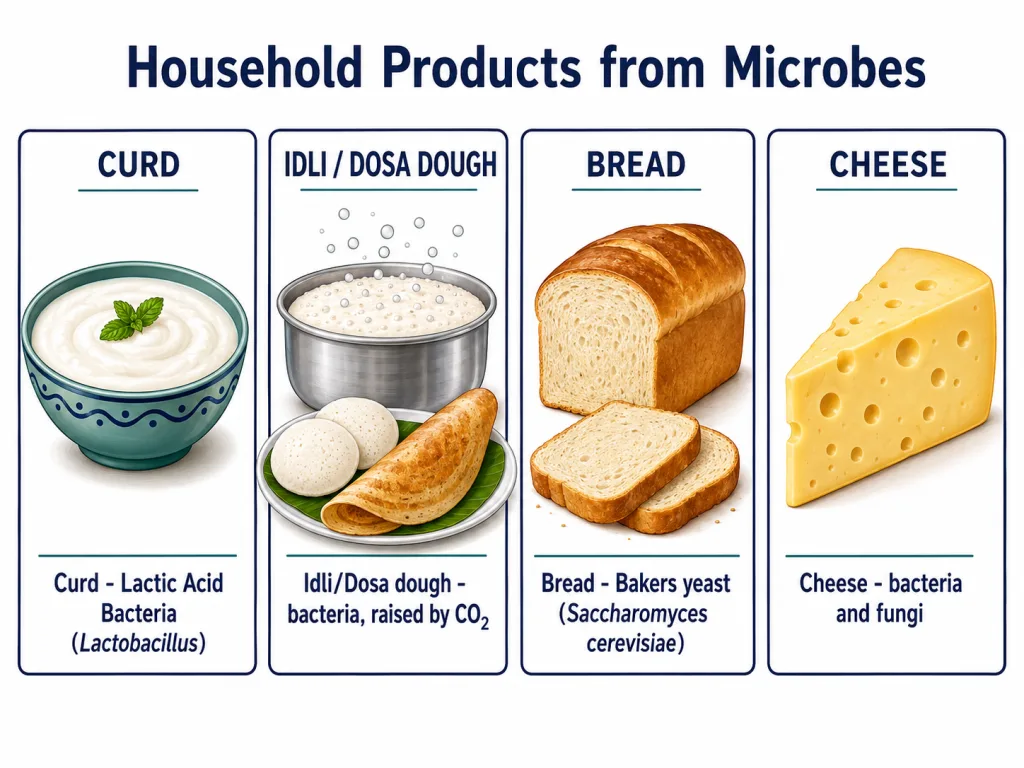
The most familiar household microbe at work is the one that turns milk into curd. Lactobacillus and other bacteria known collectively as lactic acid bacteria (LAB) grow in milk and set it. As they grow they produce acids that coagulate and partially digest the milk proteins, giving curd its thick texture. The starter is simple: a small amount of curd added to fresh milk acts as an inoculum, carrying millions of LAB that multiply at a suitable temperature and convert the whole lot to curd.
Curd is more than set milk. The LAB increase its nutritional quality by raising the amount of vitamin B12. And the same bacteria are useful inside us — in the stomach, LAB help check disease-causing microbes.
Fermented Dough — Idli and Dosa
The batter for foods such as idli and dosa is fermented by bacteria. As they grow, the microbes release carbon dioxide, and it is this gas that gives the dough its puffed-up, spongy appearance. The same principle — trapped CO2 raising a dough — runs through much of household fermentation.
Bread, Toddy and Other Fermented Foods
The dough for bread is fermented using baker's yeast, Saccharomyces cerevisiae, whose activity makes the loaf rise. Traditional drinks and foods rely on fermentation too. Toddy, a traditional drink of parts of southern India, is made by fermenting the sap of palms. Microbes are also used to ferment fish, soybean and bamboo-shoots into various foods.
Cheese
Cheese is one of the oldest foods in which microbes were deliberately used. Its many varieties are distinguished by texture, flavour and taste, and that specificity comes from the particular microbes involved. Two classic examples make the point. The large holes in Swiss cheese are produced by the large amount of CO2 released by a bacterium, Propionibacterium sharmanii. Roquefort cheese is ripened by growing a specific fungus on it, which gives the cheese its distinctive flavour.
Quick Recap
- Curd: Lactobacillus and other lactic acid bacteria (LAB) coagulate milk proteins; a little curd is the inoculum/starter; LAB raise vitamin B12 and, in the stomach, check pathogens.
- Idli/dosa dough is fermented by bacteria; the puffed appearance is due to CO2.
- Bread dough is fermented by baker's yeast, Saccharomyces cerevisiae.
- Toddy is fermented palm sap; fish, soybean and bamboo-shoots are also fermented into foods.
- Cheese: varieties come from specific microbes — Swiss cheese holes from CO2 of Propionibacterium sharmanii; Roquefort ripened by a fungus.
Solved Examples — Section 2
Q1. Which bacteria convert milk into curd, and how?
Answer: Lactic acid bacteria (LAB) such as Lactobacillus. They produce acids during growth that coagulate and partially digest milk proteins, setting the milk into curd.
Q2. How does curd improve on milk nutritionally?
Answer: LAB increase the amount of vitamin B12 in curd, improving its nutritional quality. LAB also help check disease-causing microbes in the stomach.
Q3. Why does idli/dosa dough become puffy?
Answer: Bacteria fermenting the dough release carbon dioxide, and the trapped CO2 gives the dough its puffed-up appearance.
Q4. Which organism ferments bread dough?
Answer: Baker's yeast, Saccharomyces cerevisiae.
Q5. What causes the large holes in Swiss cheese?
Answer: The large amount of CO2 produced by the bacterium Propionibacterium sharmanii.
Q6. How is Roquefort cheese given its characteristic flavour?
Answer: By ripening it through the growth of a specific fungus on the cheese.