
Why Move Away from Chemical Fertilisers
Modern farming has leaned heavily on chemical fertilisers to keep up with the ever-growing demand for food. That reliance comes at a cost. The overuse of these fertilisers has become a major source of environmental pollution, contaminating soil and ground water, and it is now clear that this cannot go on unchecked.
The response to this problem is a shift towards organic farming, and at the heart of that shift are biofertilisers. A biofertiliser is simply an organism that enriches the nutrient quality of the soil. Instead of pouring in manufactured chemicals, the farmer lets living microbes do the work of adding nutrients naturally. The main sources of biofertilisers fall into three groups — bacteria, fungi and cyanobacteria — and each brings something different to the soil.
Bacteria That Fix Nitrogen
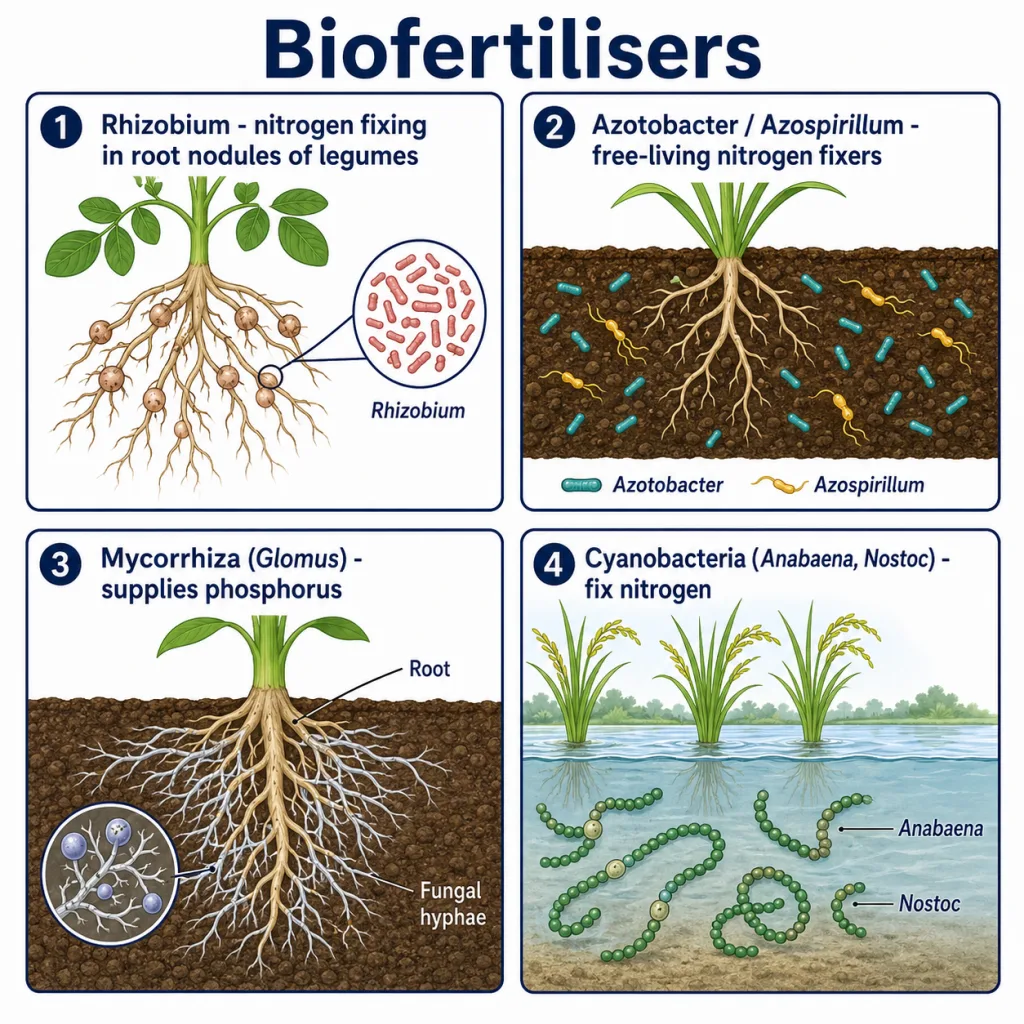
The best-known biofertilisers are nitrogen-fixing bacteria. You have already met Rhizobium, the bacterium that lives in the nodules on the roots of leguminous plants. This is a symbiotic association — the plant houses the bacteria, and in return the bacteria fix atmospheric nitrogen into organic forms that the plant can use as a nutrient. It is one of the neatest partnerships in nature, and it is the reason legumes are so valuable in crop rotation.
Not every nitrogen-fixing bacterium needs a host, however. Some fix atmospheric nitrogen while living free in the soil, without forming any association with roots. Azospirillum and Azotobacter are the standard examples. As they go about their metabolism they steadily enrich the nitrogen content of the soil, benefiting whatever crop is growing there.
Fungi and Mycorrhiza
Fungi contribute in a quite different way. Many form a symbiotic association with the roots of plants known as mycorrhiza, and a large number of the members of the genus Glomus form exactly this kind of partnership.
Here the currency is not nitrogen but phosphorus. The fungal symbiont absorbs phosphorus from the soil and passes it on to the plant, giving the plant access to a nutrient it would otherwise struggle to take up. The benefits do not stop at nutrition. Plants carrying mycorrhizal associations also show resistance to root-borne pathogens, greater tolerance to salinity and drought, and an overall increase in growth and development. A single fungal partner, in other words, makes the plant both better fed and hardier.
Cyanobacteria and Their Role in Paddy Fields
The third group is the cyanobacteria, also called blue-green algae. These are autotrophic microbes, widely distributed across both aquatic and terrestrial environments, and a great many of them can fix atmospheric nitrogen. Common examples include Anabaena, Nostoc and Oscillatoria.
In paddy fields cyanobacteria are especially valuable and serve as an important biofertiliser, quietly adding nitrogen to the waterlogged soil where rice grows. The water fern Azolla, which harbours a nitrogen-fixing cyanobacterial symbiont, is also grown in paddy fields for the same purpose. Beyond fixing nitrogen, blue-green algae also add organic matter to the soil and increase its fertility.
Today a number of biofertilisers are available commercially, and farmers use them regularly in their fields. The pay-off is twofold — the soil's nutrients are replenished naturally, and the farmer's dependence on chemical fertilisers is reduced.
Quick Recap
- Chemical fertilisers, when overused, cause environmental pollution, driving a shift to organic farming using biofertilisers — organisms that enrich the nutrient quality of the soil.
- Main sources: bacteria, fungi and cyanobacteria.
- Rhizobium forms nodules on roots of leguminous plants by symbiosis and fixes atmospheric nitrogen into organic forms for the plant.
- Free-living soil bacteria Azospirillum and Azotobacter fix atmospheric nitrogen, enriching soil nitrogen.
- Fungi of the genus Glomus form mycorrhiza; the fungal symbiont absorbs phosphorus and passes it to the plant, and also gives resistance to root-borne pathogens plus tolerance to salinity and drought.
- Cyanobacteria (Anabaena, Nostoc, Oscillatoria) are autotrophic and fix atmospheric nitrogen; in paddy fields they act as biofertilisers and add organic matter to the soil.
- Biofertilisers replenish soil nutrients and reduce dependence on chemical fertilisers.
Solved Examples — Section 9
Q1. What is a biofertiliser?
Answer: A biofertiliser is an organism that enriches the nutrient quality of the soil. The main sources are bacteria, fungi and cyanobacteria.
Q2. How does Rhizobium act as a biofertiliser?
Answer: Rhizobium forms nodules on the roots of leguminous plants by a symbiotic association and fixes atmospheric nitrogen into organic forms that the plant uses as a nutrient.
Q3. Name two free-living soil bacteria that fix atmospheric nitrogen.
Answer: Azospirillum and Azotobacter; they fix nitrogen while living free in the soil and enrich its nitrogen content.
Q4. What is mycorrhiza, and what nutrient does the fungus supply?
Answer: Mycorrhiza is a symbiotic association between a fungus and plant roots. The fungal symbiont absorbs phosphorus from the soil and passes it to the plant. Members of the genus Glomus commonly form mycorrhiza.
Q5. Give two examples of nitrogen-fixing cyanobacteria and state where they are especially useful.
Answer: Anabaena, Nostoc and Oscillatoria are nitrogen-fixing cyanobacteria. They are especially useful as biofertilisers in paddy fields, where they also add organic matter to the soil.
Q6. Apart from nutrition, what benefits does a mycorrhizal association give the plant?
Answer: Such plants show resistance to root-borne pathogens, tolerance to salinity and drought, and an overall increase in growth and development.