
What Biocontrol Means
Biocontrol refers to the use of biological methods to control plant diseases and pests. In modern farming these problems have increasingly been tackled with chemicals — insecticides, pesticides and weedicides. Such chemicals are toxic and extremely harmful to human beings and animals alike, and they pollute our environment: the soil, the ground water, and the fruits, vegetables and crop plants themselves. Biocontrol offers a way of protecting crops without leaning so heavily on these poisons.
The Organic Farmer's View
Biological control rests on a belief central to organic farming: that biodiversity furthers health. The more variety a landscape has, the more sustainable it is. So the organic farmer does not try to wipe out the insects we call pests. Instead, they are kept at manageable levels by a complex system of checks and balances within a living, vibrant ecosystem.
There is a sound ecological reason for not eradicating pests. The beneficial predatory and parasitic insects that keep pests down depend on those very pests as food or hosts. Remove the pests entirely and these helpful insects cannot survive. Understanding the web of interactions in a field — who preys on whom, their life cycles, feeding patterns and preferred habitats — is what allows appropriate biocontrol to be worked out, and it greatly reduces our dependence on toxic chemicals.
Insect Predators and Bacillus thuringiensis
Some biocontrol agents are simply useful insects. The familiar beetle with red and black markings — the ladybird — is used to get rid of aphids, and dragonflies are useful against mosquitoes.
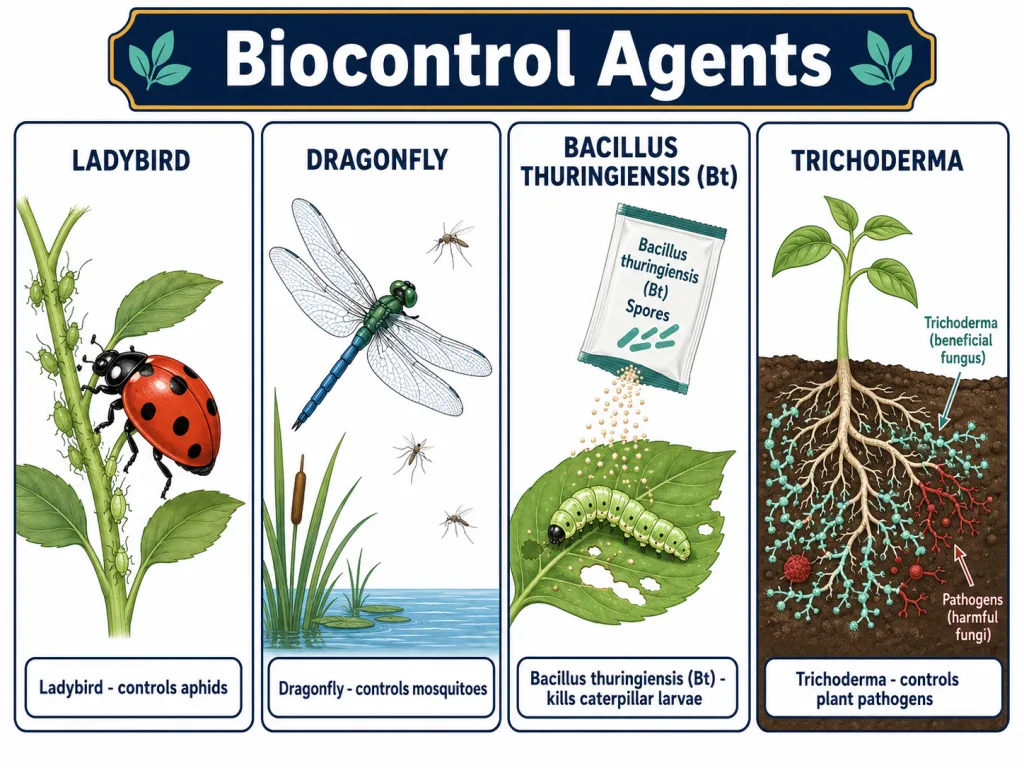
A microbial biocontrol agent used against butterfly caterpillars is the bacterium Bacillus thuringiensis, often written as Bt. It is sold as dried spores in sachets, which are mixed with water and sprayed onto vulnerable plants such as brassicas and fruit trees. The insect larvae eat the sprayed material, and in the gut of the larvae the toxin is released, killing them — while other insects are left unharmed. Using genetic engineering, scientists have introduced Bacillus thuringiensis toxin genes into plants to make them resistant to insect pests; Bt-cotton is one such example.
Trichoderma and Baculoviruses
Biocontrol is not limited to insects and bacteria. The fungus Trichoderma is being developed for the treatment of plant disease. Trichoderma species are free-living fungi that are very common in root ecosystems, and they are effective biocontrol agents of several plant pathogens.
Baculoviruses are pathogens that attack insects and other arthropods. Most baculoviruses used as biological control agents belong to the genus Nucleopolyhedrovirus. These viruses are excellent candidates for species-specific, narrow-spectrum insecticidal applications: they have been shown to have no negative impact on plants, mammals, birds, fish or even on non-target insects. That selectivity makes them especially valuable when beneficial insects are being conserved as part of an Integrated Pest Management (IPM) programme, or when an ecologically sensitive area is being treated.
Quick Recap
- Biocontrol is the use of biological methods to control plant diseases and pests, an alternative to toxic insecticides, pesticides and weedicides that pollute soil, ground water and produce.
- It rests on the organic-farming belief that biodiversity furthers health; pests are kept at manageable levels rather than eradicated, because predatory and parasitic insects need them as food or hosts.
- The ladybird controls aphids; the dragonfly controls mosquitoes.
- Bacillus thuringiensis (Bt) controls butterfly caterpillars; sold as dried spores in sachets, sprayed on plants, eaten by larvae, and the toxin is released in the larval gut to kill them without harming other insects.
- Bt toxin genes have been engineered into plants to make them pest-resistant, for example Bt-cotton.
- The fungus Trichoderma, a free-living fungus of root ecosystems, is an effective biocontrol agent of several plant pathogens.
- Baculoviruses (genus Nucleopolyhedrovirus) are species-specific, narrow-spectrum insecticides with no harm to non-target organisms, ideal for Integrated Pest Management (IPM) and ecologically sensitive areas.
Solved Examples — Section 8
Q1. What is biocontrol?
Answer: Biocontrol is the use of biological methods to control plant diseases and pests, reducing dependence on toxic insecticides, pesticides and weedicides.
Q2. Why does the organic farmer avoid eradicating pests completely?
Answer: Because the beneficial predatory and parasitic insects depend on pests as food or hosts; without the pests these useful insects could not survive. Pests are instead kept at manageable levels by natural checks and balances.
Q3. Which biocontrol agents are used against aphids and mosquitoes?
Answer: The ladybird beetle is used against aphids, and dragonflies are used against mosquitoes.
Q4. How does Bacillus thuringiensis (Bt) kill butterfly caterpillars?
Answer: Bt is sprayed as dried spores mixed with water onto vulnerable plants. The larvae eat it, and in their gut the toxin is released, killing the larvae while leaving other insects unharmed.
Q5. Give one example of a plant made pest-resistant using Bt toxin genes.
Answer: Bt-cotton, made by introducing Bacillus thuringiensis toxin genes into the plant by genetic engineering.
Q6. Why are baculoviruses well suited to Integrated Pest Management?
Answer: They are species-specific, narrow-spectrum insecticides with no negative impact on plants, mammals, birds, fish or non-target insects, so beneficial insects and sensitive areas are protected.