
Magnetism All Around Us
Magnetic phenomena are universal in nature. Vast distant galaxies, the tiny invisible atoms, humans and beasts — all are permeated through and through with a host of magnetic fields from a variety of sources. The earth's magnetism actually predates human evolution!
A bit of history: the word magnet comes from Magnesia, an island in Greece where magnetic ore deposits were found as early as 600 BC.
In Chapter 4 you learned that moving charges (currents) produce magnetic fields — the discovery credited to Oersted, Ampere, Biot and Savart. In this chapter we flip the perspective and study magnetism as a subject in its own right: bar magnets, their behaviour in external fields, Gauss's law of magnetism, and finally how all materials respond to magnetic fields (dia-, para- and ferromagnetism).
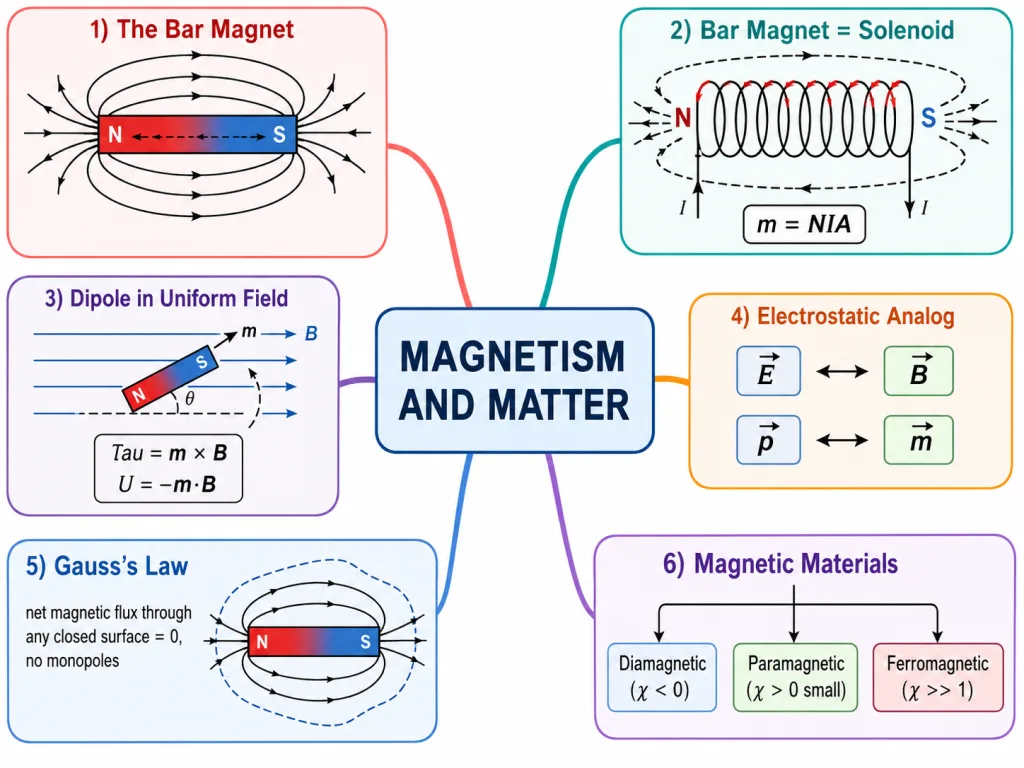
Here's the roadmap: we start with the bar magnet (this section), show it is equivalent to a solenoid, study the torque and energy of a dipole in a uniform field, use the electrostatic analog as a shortcut machine, state Gauss's law for magnetism, and end with magnetisation and the classification of materials.
Five Facts Every Magnet Obeys
Let's begin with the commonly known ideas about magnetism — simple to state, but each one is exam-worthy:
- The earth behaves as a magnet, with its magnetic field pointing approximately from the geographic south to the north.
- A freely suspended bar magnet points in the north-south direction. The tip pointing towards geographic north is called the north pole of the magnet; the tip pointing towards geographic south is the south pole.
- Like poles repel, unlike poles attract. Two north poles (or two south poles) brought close together repel; a north and a south pole attract.
- Magnetic monopoles do not exist. We cannot isolate the north or south pole of a magnet. If a bar magnet is broken into two halves, we get two similar bar magnets with somewhat weaker properties — never a lone pole. This is a sharp contrast with electric charges, which do exist in isolation.
- Magnets can be made from iron and its alloys.
[NEET Important] Fact 4 is the single most quoted line of this chapter: isolated magnetic north and south poles, known as magnetic monopoles, do not exist. It is the physical content of Gauss's law of magnetism (Section 5).
Key Point: Since a freely suspended magnet's north pole points towards the earth's geographic north, and unlike poles attract, the earth's magnetic pole located near the geographic north is actually a magnetic south pole — a favourite trick question!
The Bar Magnet and Its Field Pattern
Sprinkle iron filings on a sheet of glass placed over a short bar magnet and tap gently. The filings arrange themselves in a beautiful, regular pattern.
What does the pattern tell us?
- The magnet has two poles, analogous to the positive and negative charges of an electric dipole.
- The filings concentrate most strongly near the two ends (the poles) — the field is strongest there.
- A similar pattern is observed around a current-carrying solenoid — our first hint that a bar magnet and a solenoid are deeply related (Section 2 makes this exact).
When suspended freely, these poles point approximately towards the geographic north and south poles — which is exactly how the poles got their names.
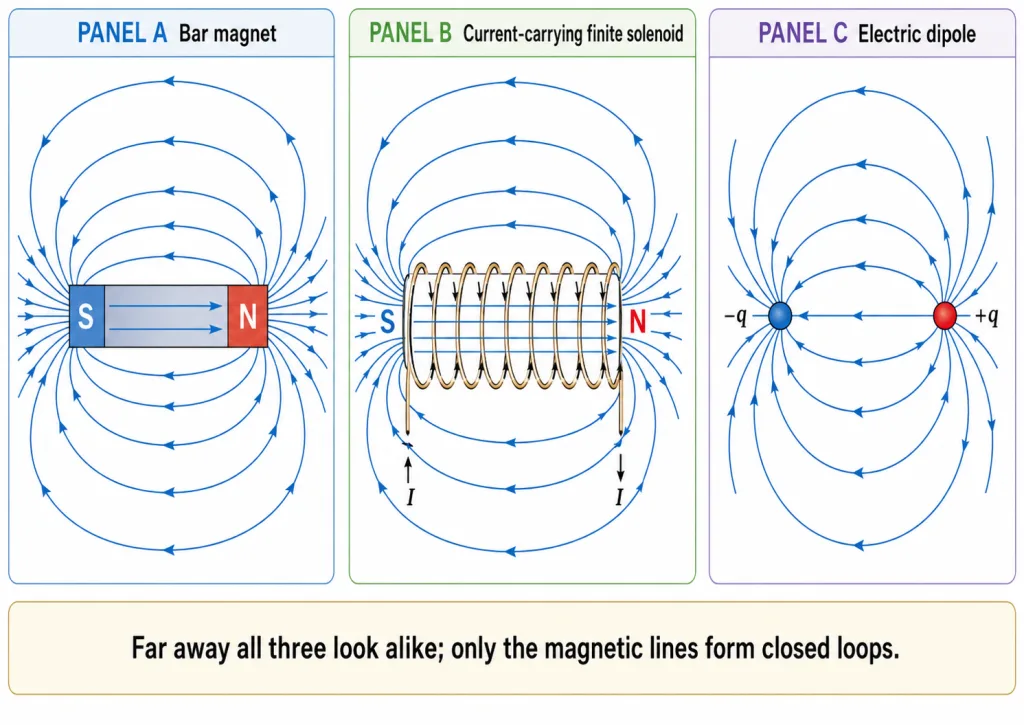
Notice from the figure: at large distances, the field lines of a bar magnet, a finite solenoid and an electric dipole look very similar — all three are dipole fields. The differences show up close-up, especially inside the source.
Properties of Magnetic Field Lines
The iron-filing pattern lets us plot magnetic field lines — a visual and intuitive realisation of the magnetic field. Their four defining properties:
- They form continuous closed loops. A field line of a magnet (or solenoid) leaves the north pole outside, enters the south pole, and continues inside the magnet from S to N, closing the loop. This is unlike the electric dipole, where lines begin on the positive charge and end on the negative charge (or escape to infinity).
- The tangent to a field line at any point gives the direction of the net magnetic field at that point.
- The denser the lines, the stronger the field. The larger the number of field lines crossing per unit area, the larger the magnitude of — that's why the field is strongest near the poles, where lines crowd together.
- Field lines never intersect. If two lines crossed, the field at the intersection point would have two directions — impossible, since the direction of must be unique at every point.
Why not call them 'lines of force'?
Some older books say magnetic lines of force. Modern textbooks deliberately avoid this name: unlike electrostatics, magnetic field lines do NOT give the direction of the force on a moving charge. The magnetic force is , which is perpendicular to , not along it.
[JEE Tip] 'Closed loops' is the discriminator. Electrostatic field lines of any charge configuration can never form closed loops (that would violate the conservative nature of the electrostatic field), while magnetic field lines always do. Statements testing this contrast appear repeatedly in JEE Main and NEET.
Mapping a field with a compass
One practical way to plot field lines: place a small magnetic compass needle at various positions and note its orientation. The needle aligns along at each point, so stepping from needle to needle traces out the field line.
Solved Examples
Example 1: Cutting a bar magnet
What happens if a bar magnet is cut into two pieces (i) transverse to its length, (ii) along its length?
Solution:
- Recall the monopole rule: isolated poles do not exist; every piece of magnetised matter has both poles.
- Apply it: In either case we get two magnets, each with a north and a south pole — somewhat weaker than the original.
- Why: magnetism arises from atomic current loops (dipoles) throughout the material, not from 'pole charges' sitting at the ends. Cutting just regroups the dipoles.
Takeaway: No matter how finely you slice a magnet, you never isolate a pole.
Example 2: Can field lines cross?
Two magnetic field lines are drawn intersecting at a point P. Why is this impossible?
Solution:
- The tangent to a field line at a point gives the direction of there.
- At an intersection point there would be two tangents, i.e. two directions of at the same point.
- The magnetic field at any point is unique, so field lines can never intersect.
Example 3: Earth's pole near geographic north
The north pole of a compass needle points towards the earth's geographic north. What kind of magnetic pole lies near the geographic north?
Solution:
- A compass needle's north pole is attracted towards the earth's geographic north.
- Unlike poles attract, so the pole attracting a north pole must be a magnetic south pole.
- Conclusion: the earth's magnetic pole near the geographic north is a magnetic south pole (and the field points approximately from geographic south to north).
Example 4: Naming the poles
A bar magnet is suspended freely by a thread. End A settles pointing towards geographic north. Which pole is end A?
Solution:
- By definition, the tip of a freely suspended magnet that points towards geographic north is the north pole of the magnet.
- So end A is the north pole; the other end (pointing south) is the south pole.
Example 5: Which bar is magnetised?
Two identical-looking iron bars A and B are given; at least one is magnetised. Using nothing but the two bars, how do you find out whether both are magnetised, and if only one, which one?
Solution:
- The sure test of magnetism is repulsion, not attraction (attraction also happens between a magnet and plain iron via induced magnetism).
- Bring different ends of A and B together in all combinations. If you ever observe repulsion, both bars are magnetised.
- If you observe attraction in every end-to-end arrangement, only one bar is magnetised. To identify it, use the fact that a magnet attracts most strongly near its poles, while the middle region of a bar magnet shows very weak pole action.
- Hold an end of A near the middle of B. Then hold the same end of A near an end of B.
- If A's end attracts the middle of B appreciably, A is the magnet and B is the ordinary iron bar.
- If attraction is weak or negligible at B's middle but strong at B's end, B is the magnet and A is the ordinary iron bar.
Takeaway: Repulsion is the only conclusive test of polarity; attraction alone is not conclusive unless you also compare end and middle behaviour.
Example 6: Closed loops vs open lines
State the key difference between the field lines of a bar magnet and those of an electric dipole, and the reason behind it.
Solution:
- Magnetic field lines form continuous closed loops — outside the magnet from N to S, and inside it from S to N.
- Electric dipole lines begin on the positive charge and end on the negative charge (or go to infinity) — they are open curves.
- Reason: electric charges exist in isolation and act as sources/sinks of field lines; magnetic monopoles do not exist, so magnetic lines have no point to start or end on.
Example 7: Reading an iron-filing pattern
In the iron-filing pattern of a bar magnet, the filings are dense near the ends and sparse near the middle. What does this say about the field?
Solution:
- The number of field lines crossing per unit area is proportional to the magnitude of .
- Dense filings near the poles mean a strong field near the poles; sparse filings near the middle of the magnet's sides mean a weak field there.
- This is also why a magnet picks up pins with its ends, not its middle.
Example 8: Why avoid 'lines of force'?
Why is the term 'magnetic lines of force' avoided for magnetic field lines?
Solution:
- In electrostatics, the force on a charge is — along the field line. The name 'line of force' makes sense there.
- In magnetism, the force on a moving charge is — perpendicular to (and to ), never along the field line.
- So magnetic field lines do not indicate the direction of force on a (moving) charge — calling them 'lines of force' would be misleading.
Example 9: Breaking a magnet into three
A bar magnet is broken transverse to its length into three equal pieces. How many poles and how many magnets result?
Solution:
- Each break creates a fresh pair of opposite poles at the broken faces (monopoles cannot exist).
- Three pieces result, and each piece is a complete magnet with its own N and S pole.
- Count: 3 magnets, 6 poles in total (each weaker than the original magnet).
Example 10: Compass mapping
Describe how a small compass needle can be used to map the magnetic field of a bar magnet, and what the needle reads at each point.
Solution:
- Place the compass at a point near the magnet; the needle aligns itself along the direction of the net at that point (its north tip pointing along the field).
- Move the compass a small step in the direction the needle indicates, and repeat. The chain of positions traces a field line.
- Repeating from different starting points maps the whole pattern — the experimental counterpart of the iron-filing picture.