
Three Magnetic Personalities
With , and in hand, every material falls into one of three classes ( is a small positive number):
| Property | Diamagnetic | Paramagnetic | Ferromagnetic |
|---|---|---|---|
| Susceptibility | |||
| Relative permeability | |||
| Permeability |
A remarkable fact: a minuscule difference in produces radically different behaviour — diamagnets sit near while paramagnets sit near , yet one is repelled and the other attracted by a magnet.
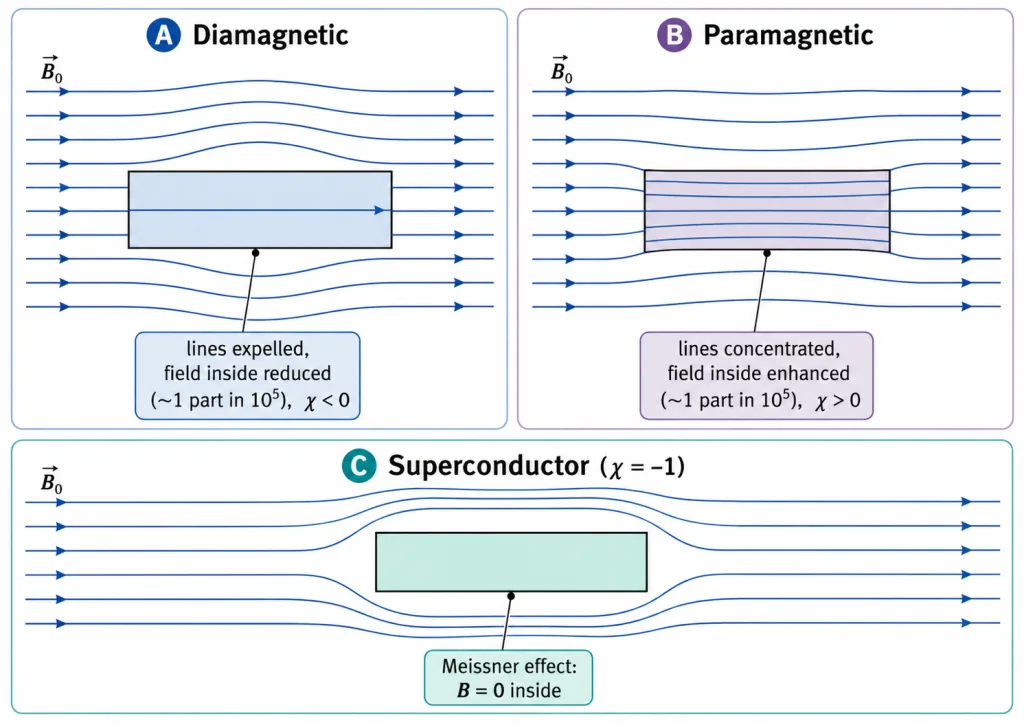
Memory hook: dia = drives lines away, para = pulls lines in (weakly), ferro = floods lines in (massively).
Diamagnetism
Behaviour: diamagnetic substances tend to move from the stronger to the weaker part of an external field — a magnet weakly repels them. Placed in a field, the field lines are repelled/expelled, and the field inside is reduced — typically by just one part in .
Mechanism: in a diamagnetic atom, the resultant magnetic moment is zero (orbital moments cancel). When a field is applied, electrons whose orbital moment lies along the field slow down, and those opposite speed up — an induced-current effect obeying Lenz's law (you'll meet it properly in Chapter 6). The atom thus acquires a net moment opposite to the applied field — hence repulsion.
Examples: bismuth, copper, lead, silicon, nitrogen (at STP), water, sodium chloride.
Key Point: Diamagnetism is present in all substances. But the effect is so weak that it is masked whenever stronger effects (para- or ferromagnetism) are present.
Superconductors: perfect diamagnets
The most exotic diamagnets are superconductors — certain materials cooled below their superconducting transition temperature, showing both perfect conductivity and perfect diamagnetism. Field lines are completely expelled:
This total expulsion is the Meissner effect. A superconductor repels a magnet and is, by Newton's third law, repelled by it — an important idea behind magnetic levitation demonstrations and superconducting maglev systems.
[JEE Tip] means , so inside a superconductor. 'What is B inside a perfect diamagnet?' — Zero. Instant mark.
Paramagnetism
Behaviour: paramagnetic substances get weakly magnetised along the field and tend to move from weak field to strong field — they are weakly attracted to a magnet. Field lines get concentrated inside the material (enhancement again ~1 part in ).
Mechanism: each atom (or ion or molecule) of a paramagnetic material has a permanent magnetic dipole moment of its own. Ceaseless random thermal motion keeps these moments scrambled — no net magnetisation in zero field. Apply a strong external field at low temperature, and the dipoles begin to align with it.
Examples: aluminium, sodium, calcium, oxygen (at STP), copper chloride.
Two behaviours worth flagging:
- For a paramagnet, and depend on the temperature as well as the material — increasing field or lowering temperature increases the magnetisation.
- Saturation: at very high field / very low temperature, reaches a maximum value when all dipoles are perfectly aligned — beyond that, no further increase.
[NEET Important] Oxygen at STP is paramagnetic, while nitrogen at STP is diamagnetic — the single most-tested 'identify the odd one' pair from this section.
Ferromagnetism
Behaviour: ferromagnetic substances get strongly magnetised in an external field, and move strongly from weak to strong field regions. Field lines inside are highly concentrated (!).
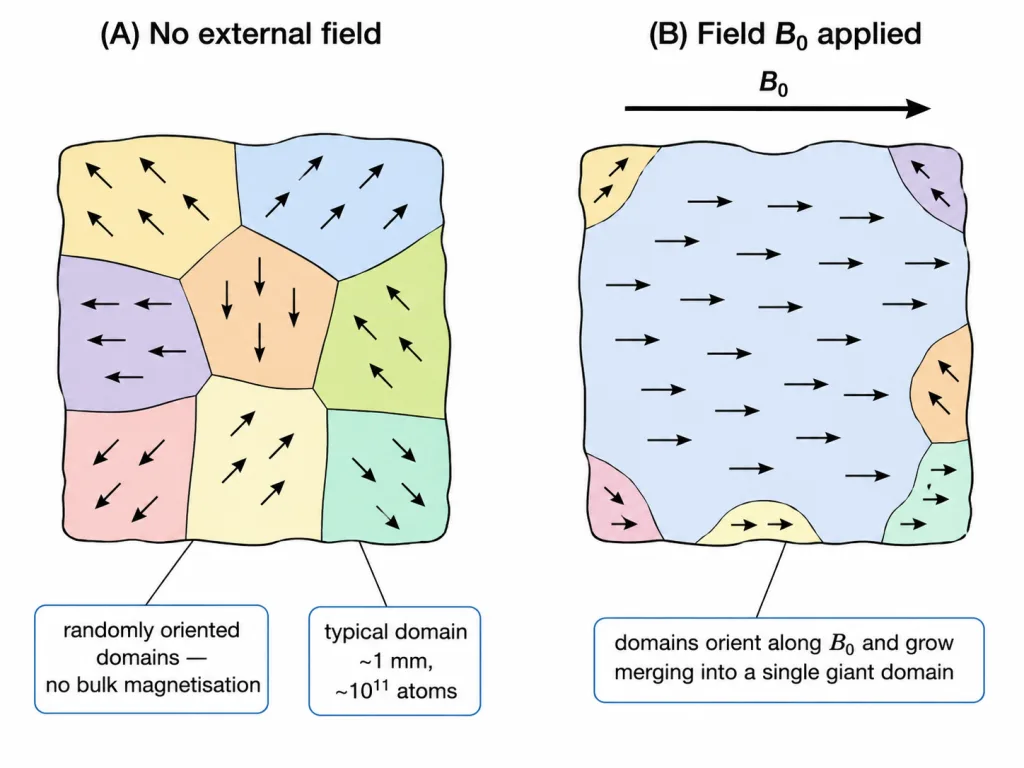
Mechanism — domains: the atoms possess permanent dipole moments (as in a paramagnet), but here they interact cooperatively and spontaneously align over macroscopic regions called domains. A typical domain is about 1 mm in size and contains roughly atoms. (The full explanation of this cooperative effect needs quantum mechanics.)
- Zero applied field: domains are randomly oriented — no bulk magnetisation.
- Field applied: domains orient along and the aligned domains grow at the expense of others, ultimately merging into a single 'giant' domain. (Domain motion is real — observable under a microscope with a liquid suspension of powdered ferromagnetic material.)
Hard and soft ferromagnets
- Hard ferromagnets retain their magnetisation when the field is removed — e.g. Alnico (alloy of iron, aluminium, nickel, cobalt, copper) and naturally occurring lodestone. These make permanent magnets (compass needles!).
- Soft ferromagnets lose almost all of their magnetisation when the field is removed — e.g. soft iron. Ideal wherever you want magnetism on demand (cores you can switch).
Examples of ferromagnetic elements: iron, cobalt, nickel, gadolinium.
Temperature behaviour
Ferromagnetism depends on temperature: at high enough temperature, the domain structure disintegrates and the ferromagnet becomes a paramagnet. This disappearance of magnetisation with temperature is gradual.
Curie's law and the Curie temperature [NEET Important]
Cooling a paramagnet quietens thermal jostling, so the dipoles align better and magnetisation grows. Experimentally, for small :
where is the Curie constant and the absolute temperature. So : halve the temperature and the susceptibility doubles. At large the law breaks down — once every dipole is aligned, saturates and cannot grow further.
The temperature at which a ferromagnet's domain structure disintegrates is its Curie temperature (for iron, K). Above the material is paramagnetic, with susceptibility given by the modified Curie-Weiss law:
[JEE Tip] Two favourite traps: (1) holds for paramagnets only — diamagnetic susceptibility is nearly temperature-independent. (2) Just above , is large (the denominator is small) and it falls as the material is heated further.
Solved Examples
Example 1: Classify by susceptibility
Three materials have , and . Classify them.
Solution:
- : small and negative — diamagnetic (e.g. copper).
- : small and positive — paramagnetic (e.g. aluminium).
- — ferromagnetic (e.g. iron).
- Corresponding : just below 1, just above 1, and about 2401.
Example 2: Why don't we notice diamagnetism everywhere?
Diamagnetism exists in all substances. Why is it observed so rarely?
Solution:
- The diamagnetic response is tiny — field changes of about 1 part in .
- If atoms also have permanent moments, the (stronger) paramagnetic or (far stronger) ferromagnetic response masks it.
- Diamagnetism stands out only in materials whose atoms have zero net moment — bismuth, copper, water, NaCl, nitrogen at STP.
Example 3: Field inside a superconductor
A superconducting sample sits in an external field intensity H. Using , find M and B inside.
Solution:
- — magnetisation exactly cancels the intensity.
- .
- Answer: B = 0 inside: complete expulsion of field lines — the Meissner effect, perfect diamagnetism ().
Example 4: Cooling a paramagnet vs a diamagnet
What happens to the magnetisation of (a) a paramagnetic and (b) a diamagnetic sample when cooled (same applied field)?
Solution:
- (a) Paramagnetic alignment fights thermal randomisation; cooling weakens the competition, so increases (towards saturation at very low T).
- (b) Diamagnetism arises from induced orbital changes, not from aligning permanent moments — it is nearly temperature-independent.
- Takeaway: temperature dependence is a fingerprint distinguishing the two weak magnetisms.
Example 5: Behaviour in a non-uniform field
A diamagnetic bar and a paramagnetic bar are placed in turn in the non-uniform field near a strong magnet's pole. How does each move?
Solution:
- Diamagnetic: acquires moment opposite to the field; moves from the stronger to the weaker field region — pushed away from the pole.
- Paramagnetic: acquires moment along the field; moves from weaker to stronger field — weakly pulled toward the pole.
- A ferromagnetic bar would do the same as the paramagnet but strongly.
Example 6: Choosing hard vs soft
You need (a) a compass needle / permanent magnet, (b) a core whose magnetisation should become negligibly small soon after the field is switched off. Which class of ferromagnet suits each, with examples?
Solution:
- (a) Hard ferromagnet — retains magnetisation after the field is removed: Alnico or lodestone.
- (b) Soft ferromagnet — magnetisation becomes very small on removing the field: soft iron.
- Reason: 'hard' and 'soft' describe precisely whether the magnetisation persists strongly or dies down quickly when .
Example 7: Estimating a domain's magnetic moment
A ferromagnetic domain contains about atoms, each contributing an atomic moment of about A m. Estimate the domain's moment when fully aligned.
Solution:
- Within a domain the moments are spontaneously parallel, so they add directly.
- A m.
- Takeaway: a single mm-sized domain is already a small magnet — bulk magnetisation is just domain bookkeeping.
Example 8: Heating a ferromagnet
What happens to a ferromagnet at high enough temperature, and how does the change occur?
Solution:
- Thermal agitation disintegrates the domain structure.
- The material becomes paramagnetic — moments persist atom-by-atom but no longer cooperate.
- The disappearance of magnetisation with temperature is gradual (not a sudden switch-off).
Example 9: Oxygen vs nitrogen
At STP, which of oxygen and nitrogen is attracted into a strong magnetic field, and why?
Solution:
- Oxygen molecules have permanent magnetic moments — O at STP is paramagnetic — so oxygen is weakly drawn into the stronger field.
- Nitrogen at STP is diamagnetic — weakly pushed out.
- (Liquid oxygen visibly sticking between magnet poles is the classic demonstration.)
Example 10: What does buy you?
A solenoid produces T when empty. Estimate B if it is filled with a ferromagnetic core of .
Solution:
- With the core (same current, same H), using the ideal linear estimate and ignoring saturation: .
- T.
- Takeaway: ferromagnetic cores can multiply fields enormously — the reason practical electromagnets use a ferromagnetic core.