
Magnetisation: How Strongly Is a Sample Magnetised?
The world is full of elements, compounds and alloys — and we'd like to classify how each responds to a magnetic field. This section builds the vocabulary for that.
Recall that a circulating electron in an atom has a magnetic moment. In a bulk material these atomic moments add vectorially, and the sample can end up with a net moment. We define the magnetisation of a sample as its net magnetic moment per unit volume:
- is a vector.
- Dimensions: LA; SI unit: A m (ampere per metre).
Quick feel for it: a 1 cm sample ( m) with net moment A m has A/m.
A Solenoid With a Core
Consider a long solenoid, turns per unit length, current . From Chapter 4, the interior field (vacuum inside) is
Now fill the interior with a material of non-zero magnetisation. The field inside changes because the magnetised material contributes its own magnetic field:
For the long-solenoid geometry used here, the material contribution is
where is the same vacuum permeability that appears in the Biot-Savart law. If is along the solenoid field, becomes larger than ; if is opposite to it, as in diamagnetic response, becomes slightly smaller.
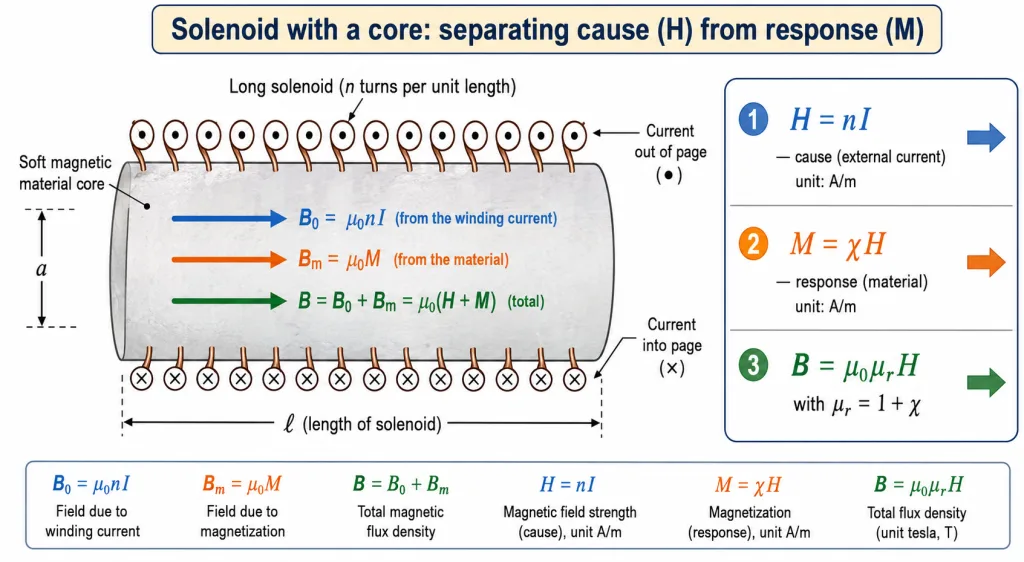
So the total field has two distinct parents: the external current (giving ) and the material's own response (giving ). Keeping these separate is exactly what the next quantity is for.
Magnetic Intensity H: Separating Cause From Response
Define the magnetic intensity by
so that the total field can always be written as
For a long solenoid where all vectors are along the axis, this is often written in scalar form as , with signs/directions understood.
The partition is beautifully clean:
- represents the part due to external factors — the free current in the windings. For our solenoid, , whether or not a core is present.
- represents the part due to the specific nature of the magnetic material.
- has the same dimensions as : unit A m.
Key Point: Same coil, same current — same . Insert a core and may grow hundreds of times, but doesn't budge. is the cause; is the material's response; is the total effect.
[NEET Important] Be careful with the trio of names: = magnetic field (tesla), = magnetic intensity (A/m), = magnetisation (A/m). Mixing up their units is the classic trap.
Susceptibility, Relative Permeability, Permeability
How strongly does the material respond to a given ? For most linear magnetic materials, especially diamagnetic and paramagnetic materials in ordinary fields, the response is written as
where is the magnetic susceptibility — dimensionless, a pure number measuring how a material responds to an external field.
- small and positive (about ): paramagnetic ( along ).
- small and negative (about ): diamagnetic ( opposite to ).
Substituting into for a linear isotropic material:
where
- = relative magnetic permeability: dimensionless, the magnetic analog of the dielectric constant in electrostatics.
- = magnetic permeability: same dimensions and units as (T m A).
[JEE Tip] , and are interrelated — only one is independent. Given any one, write the other two instantly: , . Exam questions love disguising this one-liner as a hard problem.
Solved Examples
Example 1: H inside a cored solenoid
A solenoid has 1000 turns per metre and carries a current of 2.0 A. Its core has relative permeability 400. Find the magnetic intensity H inside.
Solution:
- Key fact: depends only on the free current, not on the core: .
- A/m.
- Answer: A/m — identical with or without the core.
Example 2: The field B inside
For the same solenoid, find the magnetic field B inside the core.
Solution:
- Formula: .
- .
- ; times 400 gives about 1.0.
- Answer: T — the core boosts the field 400-fold.
Example 3: Magnetisation of the core
Find the magnetisation M of the core in the previous example.
Solution:
- From the master relation: .
- A/m.
- Check the hierarchy: here — in a strongly magnetic core, almost all of B comes from the material itself.
Example 4: The magnetising current
What additional current , passed through the same windings without the core, would produce the same B?
Solution:
- Set up: with T.
- A.
- With A: A.
- Takeaway: the core does the work of an extra 794 A! That's why electromagnets use iron cores instead of monstrous currents.
Example 5: From susceptibility to the rest
A material has magnetic susceptibility . Find its relative permeability and permeability, and classify it.
Solution:
- .
- T m/A.
- is small and positive: the material is paramagnetic.
Example 6: Magnetisation from moment and volume
A sample of volume m has a net magnetic moment of A m. Find its magnetisation.
Solution:
- Formula: .
- A/m.
- Answer: A/m along the direction of the net moment.
Example 7: Paramagnetic response numerical
Aluminium has . A field intensity A/m is applied. Find M and B inside the sample.
Solution:
- A/m — tiny but along H.
- T.
- The correction from the material is just 2.3 parts in — paramagnetism is weak.
Example 8: Diamagnetic response
For copper, . With the same A/m, what are M and B?
Solution:
- A/m — opposite to H (the meaning of negative ).
- is slightly less than : reduced by about 1 part in .
- Takeaway: in diamagnets, M opposes H, so the material slightly expels the field.
Example 9: Finding H from B in a core
The field inside a material of relative permeability 1000 is 0.5 T. Find H and M.
Solution:
- A/m.
- A/m.
- Sanity check: T. Consistent.
Example 10: Why bother with H at all?
A student asks: 'B already describes the field. Why invent H?'
Solution:
- inside matter mixes two contributions — the coil's current and the material's response — which change together when you swap cores.
- isolates what the experimenter controls: for a solenoid , fixed by the winding and current alone.
- Given and the material's , everything follows: , . One controlled input, one material property, total field predicted.