
The Translation Dictionary
Here's one of the most elegant shortcuts in Class 12 physics. The far field of a bar magnet has exactly the same mathematical form as the field of an electric dipole. So every result you derived in Chapter 1 can be translated into magnetism with three replacements:
The complete dipole analogy:
| Quantity | Electrostatics | Magnetism |
|---|---|---|
| Constant in dipole-field formula | ||
| Dipole moment | ||
| Equatorial field (short dipole) | ||
| Axial field (short dipole) | ||
| Torque in external field | ||
| Energy in external field |
[JEE Tip] Don't memorise magnetism formulas separately — memorise the dictionary. One table, two chapters.
Axial and Equatorial Fields of a Bar Magnet
For a bar magnet of size and moment , at distance from its centre:
Equatorial field (on the perpendicular bisector):
Axial field (on the axis):
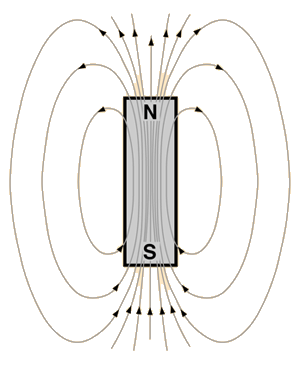
Read the signs carefully — they carry the physics:
- On the axis, is parallel to . On the N-side axial point it points away from the N pole; on the S-side axial point it points towards the S pole, but in both cases it is parallel to .
- On the equator, is antiparallel to — the minus sign! A compass on the perpendicular bisector points opposite to the magnet's moment.
- At the same distance, the axial field magnitude is twice the equatorial field magnitude: .
- Both fall as — the universal dipole signature.
[NEET Important] If a short bar magnet's axial field at distance equals its equatorial field at distance , then setting gives . This is a common exam-pattern comparison.
Two Dipoles Together
Place a dipole Q near a fixed dipole P. Q sits in P's field , so its energy is . The rules:
- Equilibrium is stable when is parallel to , unstable when antiparallel.
- On P's axis, points along (strength ).
- On P's normal bisector, points opposite to (strength ).
So at the same distance :
| Position of Q | Orientation of | Equilibrium | Energy |
|---|---|---|---|
| On axis | parallel to | Stable | (lowest!) |
| On axis | antiparallel to | Unstable | |
| On bisector | antiparallel to | Stable | |
| On bisector | parallel to | Unstable | |
| Either place | perpendicular to | Not in equilibrium (torque acts) | 0 |
The lowest-energy configuration of all: Q on the axis with both moments aligned — because the axial field is twice as strong.
[JEE Tip] At a general point at angle from the axis (distance ), the magnitude is — it interpolates between -type (axis, ) and -type (equator, ). Beyond board level, but standard in JEE.
Solved Examples
Example 1: Axial field of a short magnet
A short bar magnet has magnetic moment 0.48 J/T. Find the magnetic field at a distance of 10 cm from its centre on the axis.
Solution:
- Formula: with T m/A.
- Substitute: m, m: .
- Calculate: T.
- Answer: T (0.96 gauss), directed along the moment (from S to N).
Example 2: Equatorial field of the same magnet
For the same magnet, find the field at 10 cm on the equatorial (perpendicular bisector) line.
Solution:
- Magnitude formula: — half the axial value at the same . Vectorially, is opposite to .
- T.
- Answer: T (0.48 gauss), directed opposite to the moment .
Example 3: Where do axial and equatorial fields match?
At what distance on the axis does a short magnet produce the same field magnitude as it produces at 10 cm on the equator?
Solution:
- Set equal: with m.
- , so m.
- Answer: cm.
Example 4: Compass direction on the bisector
A compass is placed on the perpendicular bisector of a short bar magnet, far from it. Which way does its north tip point?
Solution:
- On the equatorial line, — antiparallel to .
- The compass aligns along the local field, so its north tip points opposite to the magnet's moment (i.e. in the N-to-S direction of the magnet).
- On the axis it would instead point along .
Example 5: Stable configurations of two needles
Dipole Q is placed at distance from dipole P, either on P's axis or on its normal bisector, with parallel or antiparallel to . Which configurations are in stable equilibrium?
Solution:
- Rule: stable when at Q's location.
- On the axis: . Stable when is parallel to .
- On the bisector: is antiparallel to . Stable when is antiparallel to .
- The reversed orientations in each position are unstable; perpendicular orientations are not equilibria at all (torque acts).
Example 6: The lowest-energy configuration
Among all the stable configurations of Example 5 (same ), which has the lowest potential energy?
Solution:
- , so the lowest energy needs the largest .
- The axial field () is twice the equatorial field ().
- Answer: Q on P's axis with moments parallel: — twice as negative as the bisector case.
Example 7: Interaction energy numerical
Two short magnets, each of moment 1.0 A m, are coaxial with their moments aligned, centres 1.0 m apart. Find their interaction energy.
Solution:
- Field of magnet 1 at magnet 2 (axial): T.
- Energy: .
- Answer: J. Negative — the aligned coaxial pair is bound (stable).
Example 8: Translating an electrostatics result
The electric field of a short dipole at a general point is . Write the magnetic counterpart.
Solution:
- Apply the dictionary: , , .
- Answer: .
- Check the limits: gives (axial); gives (equatorial). The dictionary works perfectly.
Example 9: Field at a general point (JEE pattern)
A short magnet has moment 1.0 A m. Find the field magnitude at 10 cm from its centre, at 60 degrees from the axis.
Solution:
- Formula: .
- , so , .
- T.
- Answer: T.
Example 10: Same field, two distances
The equatorial field of a magnet at 5 cm is . At what axial distance is the field also ?
Solution:
- and we need .
- Dividing: , so cm cm.
- Takeaway: the factor 2 always shows up as a stretch in distance.