
Ampere's Hypothesis: All Magnetism Is Circulating Currents
In Chapter 4 (Section 4.9) we saw that a current loop acts as a magnetic dipole, with magnetic moment
where is the number of turns, the current and the loop area. Ampere's hypothesis takes this idea all the way: all magnetic phenomena can be explained in terms of circulating currents. A bar magnet, on this view, is nothing mysterious — it is a large number of tiny circulating currents at the atomic level, stacked together just like the turns of a solenoid.
The evidence for the analogy:
- The field-line patterns of a bar magnet and a finite solenoid are strikingly similar (Section 1).
- Cutting a bar magnet in half is like cutting a solenoid — you get two smaller solenoids with weaker magnetic properties. The field lines remain continuous, emerging from one face and entering the other. This neatly explains why you can never isolate a pole!
- Move a small compass needle around a bar magnet and around a current-carrying finite solenoid: the deflections are similar in both cases.
Key Point: Poles are a convenient model; the deeper source of magnetism is current. The 'north face' of a solenoid is simply the face where the current appears anticlockwise (recall the clock rule from Chapter 4).
The magnetic moment vector of a bar magnet points from its south pole to its north pole inside the magnet — exactly like the area vector of the equivalent current loops.
The Axial Field of a Finite Solenoid
To make the analogy firm, let's compute the field of a finite solenoid at a faraway point P on its axis and show that it matches a bar magnet's far axial field.
Setup: a solenoid of radius , length , with turns per unit length carrying current . P lies on the axis at distance from the centre, with and .
The result:
where the total magnetic moment is — i.e. (total turns) (current) (area), which is just again.
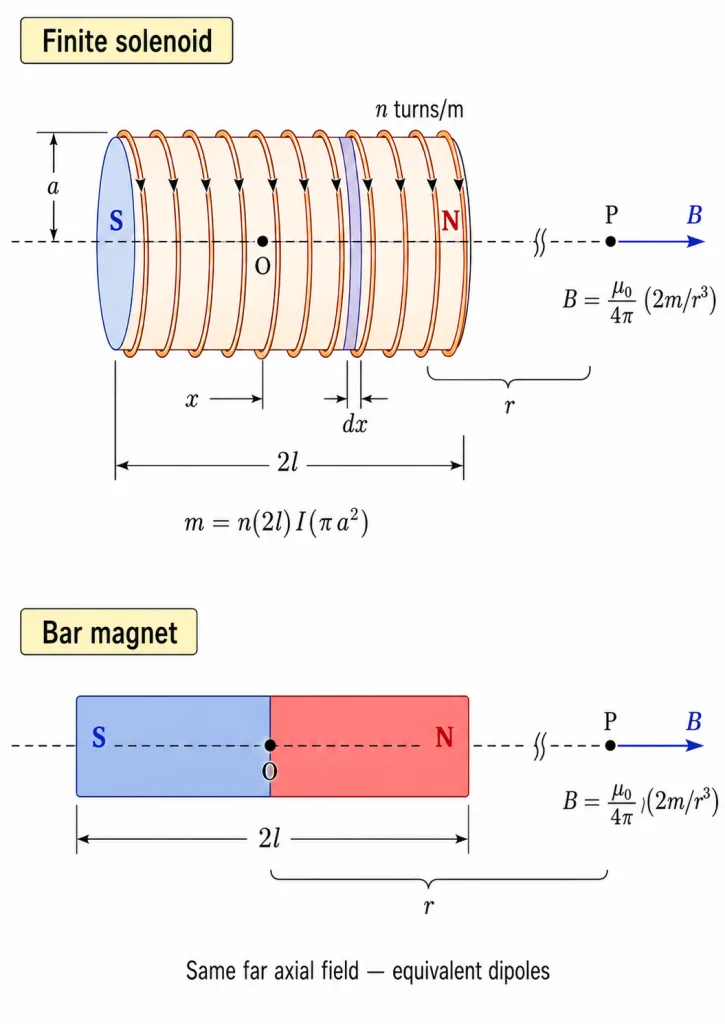
[JEE Tip] The derivation (good for building skill, though exams need only the final result): treat a slice of thickness at distance from the centre as a circular loop of turns. Its axial field at P is . For the denominator is approximately , so integrating from to gives .
This is also the far axial field of a bar magnet measured experimentally. Same far-field formula, same fall-off, and in the far-field dipole approximation, the same dipole field pattern: the bar magnet and the solenoid are equivalent magnetic dipoles.
What 'Equivalent' Really Means
The equivalence is quantitative, not just visual:
The magnetic moment of a bar magnet is equal to the magnetic moment of an equivalent solenoid that produces the same far-field magnetic dipole behaviour.
Three practical consequences:
- You can measure of a short magnet from its far axial field. Measure on the axis at a large distance ; then .
- The signature. A dipole field falls off as — much faster than the of a point charge's electric field. Double the distance and the axial field drops by a factor of 8.
- Cutting rules follow automatically. Cut a bar magnet transverse to its length: each half is a solenoid with half the turns, so halves. Cut it along its length: each half has half the loop area, so halves again. Either way you always get complete, weaker magnets.
[NEET Important] The SI unit of magnetic moment is A m (ampere metre squared), equivalently J/T (joule per tesla) — both appear in NEET options. Verify: has joules when is in J/T and in tesla, and has A m. They are the same unit.
Useful constant for numericals: T m A.
Solved Examples
Example 1: Magnetic moment of a solenoid
A closely wound solenoid of 2000 turns and cross-sectional area m carries a current of 4.0 A. What is its magnetic moment?
Solution:
- Formula: .
- Substitute: .
- Calculate: ; .
- Answer: A m, directed along the solenoid axis (S face to N face).
Takeaway: This solenoid behaves like a bar magnet of moment 1.28 J/T in the dipole approximation.
Example 2: Far axial field of the same solenoid
Find the magnetic field on the axis of the above solenoid ( A m) at a distance of 20 cm from its centre (far compared to its size).
Solution:
- Formula: .
- Substitute: m, so m. .
- Calculate: ; T.
- Answer: T along the axis.
Example 3: Cutting a solenoid (and a magnet)
A bar magnet of moment is cut into two equal halves (i) transverse to its length, (ii) along its length. What is the moment of each piece?
Solution:
- Model the magnet as a solenoid of N turns, current I, area A, with .
- (i) Transverse cut: each half is a solenoid of turns, same , same : .
- (ii) Lengthwise cut: each half keeps all N 'turns' but with half the cross-sectional area: .
- Answer: in both cases — and each piece is still a complete magnet.
Example 4: The fall-off
The axial field of a short bar magnet at 10 cm from its centre is . What is it at 20 cm?
Solution:
- For a dipole, on the axis (far field).
- Distance doubles: , so .
- Answer: . Doubling distance costs a factor of 8 — the dipole signature.
Example 5: Measuring a magnet's moment from its field
The magnetic field on the axis of a short bar magnet, 0.5 m from its centre, is measured to be T. Find the magnetic moment of the magnet.
Solution:
- Formula (rearranged): from , we get .
- Substitute: m, so .
- Calculate: numerator ; dividing by gives .
- Answer: A m. This is how a magnet's moment can be determined experimentally from its far axial field.
Example 6: Doubling turns and current
A solenoid's number of turns is doubled and its current halved, keeping geometry fixed. What happens to (a) its magnetic moment, (b) its far axial field at a fixed point?
Solution:
- : with and , — unchanged.
- depends only on and , so is unchanged too.
- Takeaway: the far field cares only about the product , not the individual factors.
Example 7: Moment from solenoid geometry
A solenoid has 500 turns per metre, length 10 cm, radius 1.0 cm, and carries 2.0 A. Treating it as a bar magnet, find its magnetic moment.
Solution:
- Total turns: turns.
- Area: m.
- Moment: A m.
- Answer: A m along the axis. This is the of the equivalent-solenoid derivation.
Example 8: Same far-field deflection test
A compass needle is moved in the far-field region around box X and box Y. X contains a short bar magnet; Y contains an equivalent current-carrying solenoid with the same magnetic moment. Can the compass tell which is which from the far-field pattern alone?
Solution:
- The far field of a bar magnet and that of an equivalent solenoid are the same dipole field.
- The compass responds only to the local magnetic field, so in the far-field dipole approximation the deflection patterns are the same.
- Answer: No — from far-field compass measurements alone, X and Y are indistinguishable. Very close to the objects, detailed fields may depend on geometry, but the equivalence meant here is the dipole/far-field one.
Example 9: Ratio of axial fields of two magnets
Two short bar magnets have moments and . At what distance ratio do they produce equal axial fields?
Solution:
- Equal fields: .
- So , i.e. .
- Answer: the stronger magnet produces the same field about 26% farther away.
Example 10: Why the lines stay continuous when you cut
When a solenoid is cut into two, why do the field lines remain continuous closed loops through each piece?
Solution:
- Each piece is itself a stack of complete current loops — a smaller solenoid.
- Field lines of any current distribution form closed loops; there are no magnetic monopoles to start or end them.
- So each half develops its own N and S faces, with lines emerging from one face, looping around, entering the other face and continuing inside. The same logic explains why cutting a bar magnet never isolates a pole.