
Torque on a Magnetic Dipole
Place a small compass needle of known magnetic moment in a uniform magnetic field and let it oscillate. What does the field do to it?
In a uniform field, the needle experiences no net force — but it does experience a torque:
In magnitude,
where is the angle between and .
Key features to internalise:
- This is a restoring torque — it always tries to rotate back into alignment with .
- Maximum torque at (needle perpendicular to field).
- Zero torque at and — the two equilibrium orientations (we'll see one is stable, the other unstable).
- The direction of is perpendicular to the plane containing and (right-hand rule).
Key Point: Uniform field — torque but no translation. Only a non-uniform field can exert a net force on a dipole. This single line answers a whole family of exam questions.
Magnetic Potential Energy
Because the field exerts a torque, work must be done by an external agent to rotate the dipole slowly against the field torque — so the dipole stores magnetic potential energy, exactly parallel to the electrostatic case.
For a slow rotation from to , the external work is
Thus, apart from an arbitrary additive constant,
or
Taking the constant of integration as zero fixes the zero of potential energy at — the needle perpendicular to the field. (Remember from Chapter 2: the zero of PE is ours to choose.)
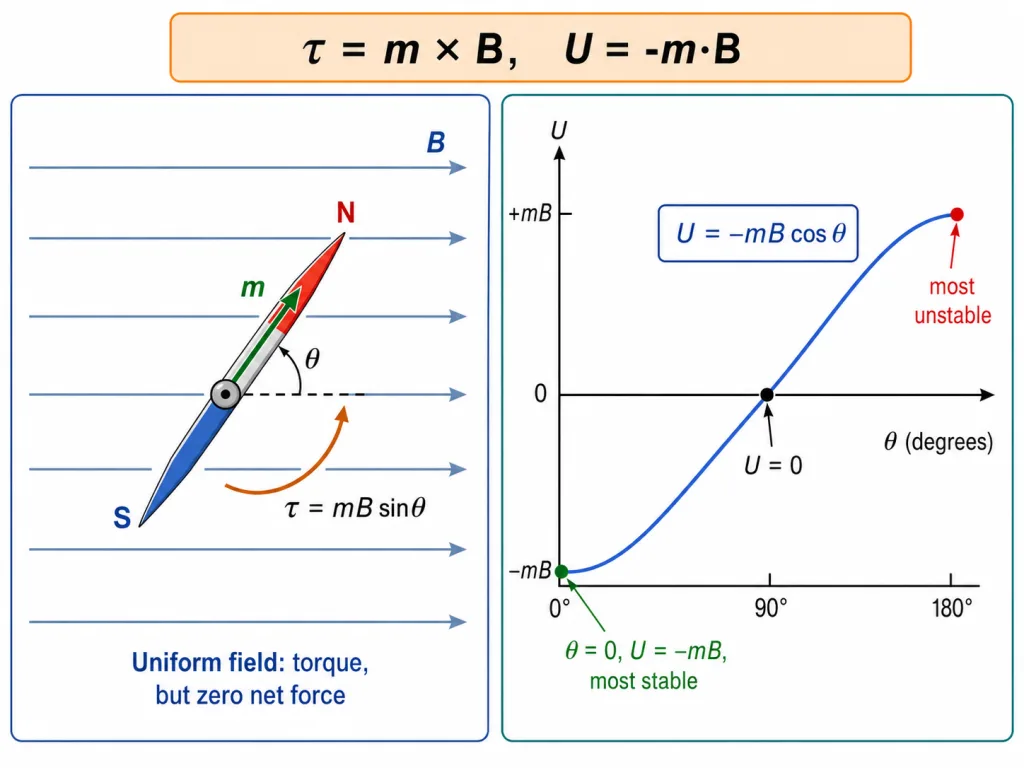
The energy landscape:
| Orientation | Torque | Nature | ||
|---|---|---|---|---|
| parallel to | (minimum) | 0 | Most stable | |
| perpendicular | 0 | (maximum magnitude) | Reference level | |
| antiparallel | (maximum) | 0 | Most unstable |
Work done in rotating a dipole
The external work equals the change in potential energy:
Two cases worth memorising: and .
[NEET Important] Work done to rotate a dipole from its stable position through is — a standard Boards/NEET application.
Oscillations, and the Classic Reasoning Set
The oscillating needle
Displace the compass needle slightly from alignment and release: the restoring torque (small ) drives angular oscillations about the field direction. This arrangement can be used to determine either or the moment of the needle.
[JEE Tip] For small oscillations, the needle behaves like a torsional pendulum with moment of inertia :
So : a stronger field means faster oscillations. Measuring gives (or ).
The reasoning set every exam loves
- Needle in a uniform field: torque, but no net force — it rotates in place.
- Iron nail near a bar magnet: the nail sits in a non-uniform field; the magnet induces a magnetic moment in it, so the nail feels both a force and a torque. The force is attractive because the induced unlike pole is closer to the magnet.
- Must every field configuration have N and S poles? No — poles exist only when the source has a net magnetic moment. A toroid has no poles at all; neither does a straight infinite conductor.
- A magnet exerts no force or torque on itself due to its own field. (But one element of a current-carrying wire can exert a force on another element of the same wire — for a straight wire this force is zero.)
Solved Examples
Example 1: Stable and unstable orientations
A bar magnet of magnetic moment 0.32 J/T is placed in a uniform field of 0.15 T. Find the potential energy in (a) the most stable, (b) the most unstable orientation.
Solution:
- Formula: .
- (a) Stable: , so J. Torque here is zero.
- (b) Unstable: , so J. Torque is again zero — but any nudge grows.
- Answer: J (stable, along ); J (unstable, opposite ).
Example 2: Torque at an angle
A magnet of moment makes an angle of with a uniform field of 0.25 T. Find the torque on it.
Solution:
- Formula: .
- Substitute: .
- Answer: N m, directed perpendicular to the plane of and , tending to align the magnet with the field.
Example 3: Work done in rotating a magnet
A magnet of moment lies along a 0.1 T field. How much work is needed to rotate it (a) by , (b) by ?
Solution:
- Formula: with .
- (a) J.
- (b) J.
- Takeaway: flipping a dipole completely costs — twice the cost.
Example 4: Torque on the solenoid of Section 2
The solenoid with is free to turn about a vertical axis in a horizontal field of 0.25 T. What is the torque when its axis makes with the field?
Solution:
- .
- Answer: N m. The solenoid is dynamically identical to a bar magnet of the same moment.
Example 5: Energy cost of a 30-degree turn
For the same solenoid (, T), find the increase in potential energy when it turns from alignment to .
Solution:
- .
- .
- Answer: J — this is also the work done against the field torque.
Example 6: Needle vs nail
A magnetised needle in a uniform field experiences a torque but no net force. An iron nail near a bar magnet, however, experiences a force of attraction in addition to a torque. Why?
Solution:
- In a uniform field the forces on the two poles of the needle are equal and opposite — net force zero, torque generally non-zero.
- The nail near a bar magnet sits in a non-uniform field. The magnet induces a moment in the nail.
- The induced unlike pole (say S) is closer to the magnet's N than the induced N, so attraction wins: net force plus torque.
Example 7: Does a toroid have poles?
Must every magnetic configuration have a north and a south pole?
Solution:
- Poles correspond to a net magnetic moment of the source.
- A toroid confines its field inside; it has no net moment and no poles. The same holds for a straight infinite conductor.
- Answer: No — N and S poles exist only when the source has a net non-zero magnetic moment (e.g. a bar magnet or solenoid).
Example 8: Oscillation period (JEE pattern)
A compass needle has magnetic moment and moment of inertia . It oscillates in a horizontal field of 0.01 T. Find its period.
Solution:
- Formula: .
- N m.
- s; square root s.
- Answer: s.
Example 9: Where is torque half its maximum?
At what angle between and is the torque on a dipole half of its maximum value?
Solution:
- ; maximum at .
- Half-max: or .
- Note: at the energy is , not half of — torque and energy vary differently with angle.
Example 10: Reading the energy landscape
A dipole is released from rest at in a uniform field. Describe its subsequent motion and the energy conversion.
Solution:
- At , and torque is maximum — the dipole starts rotating towards .
- PE converts to rotational KE: at , , so KE .
- With no damping it overshoots and oscillates between the two positions perpendicular to the field; with damping it settles into the stable alignment .