
A Capacitor on DC vs AC
Connect a capacitor to a DC source: current flows only for the brief time the capacitor charges. As charge builds, the plate voltage rises and opposes the current; once fully charged, the current stops. A capacitor blocks steady current.
Connect it to an AC source (): the capacitor is alternately charged and discharged as the current reverses every half cycle — it limits the current but never stops it. AC passes; DC doesn't.
With the charge, at every instant (Kirchhoff), so and
is the capacitive reactance: dimensions of resistance, unit ohm, and — note the contrast with — inversely proportional to frequency and capacitance.
Current Leads by 90 Degrees
Comparing with : the current is AHEAD of the voltage. The current peaks a quarter period before the voltage does. On the phasor diagram, runs 90 degrees ahead of as both rotate.
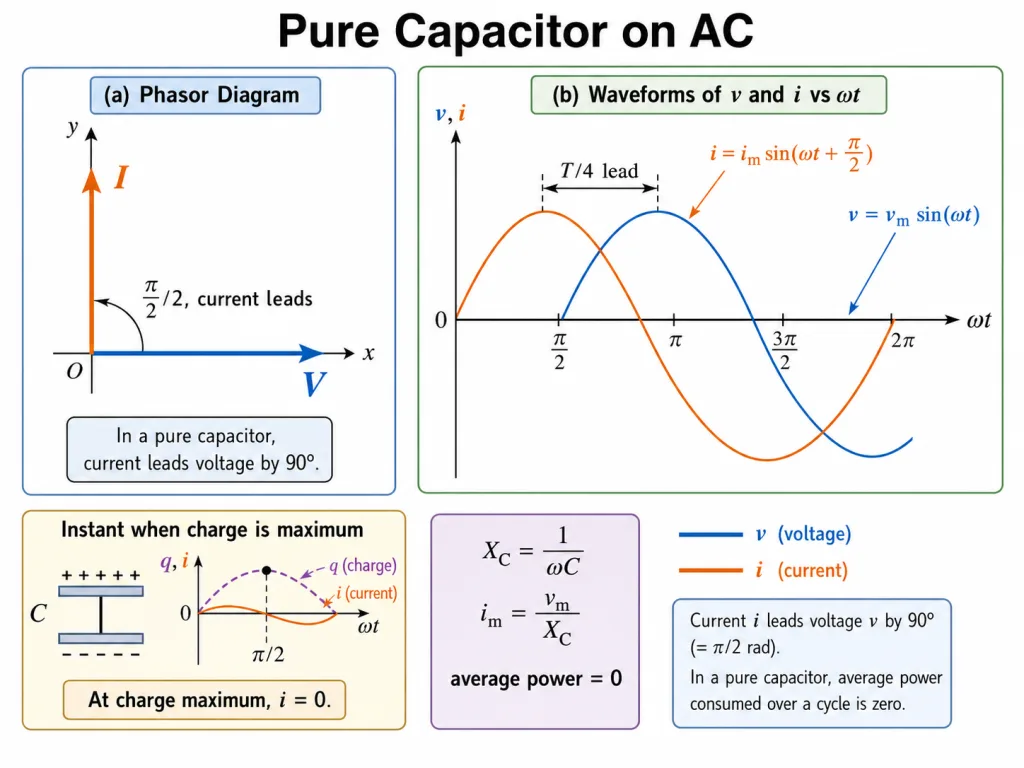
Physical picture: current must flow first to deliver charge; only then does the plate voltage build up. Charge flow precedes voltage — the lead is causality, not magic.
Power: again zero on average
The capacitor stores energy in its electric field for a quarter cycle, then hands it back — exactly like the inductor's magnetic sloshing, with the phase reversed.
Key Point: 'L lags, C leads' — and neither consumes average power. Only resistance dissipates.
Reading Like an Examiner
- DC limit (): — infinite opposition; the capacitor is an open switch to steady current. (This is why it 'blocks DC'.)
- High frequency (): — the capacitor is nearly a plain wire to fast AC.
- Bigger C, smaller : more plate area 'absorbs' charge more easily; the current flows more freely.
- Graphically, vs is a rectangular hyperbola (contrast the straight line of ).
[NEET Important] NCERT's lamp-in-series-with-capacitor reasoning (Example 7.3): on DC the lamp does not glow at all (capacitor blocks); on AC it glows; reducing C increases and the lamp dims. Asked again and again, in every disguise.
[JEE Tip] rises while falls: at some frequency they must cross — the seed of resonance (Section 5). Keep this picture; it organises the whole chapter.
Solved Examples
Example 1: The 15 microfarad capacitor (NCERT Example 7.4)
A 15.0 F capacitor is connected to a 220 V, 50 Hz source. Find the capacitive reactance and the rms and peak currents. What happens if the frequency is doubled?
Solution:
- Reactance: .
- rms current: A.
- Peak: A, oscillating between +1.47 A and A, ahead of the voltage by .
- Doubled frequency: halves (106 ), so the current doubles (2.08 A).
Example 2: A smaller capacitor [NEET Numerical]
Find the reactance of a 5.0 F capacitor on the 50 Hz mains.
Solution:
- .
- Answer: — three times the 15 F value: smaller C, larger opposition.
Example 3: Writing i(t) completely [JEE Numerical]
The voltage V is applied to a 15 F capacitor. Write the full current expression.
Solution:
- .
- A.
- Current leads by : A.
Example 4: Peak charge on the plates [JEE Numerical]
For the same circuit, find the maximum charge on the capacitor.
Solution:
- Charge follows the voltage: , so .
- C.
- Answer: about 4.7 mC, reached at each voltage peak — when the current is momentarily zero (the 90-degree story in one line).
Example 5: Frequency halved [NEET Numerical]
The 50 Hz source driving a capacitor is replaced by a 25 Hz source of the same rms voltage. What happens to the reactance and current?
Solution:
- : halving the frequency doubles the reactance.
- therefore halves.
- Lower frequency, lazier charge swapping, weaker current — the exact opposite of an inductor's response.
Example 6: Lead time on the mains [NEET Numerical]
On 50 Hz mains, by how much time does the capacitor current peak before the voltage?
Solution:
- Lead = quarter period = .
- ms, so the lead is 5 ms.
- Same magnitude as the inductor's lag — opposite sign.
Example 7: Lamp and capacitor (NCERT Example 7.3)
A lamp is in series with a capacitor. Predict the observations for DC and AC connections. What changes if C is reduced?
Solution:
- DC: the capacitor charges briefly, then blocks all current — the lamp never glows. Reducing C changes nothing.
- AC: the capacitor offers finite reactance ; current flows and the lamp shines.
- Reducing C raises , lowering the current: the lamp dims.
Example 8: Why does the current lead?
Give the physical reason the capacitor current leads the voltage.
Solution:
- Plate voltage exists only because charge has already arrived: .
- So the charging current must flow first; the voltage follows as charge accumulates.
- Mathematically, differentiates into — an automatic 90-degree advance.
Example 9: Zero average power, mechanically
Show how the capacitor manages to carry current all cycle yet consume no average power.
Solution:
- Quarter cycle 1: source charges the capacitor — energy flows into the electric field ().
- Quarter cycle 2: the capacitor discharges back through the source (), returning every joule.
- averages to zero — borrowing, never spending.
Example 10: The R-L-C phase scoreboard
Summarise the phase of current relative to voltage for pure R, L and C on AC, with the power verdict for each.
Solution:
- R: in phase () — average power (the only dissipator).
- L: current lags by 90 degrees — average power zero.
- C: current leads by 90 degrees — average power zero. Memory hook: 'L lags, C leads, R pays the bills.'