
Why the World Chose AC
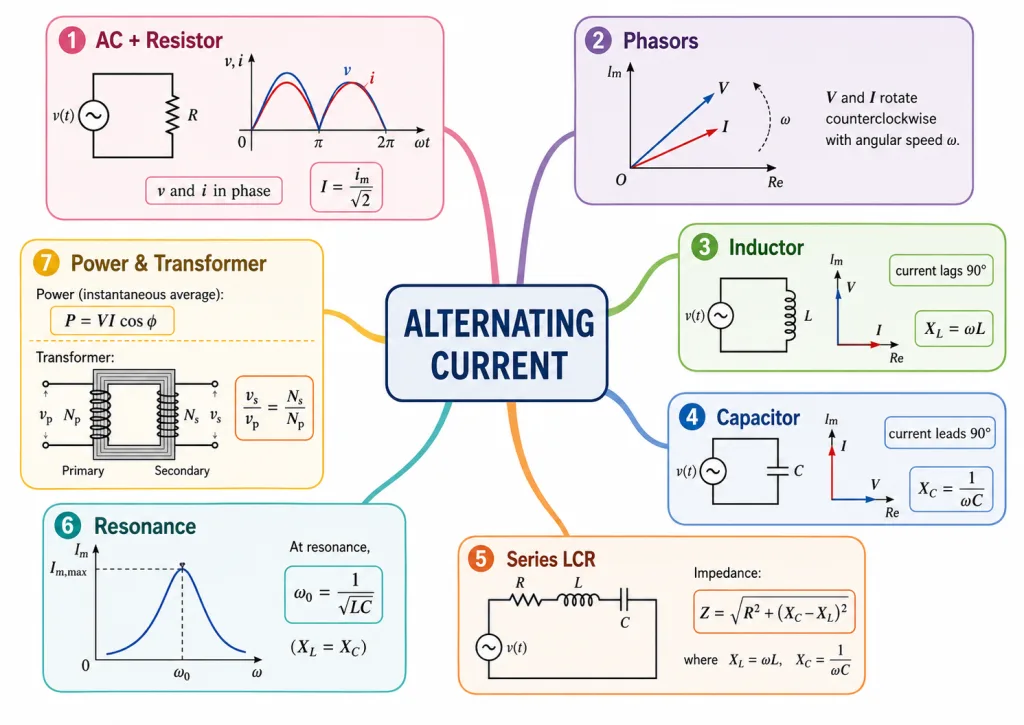
So far our circuits ran on direct current (dc) — currents that never change direction. But the mains supply in your home varies like a sine function: an alternating voltage, driving an alternating current (ac).
Why does most electrical energy travel as AC?
- AC voltages can be easily and efficiently converted from one value to another by transformers (Section 7).
- Electrical energy can then be transmitted economically over long distances.
- AC circuits have special characteristics exploited in daily devices — tuning a radio uses one of them (resonance, Section 5).
(A pedantic but charming NCERT footnote: 'ac voltage' literally reads 'alternating current voltage' — contradictory, yet universally accepted. We follow the convention.)
The cast of this chapter: a resistor first (this section), then phasors, inductors, capacitors, their grand combination (LCR), resonance, AC power, and finally the transformer.
AC Across a Resistor: In Phase, Ohm Intact
Apply (amplitude , angular frequency ) across a pure resistor R. Kirchhoff's loop rule gives
Ohm's law works equally well for AC and DC. Voltage and current reach zero, minima and maxima at the same instants: they are in phase.
Now the subtlety that defines this chapter:
- The current is positive for half the cycle and negative for the other half — its average over a full cycle is zero.
- But Joule heating is NOT zero: depends on , which is always positive.
The instantaneous power has average
using over a cycle.
Key Point: Zero average current but non-zero average power — because power goes as the square. This single line resolves half the conceptual questions ever asked on this section.
RMS Values: Making AC Look Like DC
To write AC power in the DC form , define the root mean square (rms) or effective current:
and similarly the rms voltage . Then
— identical in form to the DC equations. That is the whole point of rms values: with them, AC bookkeeping is DC bookkeeping.
The physical meaning: the rms current is the equivalent DC current that would produce the same average power loss in the resistor.
[NEET Important] Household '220 V' is the rms value. The peak is V. AC meters (ammeters/voltmeters) read rms values by construction.
[JEE Tip] rms is computed by squaring, averaging, then rooting — in that order. For the average of is 0, of is , and the rms is . Three different 'averages' — exams love mixing them up.
Solved Examples
Example 1: The 100 W bulb (NCERT Example 7.1)
A light bulb is rated 100 W for a 220 V supply. Find (a) the bulb's resistance, (b) the peak voltage of the source, (c) the rms current through the bulb.
Solution:
- (a) .
- (b) V.
- (c) From : A.
Example 2: Reading an AC expression [NEET Numerical]
The mains voltage is V. Find the rms voltage and the frequency.
Solution:
- Peak: V, so V.
- Frequency: rad/s, so Hz.
- The familiar Indian mains: 220 V rms at 50 Hz.
Example 3: Heater by the numbers [JEE Numerical]
A 1000 W heater runs on 220 V rms mains. Find its resistance, the rms current, and the peak current.
Solution:
- .
- A.
- A — the wiring must tolerate the peak, not just the rms!
Example 4: Three different 'averages' [JEE Numerical]
For the current A, find (a) the average over a full cycle, (b) the rms value.
Solution:
- (a) over a cycle, so .
- (b) A.
- Zero average current, yet a perfectly real 1.41 A effective current heating the circuit — squares don't cancel.
Example 5: When does i equal its rms value? [JEE Numerical]
Starting from at , at what fraction of the period T does first equal its rms value?
Solution:
- Set : .
- First solution: , i.e. .
- Answer: — one-eighth of a period after the zero crossing.
Example 6: Average vs peak power [NEET Numerical]
An rms current of 5 A flows through a 10 resistor on AC mains. Find the average power and the peak instantaneous power.
Solution:
- Average: W.
- Peak: W.
- Instantaneous power oscillates between 0 and 500 W; its time average is exactly half the peak — the at work.
Example 7: Zero average current, real heating
The average AC current over a cycle is zero. Why does the resistor still get hot?
Solution:
- Heating goes as , and is positive in both half cycles — the positive and negative lobes of both deposit heat.
- Averaging i cancels signs; averaging does not: .
- Hence the rms idea: a DC current of would heat exactly as much.
Example 8: Why 'effective' is the right word
In what precise sense is the rms current 'equivalent' to a DC current?
Solution:
- Pass DC of value I through R: power , steady.
- Pass AC of rms value I through the same R: average power — the same average power loss.
- So a 220 V (rms) AC supply lights a bulb exactly as brightly as a 220 V DC supply would. That equivalence is the definition of 'effective'.
Example 9: Why transmit as AC?
Give the main reason electrical energy is generated and distributed as AC rather than DC.
Solution:
- AC voltages can be stepped up or down easily and efficiently by transformers (which need changing flux — they simply don't work on steady DC).
- Stepping up the voltage slashes the current for the same power, cutting transmission losses — economical long-distance transmission.
- At the consumer's end the voltage is stepped back down to safe values. The full story completes in Section 7.
Example 10: What the meter reads
An AC ammeter in series with a resistor reads 2.0 A. What is the peak current, and what would an ideal DC-averaging meter read?
Solution:
- AC instruments report rms: A, so A.
- A meter that truly averaged over full cycles would read zero — the average AC current vanishes.
- This is precisely why rms (not the plain average) is the standard for specifying AC quantities.