
Why Free Electrons Can't Just Walk Out
Metals conduct because they have free electrons roaming inside. So here's a fair question: if they're free, why doesn't a copper wire constantly leak electrons into the air?
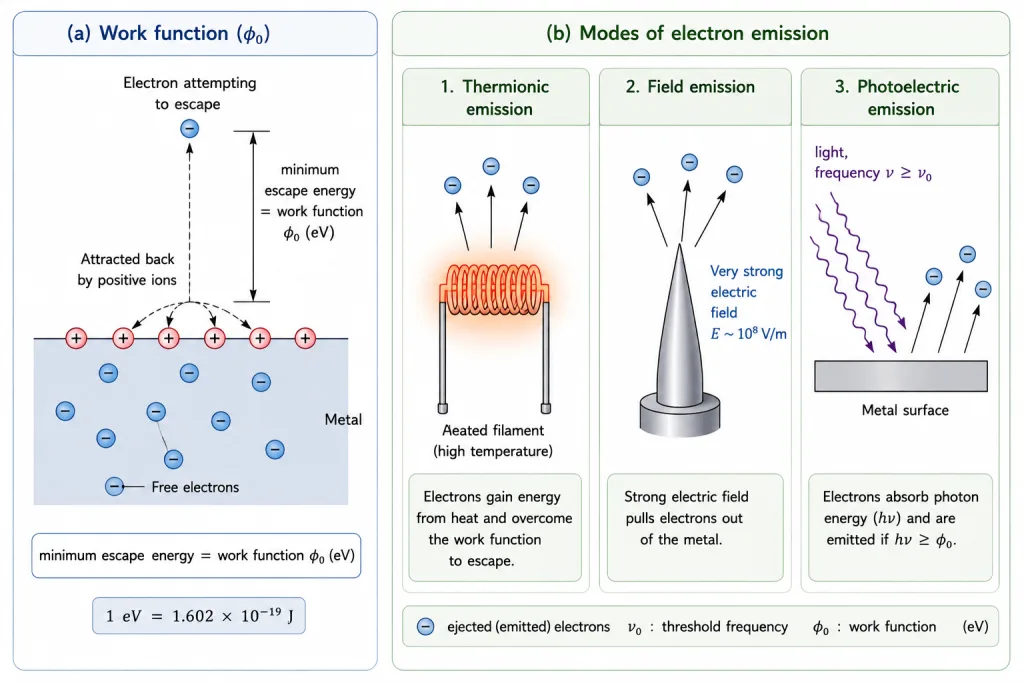
Let's break this down. The electrons are free to move inside the metal, but the moment one tries to leave the surface, the metal (now left with a net positive charge) pulls it right back. The escaping electron feels the attractive tug of the positive ions behind it. 'Free' really means free indoors.
Key Point: An electron can escape the metal surface only if it is given enough energy to overcome this attractive pull.
The work function
The minimum energy required by an electron to escape from the metal surface is called the work function of the metal, denoted .
- It depends on the properties of the metal and the nature of its surface.
- It is measured in electron volts (eV) — the natural energy currency of atomic physics.
The electron volt
One electron volt is the energy gained by an electron accelerated through a potential difference of 1 volt:
[JEE Tip] Converting between eV and joules is the single most repeated micro-skill of this chapter. Energy in eV = energy in joules ÷ . Typical work functions are 2-6 eV; caesium's 2.14 eV (lowest among NCERT's common examples) makes it the go-to metal for visible-light emission problems.
Three Ways Out: The Modes of Electron Emission
The minimum escape energy can be delivered to the free electrons by any of these physical processes:
1. Thermionic emission
Heat the metal. Sufficient thermal energy imparted to the free electrons lets them escape. This powers the electron guns of old TV picture tubes and X-ray tubes — a hot filament boiling off electrons.
2. Field emission
Apply a very strong electric field — of the order of V/m — and electrons are pulled out of the metal. NCERT's example: the spark plug of an engine.
3. Photoelectric emission
Shine light of suitable frequency on the metal surface, and electrons are emitted. These light-generated electrons are called photoelectrons — the stars of the rest of this chapter.
| Mode | Energy source | Everyday example |
|---|---|---|
| Thermionic | heat | hot filament in an X-ray tube |
| Field | electric field ~ V/m | spark plug |
| Photoelectric | light of suitable frequency | photocells, solar sensors |
[NEET Important] The order of magnitude V/m for field emission is a direct NCERT number and appears verbatim in factual MCQs. Also note the phrase light of suitable frequency — not any light — a hint of the threshold behaviour coming in the next sections.
Solved Examples
Example 1: Converting a work function
The work function of caesium is 2.14 eV. Express it in joules.
Solution:
- Conversion: 1 eV = J.
- Multiply: J.
- Answer: J.
- Takeaway: always convert to joules before mixing with h and in SI calculations.
Example 2: Energy from a potential difference
An electron is accelerated from rest through 500 V. What kinetic energy does it gain in eV and in joules?
Solution:
- Definition: energy gained = qV; for an electron through V volts, that is V electron volts.
- In eV: K = 500 eV.
- In joules: K = J.
- Takeaway: the electron volt exists precisely to make such answers instant.
Example 3: Which mode is at work?
Identify the emission mode: (a) electrons ejected from a tungsten filament at 2500 K, (b) emission from a cold metal tip in a V/m field, (c) electrons leaving a caesium surface under green light.
Solution:
- (a) High temperature supplies thermal energy → thermionic emission.
- (b) An enormous electric field (~ V/m) pulls electrons out → field emission.
- (c) Light of suitable frequency ejects electrons → photoelectric emission; the ejected electrons are photoelectrons.
Example 4: Speed of an electron with energy equal to caesium's work function [JEE Numerical]
If an electron inside caesium somehow acquires kinetic energy exactly equal to = 2.14 eV, at what speed is it moving?
Solution:
- Convert: K = J.
- Formula: .
- Substitute: .
- Calculate: m/s.
- Takeaway: electron-volt energies translate to speeds of hundreds of km/s for electrons — fast, yet far below c.
Example 5: Ranking metals by emission ease
Metal A has = 2.14 eV, metal B has 4.65 eV, metal C has 5.65 eV. Which emits photoelectrons for the lowest-frequency light, and why?
Solution:
- Concept: emission needs photon energy ≥ ; lower means a lower threshold frequency .
- Compare: A (2.14 eV) < B (4.65 eV) < C (5.65 eV).
- Answer: metal A (caesium-like) responds to the lowest frequencies — alkali metals with low work functions respond even to visible light, while high- metals need ultraviolet.
Example 6: How many electrons through a lamp? [Board Numerical]
A current of 0.32 A flows in a discharge tube. How many electrons cross any section per second?
Solution:
- Formula: I = ne/t, so n per second = I/e.
- Substitute: .
- Answer: electrons per second.
- Takeaway: currents connect straight back to electron counting — a bridge between this chapter and current electricity.
Example 7: The joule-eV two-way street
An X-ray photon carries J. Express this in keV.
Solution:
- Convert to eV: eV.
- In keV: E ≈ 20.6 keV.
- Takeaway: dividing by shifts you from the SI world to the atomic world; multiplying shifts you back.
Example 8: Why the surface matters
Two plates of the same metal, one freshly polished and one oxidised, show different work functions. Why?
Solution:
- NCERT states depends on the properties of the metal AND the nature of its surface.
- An oxide layer or contamination changes the surface barrier the electron must cross, altering .
- This is why photoelectric experiments use clean, often freshly-deposited metal surfaces in vacuum.
Example 9: Field emission threshold [JEE Conceptual]
Estimate the potential difference needed across a 1 m gap to trigger field emission.
Solution:
- Required field: E ~ V/m.
- Formula: V = Ed = .
- Answer: about 100 V across one micrometre — huge fields are easy across tiny gaps, which is exactly how sharp-tip field emitters work.
Example 10: Comparing the three modes
For each emission mode, state what is varied to increase the emission rate.
Solution:
- Thermionic: raise the temperature — more electrons gain escape energy.
- Field: strengthen the applied field — the surface barrier is lowered/narrowed further.
- Photoelectric: increase the light intensity (at fixed suitable frequency) — more photons arrive per second, ejecting more electrons. (Raising frequency increases each electron's energy, not primarily their number — the crucial distinction the next sections build on.)