
The Wave Theory on Trial
By 1900 the wave picture of light was triumphant — interference, diffraction and polarisation all explained naturally. In this picture, light is an electromagnetic wave with energy spread continuously over the wavefront. Let's see what that predicts for photoemission — and watch it fail, observation by observation.
Prediction 1: should grow with intensity — it doesn't
Greater intensity means larger E and B field amplitudes, so each electron sitting in the wave should absorb more energy. The wave theory predicts increases with intensity. Observed: is completely independent of intensity.
Prediction 2: No threshold should exist — it does
Whatever the frequency, a sufficiently intense beam (acting for enough time) should eventually pump any electron past the work function. The wave theory forbids a threshold frequency. Observed: below , nothing — at any intensity.
Prediction 3: Dim light should mean long delays — it doesn't
In the wave picture the energy is shared across the entire wavefront, and huge numbers of electrons absorb it simultaneously, so each one collects energy at a trickle. Explicit calculation: a single electron would need hours or more to gather enough energy to escape. Observed: emission within s, however dim the light.
Key Point: The wave picture contradicts observations (i), (ii) and (iii) of Section 4's summary, and its continuous-absorption assumption is demolished by the instantaneity observation (iv). It fails not narrowly but completely.
[NEET Important] Be able to list the three failures in one breath: intensity-independence of , existence of threshold frequency, no time lag. 'Which observation can the wave theory explain?' — only that photocurrent grows with intensity.
Einstein's 1905 Idea: Light Comes in Packets
Albert Einstein's resolution was radical: photoelectric emission does not happen by continuous absorption. Instead,
Radiation energy is built of discrete units — quanta of energy — where h is Planck's constant and the frequency of light.
The elementary process: one electron absorbs one quantum (). If this exceeds the minimum energy needed to escape (the work function ), the electron comes out with maximum kinetic energy:
This is Einstein's photoelectric equation — Eq. (11.2). More tightly bound electrons emerge with less than (they spend extra energy getting out), which explains the observed spread of electron energies.
How one line explains everything
- independent of intensity: the elementary act is one photon → one electron. Intensity = number of quanta arriving per unit area per unit time — irrelevant to the energy each electron receives. ✔
- Threshold frequency: demands , i.e. where Greater work function → higher threshold. Below : no emission, however intense or prolonged the light. ✔
- Photocurrent ∝ intensity: more quanta per second → more electrons absorb quanta → more electrons emitted per second (for ). ✔
- Instantaneous emission: absorption of a quantum by an electron is a one-shot, instantaneous event. Low intensity means fewer events, never delayed events. ✔
Four observations, four ticks, one equation.
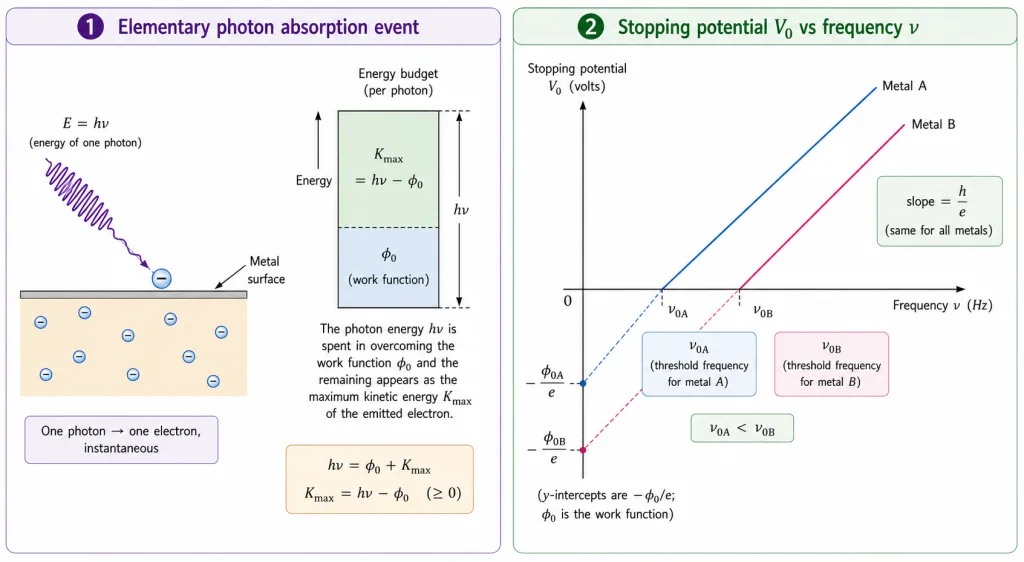
The Straight Line That Measures Planck's Constant
Combine (Section 4) with Einstein's equation:
This predicts the -vs- graph is a straight line with:
- slope = — a universal constant, independent of the material,
- x-intercept = (material-dependent),
- y-intercept = (material-dependent).
Different metals give parallel lines — same slope, shifted thresholds. This is exactly what NCERT Fig. 11.5 shows.
Millikan: the sceptic who proved it
During 1906-1916, Millikan ran a decade of precision experiments aiming to disprove Einstein's equation. Instead, measuring the slope of the - line for sodium and using his own value of e, he extracted Planck's constant h — and it matched the value ( J s) from blackbody radiation, a completely different context. He verified the equation with great precision for several alkali metals over a wide frequency range. In 1916, Millikan had proved what he set out to demolish.
The hypothesis of light quanta, plus experimentally consistent values of h and , forced physics to accept Einstein's picture. Einstein received the 1921 Nobel Prize (citing the photoelectric effect); Millikan the 1923 Nobel Prize (elementary charge and photoelectric effect).
[JEE Tip] Graph questions cluster here: slope of - line = (same for all metals); the slope of the - line = h. From slope V s, get slope J s (that's NCERT Exercise 11.5). Also memorise the workhorse eV nm for photon-energy conversions in one step.
Solved Examples
Example 1: Caesium end-to-end (NCERT Example 11.2)
The work function of caesium is 2.14 eV. Find (a) the threshold frequency, and (b) the wavelength of incident light if the photocurrent is brought to zero by a stopping potential of 0.60 V.
Solution:
- (a) Threshold: .
- Calculate: Hz. Below this, no photoelectrons.
- (b) Einstein's equation with : .
- Substitute: .
- Answer: nm.
- Takeaway: = photon energy — build the photon first, then convert to wavelength.
Example 2: The quick version with hc = 1240 eV nm [JEE Shortcut]
Redo Example 1(b) using eV nm.
Solution:
- Photon energy needed: eV.
- Wavelength: nm.
- Takeaway: the 1240 shortcut turns a five-line SI computation into one division (small rounding differences are expected and fine for MCQs).
Example 3: Maximum kinetic energy and speed (NCERT Exercise 11.2 style)
Caesium ( = 2.14 eV) is illuminated by light of frequency Hz. Find (a) , (b) the stopping potential, (c) the maximum speed of photoelectrons.
Solution:
- Photon energy: eV.
- (a) eV.
- (b) V.
- (c) m/s.
- Takeaway: the chain is the chapter's standard four-step ladder.
Example 4: Predicting a cut-off voltage (NCERT Exercise 11.6)
The threshold frequency for a metal is Hz. Light of frequency Hz is incident. Predict the cut-off voltage.
Solution:
- Formula: .
- Substitute: .
- Calculate: V.
- Takeaway: when is given, skip entirely — work with directly.
Example 5: Will it emit? (NCERT Exercise 11.7)
The work function of a metal is 4.2 eV. Will it emit photoelectrons for radiation of wavelength 330 nm?
Solution:
- Photon energy: eV.
- Compare: 3.76 eV < 4.2 eV = .
- Answer: No emission — the photon falls short of the work function, and no amount of intensity changes that.
- Takeaway: always settle the yes/no question (photon vs ) before computing anything else.
Example 6: Planck's constant from a slope (NCERT Exercise 11.5)
The slope of the cut-off voltage versus frequency graph is V s. Find h.
Solution:
- Theory: , so slope = .
- Rearrange: slope .
- Answer: J s.
- Takeaway: this is literally Millikan's method — the slope of that line measured Planck's constant from photoelectricity.
Example 7: Threshold from photoelectron speed (NCERT Exercise 11.8)
Light of frequency Hz is incident on a metal; electrons with maximum speed m/s are ejected. Find the threshold frequency.
Solution:
- Maximum kinetic energy: J.
- Einstein's equation: .
- Substitute: .
- Calculate: Hz.
- Takeaway: speed → energy → subtract from photon frequency: a three-step backward pass through Einstein's equation.
Example 8: Work function from an argon laser (NCERT Exercise 11.9)
Light of wavelength 488 nm from an argon laser gives photoelectrons with stopping potential 0.38 V. Find the emitter's work function.
Solution:
- Photon energy: eV.
- Einstein rearranged: .
- Answer: eV.
- Takeaway: photon energy minus stopping energy = work function; every quantity in eV keeps it one clean subtraction.
Example 9: Two wavelengths, one metal [JEE Multi-step]
For a metal, stopping potentials are 1.0 V with 400 nm light and 0.22 V with 500 nm light (illustrative values). Show how h can be extracted from just these two readings.
Solution:
- Write the equation twice: and .
- Subtract (kills ): .
- Solve for h: .
- Calculate: J s — order-correct for these rounded illustrative readings; precise data give J s.
- Takeaway: the two-wavelength subtraction eliminates the unknown work function — a standard JEE construction.
Example 10: Why the wave theory predicts hours [Board Conceptual]
Outline the wave-theory time-lag estimate and why it fails.
Solution:
- In the wave picture, energy arrives continuously spread over the whole wavefront, shared among an enormous number of surface electrons.
- The power collected by the tiny cross-section of a single electron is minuscule; explicit calculation shows hours or more are needed to accumulate a few eV.
- Experiment: emission within s at any intensity.
- Conclusion: continuous absorption is wrong; energy must arrive in concentrated packets () absorbed whole by single electrons — Einstein's elementary process.