
Nature Loves Symmetry: de Broglie's Bold Guess
By 1924 the evidence was in: radiation has a dual nature. Interference, diffraction and polarisation shout wave; the photoelectric effect and Compton scattering shout particle. Which description applies? It depends on the experiment. Even ordinary seeing uses both: the eye-lens focuses light (wave picture), while the rods and cones absorb it (photon picture).
Then came the beautiful question. The French physicist Louis Victor de Broglie (1892-1987) reasoned: nature is symmetrical, and its two great entities — matter and energy — should mirror each other. If radiation (energy) is both wave and particle, then moving particles of matter should show wave-like properties under suitable conditions.
His proposal — the de Broglie relation:
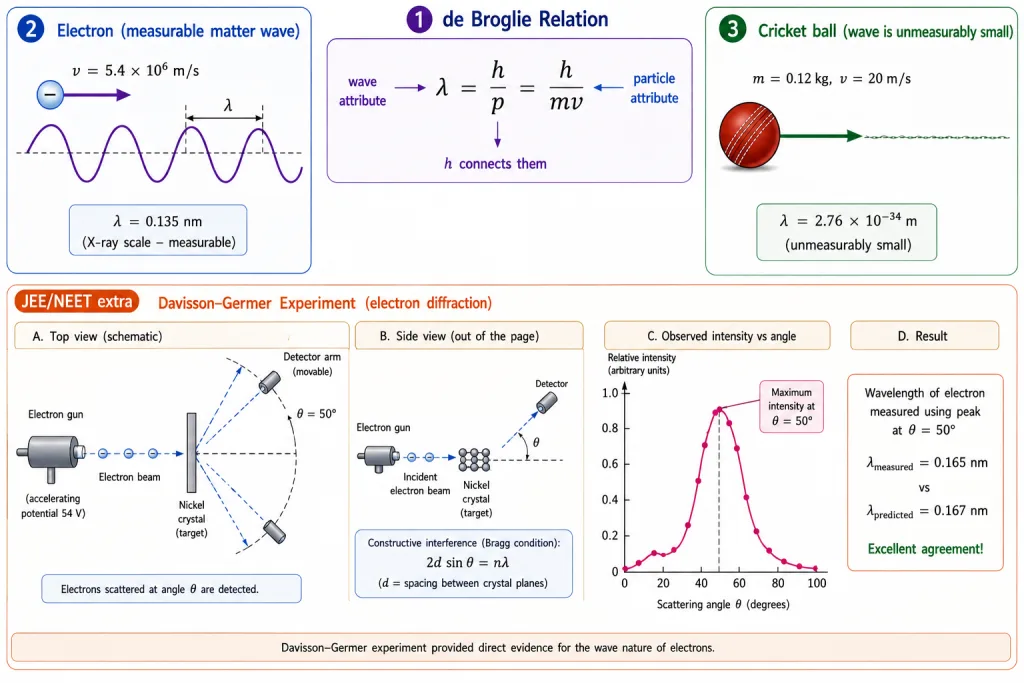
Look at the two sides: is a wave attribute; momentum p = mv is a particle attribute. Planck's constant h relates the two — the dual aspect of matter written in one line. is called the de Broglie wavelength, and the associated waves are matter waves.
De Broglie's idea was later developed by Erwin Schrödinger into wave mechanics — the standard form of quantum mechanics. De Broglie won the 1929 Nobel Prize for the discovery of the wave nature of electrons.
Testing the Relation: Photons Pass, Cricket Balls Hide
The photon consistency check
A hypothesis this bold should at least agree with what we know. For a photon, p = , so
The de Broglie wavelength of a photon equals the electromagnetic wavelength of its radiation. Perfectly consistent. ✔
Why you don't diffract through doorways
From : heavier or faster → smaller wavelength. NCERT's example: a ball of mass 0.12 kg moving at 20 m/s:
That is unimaginably beyond measurement — about times a proton's size. This is why macroscopic objects never show wave behaviour. But in the sub-atomic domain the story flips: an electron at m/s has nm — X-ray scale, comparable to atomic spacings in crystals, hence measurable.
The accelerated-electron shortcut
An electron accelerated from rest through potential V gains K = eV, and , so
For V = 120 V: nm. [JEE Tip] Memorise nm — it converts a huge fraction of numerical problems into one square root. General mass-m, charge-q version: .
Key Point (from NCERT Points to Ponder): the matter wave's wavelength is physically significant, but its phase velocity has no physical significance; the group velocity is meaningful and equals the particle's velocity.
Davisson-Germer: Seeing Electron Waves — [JEE/NEET Extra]
The rationalised NCERT no longer includes this experiment for Boards, but JEE and NEET still expect it — so here is the essential picture, clearly marked as beyond the current Board syllabus.
In 1927, C. J. Davisson and L. H. Germer (and independently G. P. Thomson, 1928) confirmed de Broglie's hypothesis directly:
- A beam of electrons, accelerated through a variable voltage (tested around 44-68 V), was scattered off a nickel crystal.
- The scattered intensity, measured versus angle, showed a strong peak at 50 degrees for V = 54 V — not the smooth fall-off particles would give, but a diffraction maximum: crystal planes acting as a grating for electron waves.
- The wavelength deduced from the diffraction geometry: 0.165 nm. The de Broglie prediction: nm. Agreement to within about 1%.
Matter waves are real. Electrons diffract exactly as de Broglie's demands. (G. P. Thomson — J. J. Thomson's son — shared the 1937 Nobel with Davisson for electron diffraction. The father proved the electron a particle; the son proved it a wave. Physics has a sense of humour.)
[NEET Important] Memory pegs: nickel crystal, 54 V, 50 degrees, ~0.165 nm, year 1927. The electron microscope is the flagship application of matter waves — electron wavelengths thousands of times shorter than visible light give correspondingly higher resolving power.
[JEE Tip] Useful comparison set at a common kinetic energy K: , so — electron > proton > alpha. At common momentum, all particles (and photons) share the same . Sort by what is held equal before comparing!
Solved Examples
Example 1: Electron vs cricket ball (NCERT Example 11.3)
Find the de Broglie wavelength of (a) an electron moving at m/s, and (b) a 150 g ball moving at 30.0 m/s.
Solution:
- (a) Electron momentum: kg m/s.
- Wavelength: nm — X-ray scale, measurable.
- (b) Ball momentum: kg m/s.
- Wavelength: m — about times a proton's size, utterly unmeasurable.
- Takeaway: same formula, 23 orders of magnitude apart — the whole quantum-classical divide in one example.
Example 2: The 1.227 shortcut [JEE Numerical]
What is the de Broglie wavelength of an electron accelerated through 100 V?
Solution:
- Shortcut: nm.
- Substitute: nm.
- Answer: ≈ 0.123 nm.
- Takeaway: ~100 V electrons have ~0.12 nm wavelengths — atomic-lattice scale, which is why crystals diffract them.
Example 3: Bullet, ball and dust grain (NCERT Exercise 11.10)
Find the de Broglie wavelength of (a) a 0.040 kg bullet at 1.0 km/s, (b) a 0.060 kg ball at 1.0 m/s, (c) a kg dust particle drifting at 2.2 m/s.
Solution:
- (a) p = 0.040 × 1000 = 40 kg m/s; m.
- (b) p = 0.060 × 1.0 = 0.060 kg m/s; m.
- (c) p = × 2.2 = kg m/s; m.
- Takeaway: even a barely-visible dust grain has a hopelessly unmeasurable wavelength — matter waves matter only for subatomic masses.
Example 4: Photon and matter wave equality (NCERT Exercise 11.11)
Show that the wavelength of electromagnetic radiation equals the de Broglie wavelength of its photon.
Solution:
- Photon momentum: .
- de Broglie wavelength: .
- But is precisely the electromagnetic wavelength of the radiation.
- Conclusion: — the de Broglie relation contains the photon as a special case, a key internal-consistency check.
Example 5: Electron vs proton at the same speed [NEET Comparison]
An electron and a proton move with the same speed. Which has the longer de Broglie wavelength, and by what factor? ()
Solution:
- Formula: — at equal v, .
- Compare: the electron is 1836 times lighter → .
- Answer: the electron's wavelength is longer by a factor ≈ 1836.
- Takeaway: lighter always means longer wavelength when speeds match.
Example 6: Equal kinetic energies [JEE Comparison]
An electron and a proton have the same kinetic energy K. Compare their de Broglie wavelengths.
Solution:
- Momentum from K: .
- Wavelength: at fixed K.
- Compare: .
- Answer: the electron's wavelength is about 43 times longer.
- Takeaway: equal speed → factor m; equal energy → factor ; equal momentum → equal . Three regimes, three answers — identify which is fixed before comparing.
Example 7: Wavelength from kinetic energy [JEE Numerical]
Find the de Broglie wavelength of an electron with kinetic energy 120 eV.
Solution:
- Shortcut (K in eV equals V in volts for an electron): nm.
- Calculate: , so nm.
- Answer: ≈ 0.112 nm.
- Takeaway: 'accelerated through V volts' and 'kinetic energy V eV' are the same input for an electron — spot the equivalence and reuse the shortcut.
Example 8: Davisson-Germer check [JEE/NEET Extra]
In the Davisson-Germer experiment at 54 V, compare the de Broglie prediction with the measured 0.165 nm.
Solution:
- Prediction: nm.
- Measured (from crystal diffraction): 0.165 nm.
- Agreement: within about 1% — experimental confirmation that electrons diffract as waves with .
- Takeaway: 54 V, 50 degrees, nickel, 0.165 nm — the four numbers that confirmed matter waves (beyond current Board syllabus, alive and well in JEE/NEET).
Example 9: What voltage for a given wavelength? [JEE Reverse]
Through what potential difference must an electron be accelerated to have a de Broglie wavelength of 0.05 nm?
Solution:
- Shortcut inverted: .
- Substitute: .
- Answer: V ≈ 602 V.
- Takeaway: sub-0.1 nm wavelengths need hundreds of volts — the operating regime of electron diffraction cameras.
Example 10: Group velocity ponder [Conceptual]
For a matter wave, which velocity carries physical meaning — phase or group — and what does it equal?
Solution:
- NCERT (Points to Ponder): the phase velocity of a matter wave has no physical significance.
- The group velocity — the speed of the wave-packet envelope — is physically meaningful.
- It equals the velocity of the particle itself: the packet travels with the electron.
- Takeaway: a favourite assertion-reason item: ' is physical, phase velocity is not, group velocity = particle velocity.'