
The Stage at the End of the 19th Century
By 1887, light seemed a solved problem. Maxwell's equations said light is an electromagnetic wave, and Hertz's experiments on generating and detecting EM waves confirmed it spectacularly. Interference, diffraction, polarisation — the wave picture explained them all.
But in the very same decade, a different set of experiments — electric discharge through gases at low pressure — was quietly setting up the greatest plot twist in physics.
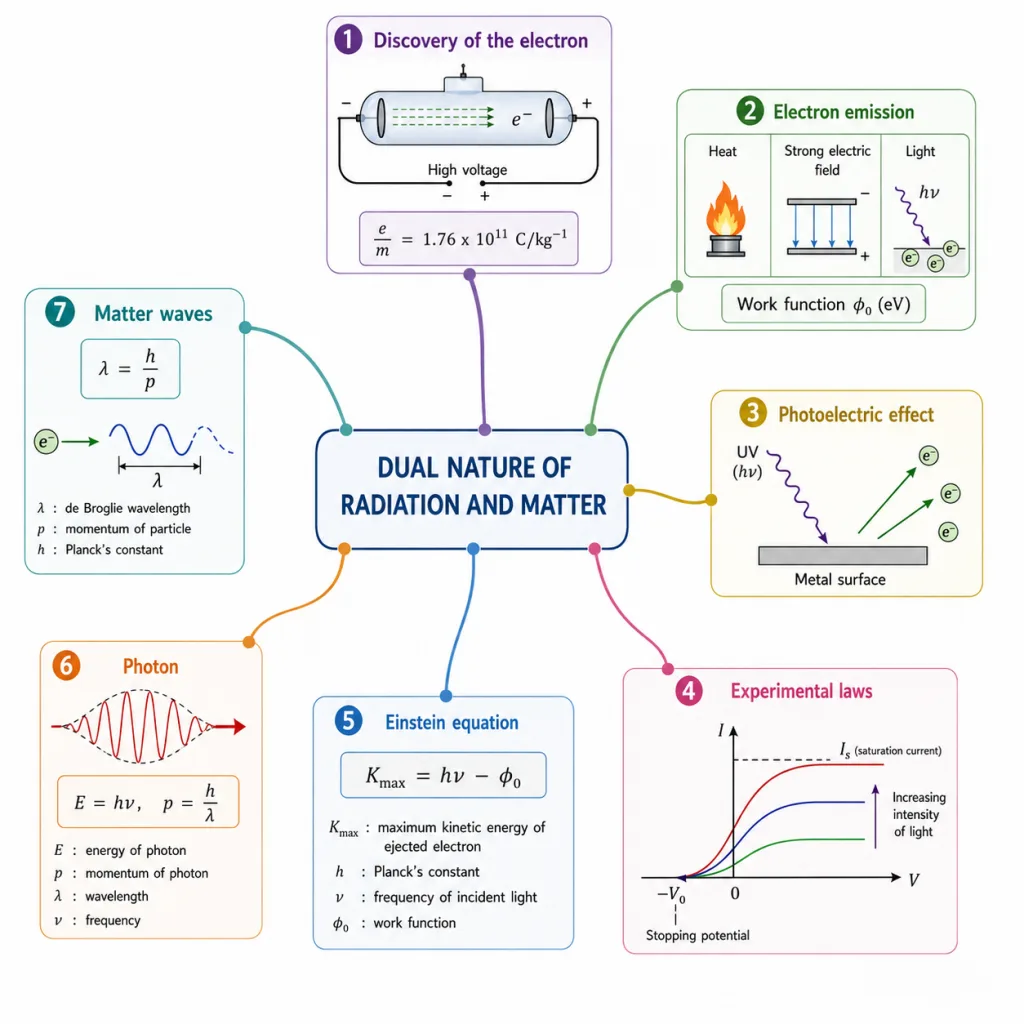
Think of it this way: physicists pointed high voltage across a gas-filled glass tube and kept pumping the gas out. At a pressure of about 0.001 mm of mercury, a discharge flowed between the electrodes and a fluorescent glow appeared on the glass opposite the cathode (yellowish-green for soda glass). Something invisible was streaming from the cathode and lighting up the far wall.
- 1870 — William Crookes discovered these cathode rays.
- 1879 — Crookes proposed they were streams of fast-moving, negatively charged particles.
- 1895 — Roentgen discovered X-rays from discharge-tube experiments.
- 1897 — J. J. Thomson confirmed the charged-particle hypothesis and changed physics forever.
Thomson's e/m Experiment: Weighing the Unweighable
J. J. Thomson (1856-1940) applied mutually perpendicular electric and magnetic fields across the discharge tube. By balancing the two deflections he became the first person to measure, for cathode ray particles:
- their speed: about 0.1 to 0.2 times the speed of light ( m/s), and
- their specific charge (charge-to-mass ratio):
The universality discovery
Here's the result that made electrons famous. The value of came out the same regardless of:
- the cathode material (any metal emitter),
- the gas in the discharge tube,
- and even the method of producing the particles.
Around the same time (1887), metals irradiated by ultraviolet light emitted slow negatively charged particles; metals heated to high temperatures did the same. The of these particles matched the cathode-ray value exactly. Different sources, identical particle.
In 1897 Thomson named these particles electrons and boldly proposed they are fundamental, universal constituents of matter. He received the 1906 Nobel Prize in Physics for this discovery.
[NEET Important] Fact-recall favourites: cathode rays discovered by Crookes (1870); first measured by Thomson using crossed E and B fields; accepted value C/kg; speeds ~0.1-0.2 c. Match the name to the deed — options are built to swap them.
Millikan's Oil-Drop Experiment: Charge Comes in Packets
Knowing is only half the story — you need separately to get the mass . That step came in 1913, when the American physicist R. A. Millikan (1868-1953) performed his legendary oil-drop experiment.
Millikan watched tiny charged oil droplets drift between capacitor plates, balancing gravity against the electric force. Measuring the charge on droplet after droplet, he found something remarkable:
The charge on any oil droplet was always an integral multiple of one elementary charge:
No droplet ever carried 1.5e or 0.7e. Charge is quantised — it comes in whole-number packets of (recall the property from electrostatics).
Putting the two experiments together
Thomson's + Millikan's = the electron's mass. Two experiments, sixteen years apart, jointly weighing a particle no one can see.
[JEE Tip] JEE loves dimensional/ratio play here: given and , compute ; given a droplet's charge, check whether it's an allowed multiple of . Any charge that is not an integer multiple of C is physically impossible.
Solved Examples
Example 1: The mass of the electron
Using Thomson's C/kg and Millikan's C, find the mass of the electron.
Solution:
- Formula: .
- Substitute: kg.
- Calculate: kg.
- Takeaway: this is exactly how the electron's mass was first determined — neither experiment alone could do it.
Example 2: Is this charge possible? [NEET Conceptual]
A student reports an oil droplet carrying a charge of C. Is this consistent with Millikan's result?
Solution:
- Condition: charge must satisfy with n an integer.
- Check: — not an integer.
- Conclusion: impossible. The nearest allowed values are C (n = 2) and C (n = 3).
Example 3: Speed of cathode rays [JEE Numerical]
Cathode ray particles travel at 0.15 times the speed of light. Compute their speed and the time to cross a 30 cm tube.
Solution:
- Speed: m/s.
- Time: s.
- Takeaway: nanosecond transit times — cathode rays are fast but comfortably sub-relativistic at these voltages.
Example 4: Why 'universal' mattered
What single experimental fact convinced Thomson that cathode-ray particles are constituents of ALL matter?
Solution:
- The measured was independent of the cathode material and the gas in the tube.
- Particles from UV-illuminated metals and heated metals gave the same .
- One identical particle emerging from every material by every method → it must be a universal building block of matter.
Example 5: Counting electrons on a droplet
An oil droplet in Millikan's experiment carries a charge of C. How many excess electrons does it hold?
Solution:
- Formula: .
- Substitute: .
- Answer: exactly 5 electrons — an allowed, integral multiple, as quantisation demands.
Example 6: Force ratio in a discharge tube [JEE Conceptual]
In Thomson's experiment the electric and magnetic forces on the particle are balanced. If E = V/m and B = T, find the particle speed.
Solution:
- Balance condition: .
- Substitute: m/s.
- Takeaway: the crossed-fields velocity selector is exactly how Thomson measured cathode-ray speeds — half the speed of light here, matching the '0.1 to 0.2 c' range only for lower E/B settings.
Example 7: Timeline sort [NEET Pattern]
Arrange chronologically: Millikan's oil-drop result, Crookes' cathode rays, Thomson naming the electron, Roentgen's X-rays.
Solution:
- Crookes' cathode rays (1870) → Roentgen's X-rays (1895) → Thomson names the electron (1897) → Millikan's oil drop (1913).
- Memory hook: Cathode rays, X-rays, electron, elementary charge — discovery order 1870, 1895, 1897, 1913.
Example 8: Total charge of a microgram of electrons [JEE Numerical]
What is the total charge of electrons?
Solution:
- Formula: .
- Substitute: C.
- Calculate: C C.
- Takeaway: a trillion electrons carry barely a sixth of a microcoulomb — everyday charges involve astronomical electron counts.
Example 9: The glow on the glass
In a discharge tube at about 0.001 mm of mercury, why does the glass opposite the cathode glow, and what colour is it for soda glass?
Solution:
- At sufficiently low pressure, radiation streams from the cathode — the cathode rays — and strikes the far glass wall.
- The glass fluoresces under this bombardment; the colour depends on the glass type.
- For soda glass the fluorescent glow is yellowish-green. NCERT states these observation details explicitly — a favourite for one-mark recall.
Example 10: e/m from mass and charge check
Verify that C and kg reproduce Thomson's specific charge.
Solution:
- Formula: .
- Calculate: C/kg.
- Consistency confirmed — the three numbers e, m and e/m always travel together; knowing any two gives the third.