
Hertz's Accidental Discovery (1887)
Here's a delicious irony of physics history: Heinrich Hertz (1857-1894), while performing the very experiments that proved light is an electromagnetic wave, stumbled upon the phenomenon that would eventually prove light is also a particle.
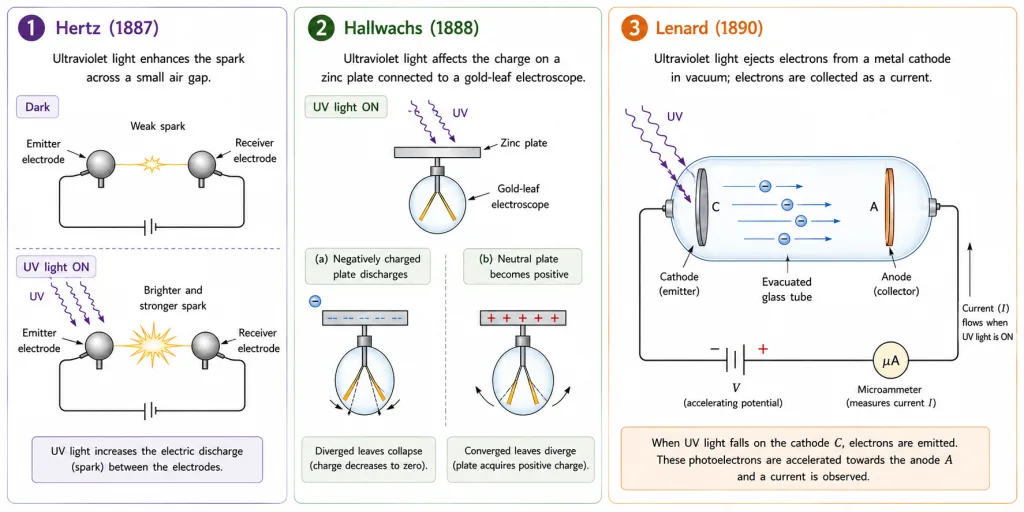
In his spark-discharge experiments for generating and detecting EM waves, Hertz noticed something odd: high-voltage sparks across his detector loop were enhanced when the emitter plate was illuminated by ultraviolet light from an arc lamp.
What was happening? Light shining on the metal surface somehow facilitated the escape of free, charged particles — the particles we now know as electrons. When light falls on the metal, some electrons near the surface absorb enough energy from the radiation to overcome the attraction of the positive ions; with sufficient energy, they escape into the surrounding space.
This is the photoelectric effect — discovered in 1887, the same year Hertz confirmed Maxwell's waves.
Lenard's Tube: Current That Follows the Light
Wilhelm Hallwachs and Philipp Lenard investigated photoelectric emission in detail during 1886-1902.
Lenard (1862-1947) used an evacuated glass tube with two metal plates (electrodes). His observation sequence:
- Shine ultraviolet radiation on the emitter plate C → current flows in the circuit.
- Stop the ultraviolet light → the current stops instantly.
The interpretation: UV light ejects electrons from the emitter plate C; the electric field sweeps them to the positive collector plate A; electrons flowing through the evacuated tube complete the circuit. Light in, current on. Light off, current gone.
Hallwachs and Lenard then studied how this photocurrent varied with collector plate potential, and with the frequency and intensity of the light — the systematic study the next section formalises.
[NEET Important] Dates and durations are quizzed directly: Hertz's discovery 1887; Hallwachs-Lenard detailed studies 1886-1902; Lenard's tube demonstrates that the photocurrent follows the light with no perceptible lag.
Hallwachs' Electroscope: Proving the Charge is Negative
In 1888, Hallwachs ran an elegantly simple series of tests with a zinc plate connected to an electroscope:
| Zinc plate initially | Under UV light | Conclusion |
|---|---|---|
| Negatively charged | loses its charge | negative charge is leaving |
| Uncharged | becomes positively charged | negative charge is being emitted |
| Positively charged | positive charge is further enhanced | emitted negative particles escape completely |
All three rows point one way: negatively charged particles are emitted from the zinc plate under ultraviolet light. After the electron's discovery in 1897, it became evident these particles are electrons — henceforth called photoelectrons.
The first hint of a threshold
Hallwachs and Lenard also noticed something the wave theory could never digest: when the frequency of the incident light was below a certain minimum value — the threshold frequency — no electrons were emitted at all, no matter what. This minimum frequency depends on the nature of the emitter material.
Which metals respond to which light?
- Zinc, cadmium, magnesium: respond only to ultraviolet (short-wavelength) light.
- Alkali metals (lithium, sodium, potassium, caesium, rubidium): sensitive even to visible light.
All these photosensitive substances emit electrons when illuminated by suitable light — the phenomenon named the photoelectric effect.
[JEE Tip] 'Threshold depends on the material' is the load-bearing fact. In every two-metal comparison problem, the metal needing only visible light is the one with the smaller work function — and therefore the smaller threshold frequency.
Solved Examples
Example 1: Reading Hallwachs' electroscope
A negatively charged zinc plate on an electroscope is exposed to UV light and loses its charge. What happens if the plate is positively charged instead, and why?
Solution:
- UV light ejects negatively charged particles (photoelectrons) from zinc.
- From a negative plate, the emitted electrons carry away the excess negative charge → plate discharges.
- From a positive plate, emitted electrons leave an even greater positive imbalance → the positive charge is further enhanced (the plate also pulls some electrons back, but net emission continues).
- Takeaway: all three of Hallwachs' observations consistently prove the emitted particles are negative.
Example 2: Why did the current stop with the light? [Board Conceptual]
In Lenard's experiment, the circuit current vanished the moment the UV source was switched off. What does this establish?
Solution:
- The current is carried by electrons ejected from the emitter plate by the light.
- No light → no ejection → no charge carriers crossing the evacuated gap → no current.
- This establishes that light itself causes the emission (and hints that emission is essentially instantaneous — quantified later as ~ s).
Example 3: Matching metals to light [NEET Pattern]
UV light of a given frequency causes emission from zinc. Will the same source necessarily cause emission from caesium? Will red light?
Solution:
- Zinc responds only to UV — its threshold lies in the UV range.
- Caesium (alkali metal) has a lower threshold, in the visible range. UV frequency > caesium's visible threshold → yes, caesium emits.
- Red light (lowest visible frequencies, photon energy ~1.8 eV) lies below caesium's threshold (2.14 eV work function) → no emission even from caesium.
- Takeaway: higher-frequency light clears every lower threshold; the converse never holds.
Example 4: The direction of photocurrent
In Lenard's tube, electrons flow from emitter C to collector A inside the tube. What is the direction of conventional current in the external circuit?
Solution:
- Inside the tube: electrons move C → A.
- Conventional current flows opposite to electron flow: A → C inside the tube.
- In the external circuit, conventional current therefore flows from C's terminal through the circuit to A's terminal — i.e. the external current direction is from the emitter's terminal around to the collector. Tracking this direction correctly is a common one-mark trap.
Example 5: An uncharged plate charges up [Board Conceptual]
Explain why an initially uncharged, insulated zinc plate becomes positively charged under prolonged UV illumination.
Solution:
- UV photons eject photoelectrons from the neutral plate.
- Each departing electron leaves the plate with a net deficiency of negative charge.
- Accumulated deficiency = net positive charge, which grows until the plate's positive potential pulls returning electrons back as fast as they are emitted.
- Takeaway: exactly Hallwachs' second observation — emission from even a neutral surface.
Example 6: Estimating the historical window
Between which years did Hallwachs and Lenard conduct their detailed photoelectric investigations, and what two parameters of light did they vary?
Solution:
- 1886-1902 — the two-decade window NCERT cites.
- They studied photocurrent variation with collector plate potential, and with the frequency and intensity of the incident light.
- These systematic variations set the stage for the four laws of photoelectric emission (next section).
Example 7: Why ultraviolet for Hertz?
Hertz's spark-gap sparks strengthened specifically under ultraviolet illumination. Using threshold ideas, explain why visible room light didn't produce the effect on his metal electrodes.
Solution:
- Ordinary electrode metals (like zinc-coated surfaces) have work functions of several eV — thresholds in the ultraviolet.
- Visible photons carry only 1.8-3.1 eV — below such thresholds → no photoemission, no spark enhancement.
- UV photons exceed the threshold, liberating electrons that help the gap break down → enhanced sparks.
Example 8: Threshold depends on material [JEE Conceptual]
Light of frequency causes emission from sodium but not from zinc. What can you conclude about ?
Solution:
- Emission from sodium → .
- No emission from zinc → .
- Hence — the frequency is bracketed between the two thresholds, and zinc's threshold is higher (consistent with zinc responding only to UV).
- Takeaway: bracketing an unknown frequency between two material thresholds is a standard exam construction.
Example 9: The evacuated tube detail
Why must Lenard's tube be evacuated for the experiment to work cleanly?
Solution:
- Photoelectrons must travel from emitter to collector without collisions.
- Gas molecules in the path would scatter or capture electrons and could themselves ionise, contaminating the current.
- A vacuum ensures the measured current counts only light-generated electrons — clean cause and effect.
Example 10: Classifying the observations
Attribute each observation to Hertz, Hallwachs or Lenard: (a) UV-enhanced sparks in a detector loop, (b) charged zinc plate and electroscope studies, (c) current in an evacuated two-plate tube under UV.
Solution:
- (a) Hertz (1887) — spark-gap enhancement during EM-wave experiments.
- (b) Hallwachs (1888) — zinc plate + electroscope charge studies.
- (c) Lenard — evacuated tube, current flowing while UV shines and stopping when it stops.
- Takeaway: three names, three signature set-ups; exams check the pairing, not the details.