
From Energy Quantum to Genuine Particle
The photoelectric effect showed that light, in interaction with matter, behaves as if made of quanta of energy . But is a 'quantum of energy' really a particle? A particle should carry a definite momentum too.
Einstein supplied the answer: the light quantum carries momentum
A definite energy and a definite momentum — that's the calling card of a particle. This particle of light was later named the photon.
The clinching experimental proof came in 1924 from A. H. Compton's scattering of X-rays from electrons: the X-ray photon bounces off an electron exactly like a billiard-ball collision, conserving energy and momentum. Particle behaviour, caught in the act.
Nobel scoreboard
- Einstein — Nobel Prize 1921, for contributions to theoretical physics and the photoelectric effect.
- Millikan — Nobel Prize 1923, for the elementary charge and the photoelectric effect.
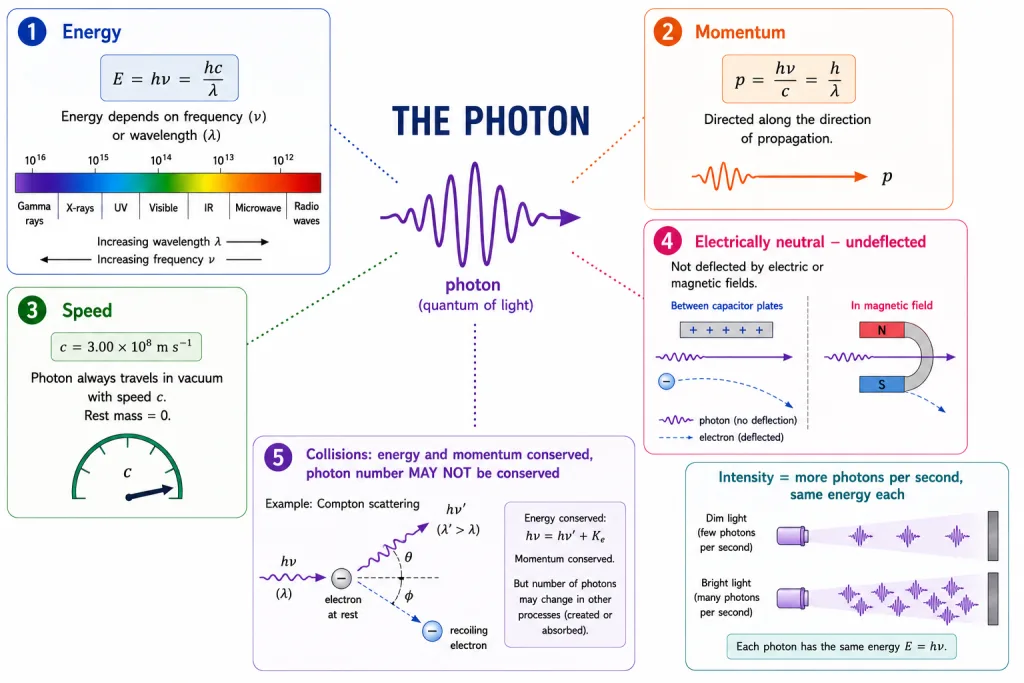
The Photon Picture: Five Properties to Memorise
NCERT summarises the photon picture of electromagnetic radiation in five statements — learn them as a set:
- In interaction with matter, radiation behaves as if made of particles — photons.
- Each photon has energy , momentum , and speed c, the speed of light.
- All photons of a given frequency (or wavelength) are identical in energy and momentum, whatever the intensity. Increasing intensity only increases the number of photons crossing a given area per second — never the energy per photon.
- Photons are electrically neutral, and are not deflected by electric or magnetic fields.
- In a photon-particle collision (say photon-electron), total energy and total momentum are conserved — but the number of photons may not be conserved: a photon may be absorbed, or a new one created.
Key Point: Property 5 is subtle and exam-worthy: energy and momentum conservation hold, photon number conservation does not. Light can be born and can die; electrons cannot (in these processes).
[JEE Tip] Two workhorse formulas: and . For photon-counting problems, the number emitted per second by a source of power P is — NCERT Example 11.1 exactly.
[NEET Important] A photon has zero rest mass, travels only at c, and its 'effective mass' questions () occasionally appear — but its rest mass is strictly zero. Neutrality (no deflection in E or B fields) distinguishes photon beams from cathode rays instantly.
Solved Examples
Example 1: Photons from a laser (NCERT Example 11.1)
Monochromatic light of frequency Hz is produced by a laser of power W. (a) What is the energy of each photon? (b) How many photons per second does the source emit?
Solution:
- (a) Photon energy: J ≈ 2.49 eV.
- (b) Counting: power P = N × E per second, so .
- Answer: photons per second.
- Takeaway: even a feeble milliwatt beam delivers quadrillions of photons a second — which is why light looks continuous.
Example 2: Energy and momentum of one photon (NCERT Exercise 11.4 style)
A helium-neon laser emits at 632.8 nm with power 9.42 mW. Find each photon's energy and momentum, and the photons arriving per second at a target.
Solution:
- Energy: J.
- Momentum: kg m/s.
- Rate: photons/s.
- Takeaway: needs ; momentum needs only — no factor of c.
Example 3: A hydrogen atom matching photon momentum (NCERT Exercise 11.4c)
How fast must a hydrogen atom (m = kg) travel to have the momentum of a 632.8 nm photon?
Solution:
- Photon momentum (from Example 2): kg m/s.
- Set equal: .
- Answer: v ≈ 0.63 m/s — walking pace!
- Takeaway: photon momenta are tiny; an atom matches one at less than 1 m/s. This is why radiation pressure is so gentle.
Example 4: X-ray production limits (NCERT Exercise 11.1)
Electrons accelerated through 30 kV strike a target. Find (a) the maximum frequency and (b) the minimum wavelength of the X-rays produced.
Solution:
- Concept (inverse photoelectric effect): the entire electron energy eV converts, at best, into one photon: .
- (a) Hz.
- (b) nm (or use nm).
- Takeaway: the photoelectric effect run backwards — electron energy → photon energy — sets the hard short-wavelength limit of an X-ray tube.
Example 5: Which beam has more photons? [NEET Conceptual]
A 1 W red beam (700 nm) and a 1 W violet beam (400 nm): which delivers more photons per second, and by what factor?
Solution:
- Rate: — at equal power, N ∝ .
- Ratio: .
- Answer: the red beam delivers 1.75 times more photons per second — each red photon is weaker, so more are needed to carry the same power.
- Takeaway: equal power never means equal photon count; the longer wavelength always wins on numbers.
Example 6: Photon in fields [Board Conceptual]
A beam passes undeflected through strong electric and magnetic fields. Can you conclude it is a photon beam?
Solution:
- Photons are electrically neutral — never deflected by E or B fields. Consistent.
- But neutrality alone doesn't clinch it: neutrons or any neutral particles also pass undeflected.
- Conclusion: undeflected passage is necessary but not sufficient evidence; contrast with cathode rays, which E and B fields visibly bend (Section 1).
Example 7: Photon number is not conserved [JEE Conceptual]
In a photon-electron collision, which of these are conserved: total energy, total momentum, number of photons, number of electrons?
Solution:
- Total energy: conserved. Total momentum: conserved. (Standard collision rules.)
- Photon number: NOT necessarily conserved — the photon may be absorbed (vanishing) or a new photon created.
- Electron number: conserved in these processes.
- Takeaway: NCERT's property (v) verbatim — a favourite true/false discriminator.
Example 8: Intensity vs photon energy [NEET Conceptual]
A fixed-wavelength source is turned up from 1 W to 10 W. What happens to (a) each photon's energy and momentum, (b) the photon flux, (c) the beam's total momentum delivered per second?
Solution:
- (a) unchanged — E = and p = depend only on wavelength.
- (b) photon flux (photons/s) rises tenfold: N = ∝ P.
- (c) momentum delivered per second = N × p also rises tenfold — radiation pressure scales with intensity.
- Takeaway: intensity is a count dial, not an energy-per-photon dial — the photon picture's core message.
Example 9: Compton's role [Board Conceptual]
What did Compton's 1924 experiment demonstrate, and why was it decisive for the photon concept?
Solution:
- Compton scattered X-rays off electrons and analysed the scattered radiation.
- The results matched a particle-particle collision: a photon of energy and momentum striking an electron, with energy and momentum conserved.
- Decisive because momentum transfer is a particle signature — energy quanta alone (photoelectric effect) could conceivably be a property of absorption; Compton showed the quanta travel as particles.
Example 10: Photons per second from a sodium lamp [JEE Numerical]
A 60 W sodium lamp radiates at an effective wavelength of 589 nm. How many photons leave it per second?
Solution:
- Photon energy: eV J.
- Rate: .
- Answer: photons per second.
- Takeaway: household sources emit ~ photons a second — the graininess of light is hidden under sheer numbers.