
Can Moving Magnets Make Electricity?
By the early nineteenth century, Oersted, Ampere and others had established that moving electric charges produce magnetic fields — a current deflects a compass needle. The obvious next question: is the converse possible? Can moving magnets produce electric currents?
The answer is a resounding yes. Around 1830, Michael Faraday in England and Joseph Henry in the USA demonstrated conclusively that electric currents are induced in closed coils subjected to changing magnetic fields. This phenomenon — current generated by varying magnetic fields — is called electromagnetic induction.
When Faraday first showed that relative motion between a bar magnet and a wire loop produced a small current, someone asked, 'What is the use of it?' His reply: 'What is the use of a new born baby?' Today the answer surrounds you — generators and transformers, electric lights, trains, telephones, computers — all descend directly from these experiments.
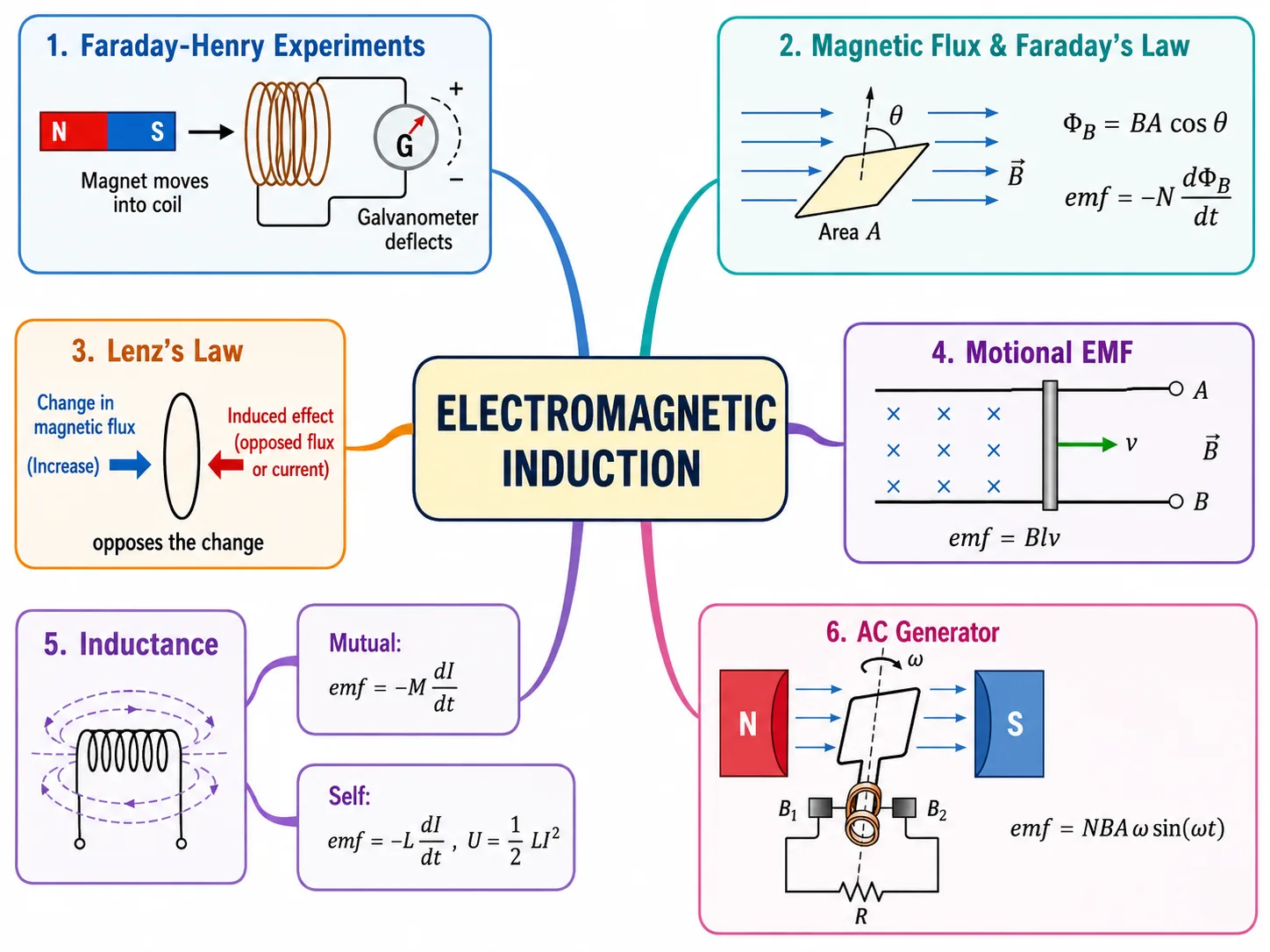
The roadmap: the three Faraday-Henry experiments (this section), magnetic flux and Faraday's law, Lenz's law and energy conservation, motional emf, mutual and self-inductance, and finally the AC generator.
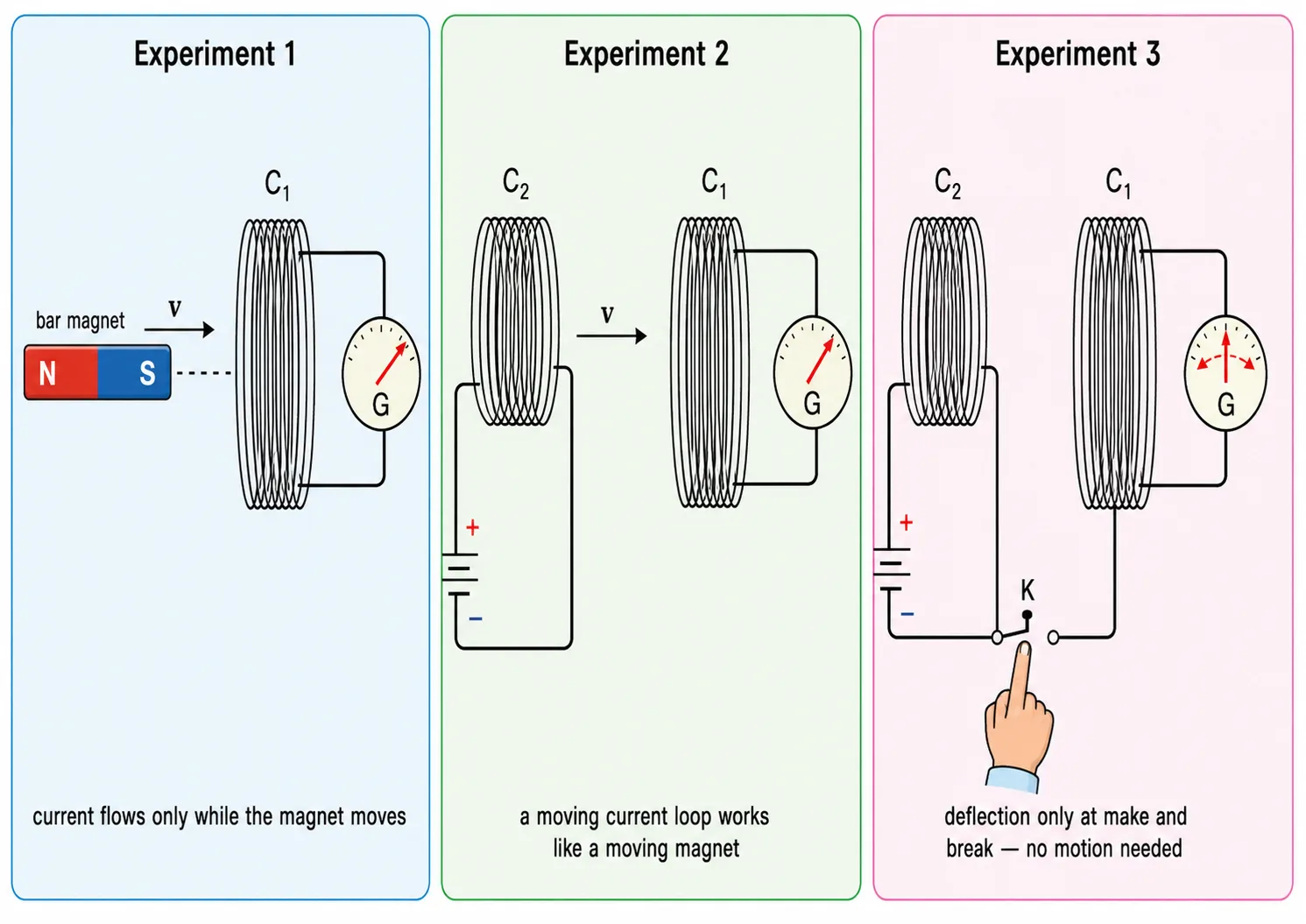
Experiment 1: A Magnet and a Coil
Connect a coil C to a galvanometer G, and play with a bar magnet. The observations, each one exam-worthy:
- Push the North pole towards the coil — the galvanometer deflects: a current flows.
- The deflection lasts only as long as the magnet is moving. Hold the magnet stationary — no deflection, however close or strong it is.
- Pull the magnet away — the deflection reverses: the current direction reverses.
- Use the South pole instead — all deflections are opposite to the North-pole case.
- Move faster — the deflection (and current) is larger.
- Hold the magnet fixed and move the coil instead — same effects.
Key Point: It is the relative motion between magnet and coil that induces the current. Nature doesn't care which one moves.
Experiment 2: Two Coils
Replace the bar magnet by a second coil C carrying a steady current from a battery. The steady current in C produces a steady magnetic field — C behaves just like a bar magnet (remember the equivalence from Chapter 5!).
- Move C towards C: the galvanometer in C deflects.
- Move C away: deflection in the opposite direction.
- Again, the current appears only during relative motion, and grows with speed.
This confirms the lesson of Experiment 1 with an electromagnet in place of a permanent magnet.
Experiment 3: No Motion at All!
Faraday's most remarkable experiment: both coils held stationary. Coil C has a galvanometer; coil C is connected to a battery through a tapping key K.
- Press the key: a momentary deflection in C — it returns to zero quickly.
- Hold the key pressed continuously: no deflection, even though a steady current flows in C.
- Release the key: a momentary deflection again, in the opposite direction.
- Insert an iron rod along the axis of the coils and repeat: the deflections increase dramatically.
[NEET Important] The deflection occurs only at make and break of the circuit — i.e. only while the current (and hence the magnetic field) in C is changing. A steady current, however large, induces nothing.
Key Point: Motion is not fundamental — change of magnetic field (flux) is. The three experiments together point to one law, which Faraday wrote down. That's Section 2.
A practical footnote: sensitive electrical instruments near an electromagnet can be damaged by induced emfs when the electromagnet is switched on or off — exactly this make-and-break effect.
Solved Examples
Example 1: Getting a bigger deflection
In Experiment 2, what would you do to obtain a large deflection of the galvanometer?
Solution: Strengthen the changing flux through C by any of:
- Insert a soft iron rod inside coil C (boosts the field enormously, as in Chapter 5's cored solenoid).
- Connect C to a more powerful battery (larger current, larger field).
- Move the arrangement faster towards/away from C (faster flux change).
Example 2: No galvanometer? No problem
How would you demonstrate the presence of an induced current without a galvanometer?
Solution: Replace the galvanometer with a small torch bulb. The relative motion between the coils makes the bulb glow, demonstrating the induced current. (In experimental physics one must learn to innovate — Faraday was legendary for exactly this.)
Example 3: Faster withdrawal, bigger kick [NEET Numerical]
Withdrawing a magnet from a coil over 0.2 s produces an average induced emf of 3 mV. The same withdrawal (same flux change) is done in 0.05 s. Find the new average emf.
Solution:
- The induced emf is proportional to the rate of flux change: with fixed.
- Time shrinks by , so the emf grows 4-fold.
- Answer: mV. Same change, quarter the time, four times the emf.
Example 4: Speed and turns together [JEE Numerical]
A magnet approaching a 50-turn coil at speed v induces 2 mA in the galvanometer circuit. Estimate the current if the coil is replaced by a 100-turn coil (same geometry/resistance) and the magnet approaches at 2v.
Solution:
- The emf scales with the number of turns () and with the rate of flux change ( speed).
- Factor .
- Answer: mA, in the same sense as before.
Example 5: The iron-core multiplier [NEET Numerical]
In Experiment 3, pressing the key induces a momentary emf of 0.5 mV in C. A soft-iron rod () is inserted along the axis and the experiment is repeated with the same switching time. Estimate the new emf.
Solution:
- The core multiplies the field — and hence the flux through C — by about (Chapter 5).
- Same switching time, 400 times the flux change: .
- Answer: mV V — the 'dramatic increase' described qualitatively, now with a number.
Example 6: Same flux change, different resistance [JEE Numerical]
A given magnet movement always sends charge mC through a coil circuit of resistance 2 . The galvanometer is replaced so the total resistance becomes 8 . What charge flows for the same movement?
Solution:
- The charge depends only on the total flux change and resistance: (so mWb here).
- New charge: mC.
- Answer: 2 mC — quadrupling R quarters the charge; the speed of the movement would change the current but never this charge.
Example 7: The tapping key mystery
In Experiment 3, why does the galvanometer deflect only when the key is pressed or released, and not while it is held pressed?
Solution:
- Press: current in C rises from zero to maximum in a short time — the field and the flux through C increase — emf is induced.
- Held pressed: current is steady, flux through C is constant — no change, no emf, current in C drops to zero.
- Release: current and flux collapse to zero — flux decreases — emf induced with opposite polarity.
Example 8: Make and break by the numbers [JEE Numerical]
Pressing the key raises C's current from 0 to 4 A in 20 ms, inducing an average emf of 6 mV in C. The key is then released and the current dies in 5 ms. Find the average emf at break.
Solution:
- The emf scales as the rate of change of current (flux): with the same A.
- Break is times faster than make.
- Answer: mV, opposite in polarity to the make pulse. (Break is usually sharper than make — which is why switching OFF gives the bigger kick.)
Example 9: Two-speed comparison with a pole flip [NEET Numerical]
Pushing a magnet's N-pole towards a coil at speed v gives a current of 2 mA, rightward on the meter. Find the current (magnitude and meter direction) when the S-pole is pushed in at speed 3v.
Solution:
- Magnitude: the emf (and current) is proportional to the rate of flux change, i.e. to the speed: mA.
- Direction: swapping the pole reverses the sense of the flux change, so the deflection reverses: leftward.
- Answer: 6 mA, deflecting left — observations 4 and 5 of Experiment 1, quantified.
Example 10: An honest summary
State the single conclusion that unifies all observations of the three experiments.
Solution:
- Experiment 1 and 2: relative motion changes the field through C. Experiment 3: switching changes it with nothing moving.
- In every case a current appears only while the magnetic flux through the coil is changing, and is larger when the change is faster.
- Conclusion: the time rate of change of magnetic flux through a circuit induces an emf in it — Faraday's law, stated formally in the next section.