
Inductance: The Geometry Constant
Whether flux through a coil comes from a neighbouring coil's current or its own, one proportionality always holds (for fixed geometry):
For a closely wound coil of turns, the same flux links every turn, so we use the flux linkage , and write
The constant of proportionality is called inductance. Like capacitance, it depends only on geometry (and intrinsic material properties such as ) - not on the current.
- Inductance is a scalar.
- Dimensions: (flux linkage over current).
- SI unit: henry (H), honouring Joseph Henry, who discovered induction in the USA independently of Faraday.
Key Point: 1 henry = 1 weber per ampere = 1 volt-second per ampere. Equivalently, a coil has if a current changing at 1 A/s induces 1 V in it.
Two flavours follow: mutual inductance (this section) — one coil's changing current induces emf in another; and self-inductance (next section) — a coil induces emf in itself.
Coaxial Solenoids: Calculating M
Take two long coaxial solenoids, each of length : inner solenoid S (radius , turns/length) and outer S (radius , turns/length).
Current in the outer, flux in the inner. Pass through S. Its interior field is , and the flux linkage of S (total turns , each of area ) is
Current in the inner, flux in the outer. Now pass through S. Its field is confined inside S (long solenoid), threading area of each of S's turns:
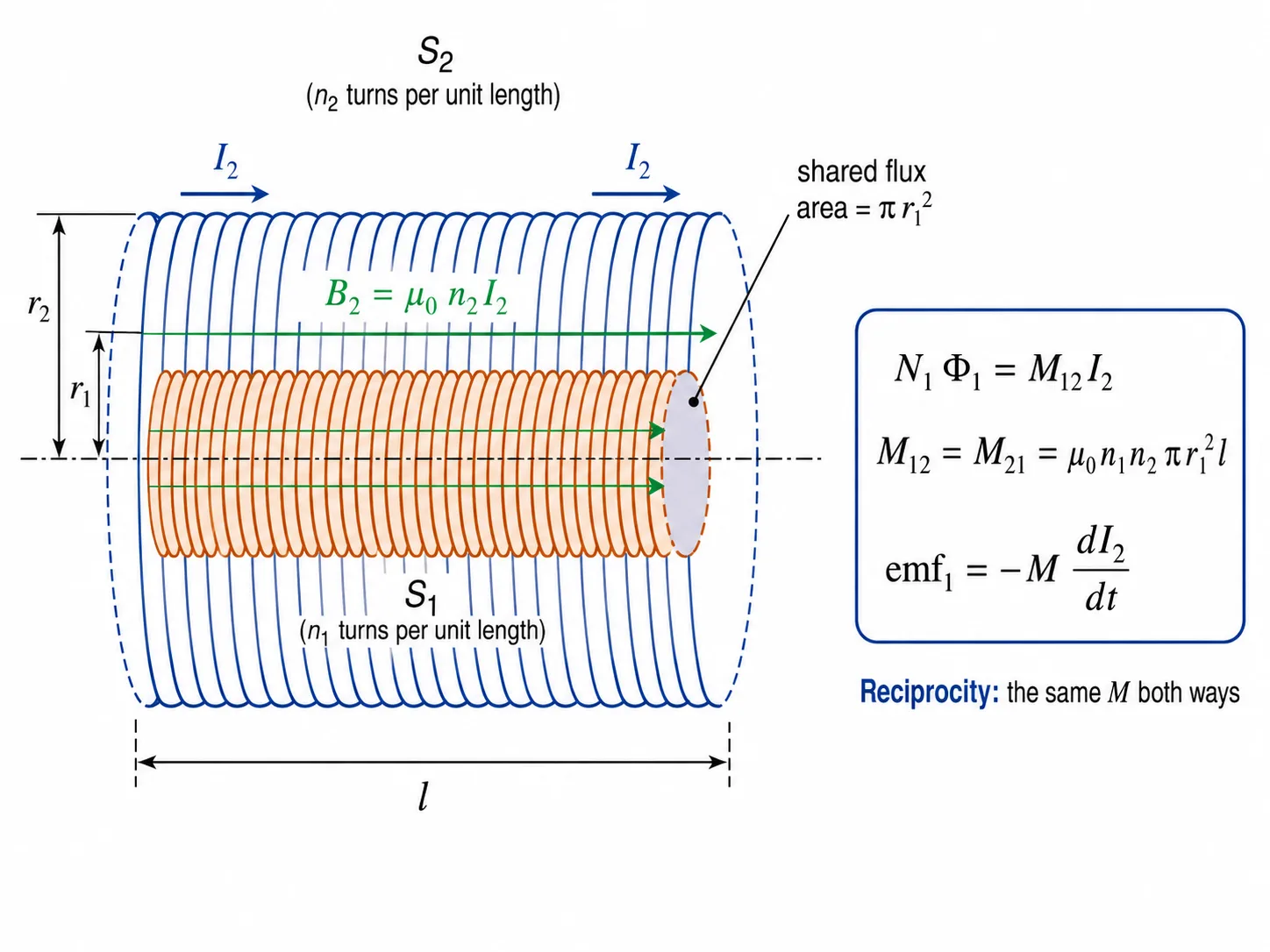
Note two things worth stressing: (i) it is the smaller radius that appears - only the inner area carries shared flux; (ii) the equality (reciprocity) is completely general, and is a free gift in hard problems: if one direction is difficult to compute (flux of a short inner coil through a long outer one), compute the easy direction instead!
The Working Law and the Concentric-Coils Classic
From , differentiating when varies with time:
A varying current in one coil induces an emf in a neighbouring coil, proportional to the rate of change of current. This is exactly Experiment 3 of Section 1 - the tapping key - now quantified. It is also the heart of the transformer (next chapter).
The concentric-coils result: a small coil of radius sits at the centre of a large coplanar, concentric coil of radius (). Current in the big coil makes a nearly uniform field over the small coil's area, so
[JEE Tip] Notice the reciprocity trick in action: computing the small coil's (non-uniform!) flux through the big coil directly would be very hard - but lets us use the easy direction. This exact reasoning (and formula) is a JEE regular.
[NEET Important] depends on geometry (sizes, turns, separation, orientation) and the medium ( multiplies it if a magnetic material fills the space) — never on the currents themselves.
Solved Examples
Example 1: Concentric coils
Two concentric, coplanar circular coils have radii and with . Obtain the mutual inductance.
Solution:
- Let current flow in the outer coil. At its centre, — effectively uniform over the tiny inner coil.
- Flux through the inner coil: .
- Comparing with : (and by reciprocity is the same).
- The approximation is good precisely because .
Example 2: Coaxial solenoids numerical
Two coaxial solenoids of length 1.0 m each have turns/m; the inner one has radius 2.0 cm. Find .
Solution:
- Formula: .
- m.
- .
- Answer: H mH.
Example 3: EMF from a changing current
Two coils have mutual inductance 1.5 H. The current in one changes from 0 to 20 A in 0.5 s. Find (a) the change of flux linkage with the other coil, (b) the average induced emf in it.
Solution:
- (a) Wb.
- (b) V.
- The faster the switch-on, the larger the induced emf — the tapping-key effect, quantified.
Example 4: Concentric coils numerical
A small coil of radius 1.0 cm lies at the centre of a large coil of radius 20 cm. Find .
Solution:
- .
- Numerator: .
- Answer: H — about 1 nH. Small coils far apart couple weakly.
Example 5: Why reciprocity is a gift
A short coil is placed well inside a very long solenoid. Computing the flux of the short coil's (complicated) field through the long solenoid is hard. How do you find ?
Solution:
- Use : compute the easy direction — the long solenoid's uniform field through the short coil's turns.
- If the short coil has turns of area : .
- Reciprocity converts an impossible integral into one line — this is exactly the useful trick.
Example 6: Flux linkage from
Two coils have mH. What flux linkage does a 4 A current in one produce through the other?
Solution:
- .
- Answer: Wb of flux linkage — no emf yet; emf needs this to change.
Example 7: Defining the henry
Define 1 henry of mutual inductance in two equivalent ways.
Solution:
- Via flux: H if 1 A in one coil produces a flux linkage of 1 Wb in the other ().
- Via emf: H if a current changing at 1 A/s in one coil induces 1 V in the other ().
- Both follow from the same equation — Wb/A = V s/A = H.
Example 8: Coil inside a long solenoid [JEE Numerical]
A short 100-turn coil of area m sits well inside a long solenoid of 1500 turns/m. Find , and the emf in the coil when the solenoid's current changes at 50 A/s.
Solution:
- Easy direction (reciprocity): the solenoid's field threads the coil's turns: .
- H.
- V mV.
Example 9: Scaling the solenoids
Both turn densities and of a coaxial-solenoid pair are doubled. By what factor does change?
Solution:
- .
- Doubling both: .
- Answer: four times. (Doubling only the inner radius would also give 4x — the dependence.)
Example 10: The tapping key, quantified
In Experiment 3 (Section 1), the key press raises from 0 to 5 A in 0.01 s; the coil pair has mH. Find the average emf induced in C at make, and explain the zero deflection while the key stays pressed.
Solution:
- At make: V.
- Key held: , so — steady current, no induction.
- At break, the same magnitude appears with opposite polarity (flux collapsing). The 190-year-old experiment is one line of algebra now.