
The Law of Opposition
Faraday's law gives the magnitude of the induced emf. Its polarity comes from a beautifully concise rule deduced in 1834 by the German physicist Heinrich Friedrich Lenz:
The polarity of the induced emf is such that it tends to produce a current which opposes the change in magnetic flux that produced it.
This is exactly what the negative sign in encodes.
The bar-magnet picture (the exam classic):
- N-pole approaching the coil: flux through the coil increases → the induced current opposes the increase → it flows counter-clockwise as seen from the magnet's side → the coil's near face becomes a north pole → it repels the approaching magnet.
- N-pole receding: flux decreases → induced current flows clockwise (seen from the magnet) → near face becomes a south pole → it attracts the receding magnet, opposing its departure.
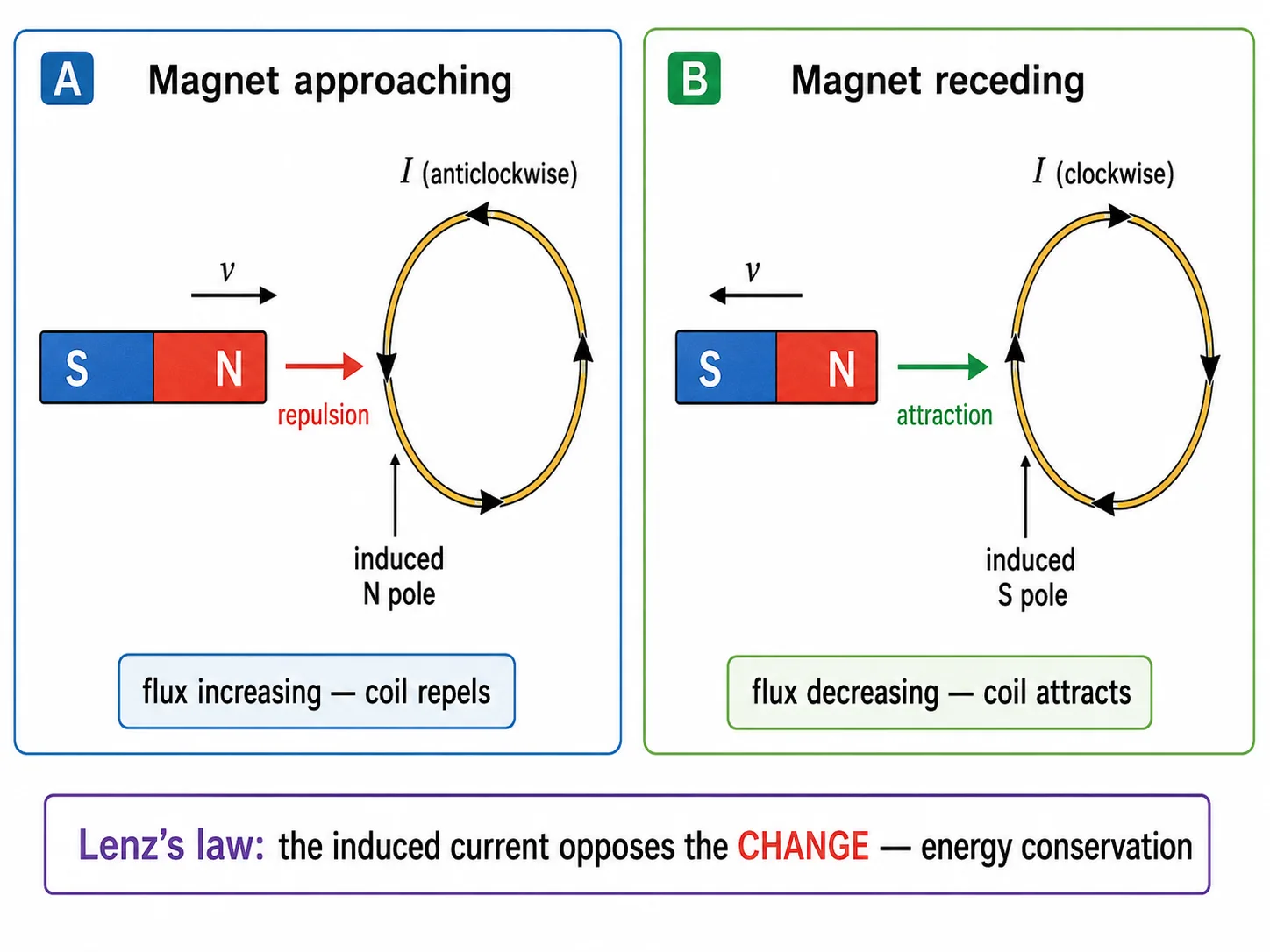
Either way, the coil fights the change — never the flux itself. And the rule works even for an open circuit: an emf of the corresponding polarity appears across the open ends, ready to drive that opposing current.
Lenz's Law IS Conservation of Energy
Suppose Lenz's law were reversed: the approaching N-pole induced a south face on the coil. The magnet would be attracted, accelerate, increase the flux faster, induce more current, attract harder… A gentle push would make its velocity and kinetic energy grow without any energy being spent. You could build a perpetual-motion machine.
That violates the law of conservation of energy — so it cannot happen.
In the correct (Lenz) case:
- The magnet is repelled, so the person pushing it must do work against the opposition.
- Where does that work go? It is dissipated as Joule heat by the induced current in the coil.
Key Point: Energy bookkeeping is exact: mechanical work in = electrical energy induced = heat out. Lenz's law is not a separate axiom; it is energy conservation wearing electromagnetic clothes.
[NEET Important] A magnet dropped through a conducting ring/coil falls with acceleration less than g while interacting (opposed approaching and leaving); the same magnet dropped through a cut (open) ring falls at exactly g because no current can flow through the gap (though an emf still appears across the cut).
The Direction Toolkit & Reasoning Set
Standard direction calls (field into the page, loop in the plane of the page):
| Situation | Flux (into page) | Induced current |
|---|---|---|
| Loop entering the field region | increasing | anticlockwise (makes out-of-page flux) |
| Loop fully inside, moving | constant | zero |
| Loop leaving the field region | decreasing | clockwise (makes into-page flux) |
This is the leaving-the-field case in compact form — and note its punchline: no current flows while the loop is completely inside or completely outside the field region, however fast it moves.
Three reasoning gems:
- Stationary loop between very strong fixed magnets: no current, however strong the magnets. No change of flux, no induction.
- Loop moving in the uniform electric field of a capacitor: no magnetic flux anywhere in the problem, so no induced current — whether wholly inside or partially outside the plates.
- Rectangular vs circular loop leaving a field region at constant v: the rectangular loop gives a constant emf during exit (the in-field length, and so , is constant), while the circular loop's in-field width keeps changing — its emf varies during the passage.
[JEE Tip] For any 'find the direction' question, run the three-step drill: (1) which way is through the loop? (2) is increasing or decreasing? (3) the induced current makes flux opposing that change — fix its sense by the right-hand rule. Three seconds, full marks.
Eddy Currents
When a solid conductor (not a thin wire) sits in a changing magnetic flux, the induced currents are not confined to a single loop — they swirl through the bulk of the metal in closed paths, like little whirlpools. These are eddy currents (also called Foucault currents). Their direction always obeys Lenz's law: they oppose the very change of flux that creates them.
Because the metal has resistance, eddy currents dissipate energy as heat (). Depending on the situation that is a nuisance, a brake, or the whole point:
As a brake (electromagnetic damping): in magnetic braking of trains, electromagnets over the rails induce eddy currents whose Lenz-law drag brings the train to a smooth, frictionless halt. The same damping makes a galvanometer dead-beat — a metal frame moving in the field is braked, so the pointer settles at once instead of oscillating.
As a heater: an induction furnace uses high-frequency eddy currents to melt a metal charge for preparing alloys; an induction cooktop heats the pan the same way.
As an unwanted loss: in transformer and motor cores eddy currents waste energy. The cure is lamination — the core is built from thin, insulated sheets, which chops the eddy loops into many small high-resistance paths and sharply cuts the dissipation.
[NEET Important] An eddy current is nothing exotic: it is an ordinary induced current in a bulk conductor. Faraday's law still fixes its size and Lenz's law still fixes its direction.
Solved Examples
Example 1: Direction AND magnitude at entry [JEE Numerical]
A rectangular loop of width 0.2 m and circuit resistance 0.4 enters a 0.5 T field region (into the page) at 2 m/s. Find the induced current's magnitude and sense.
Solution:
- Magnitude: only the leading side cuts lines: V, so A.
- Direction (Lenz): into-page flux is increasing → oppose with out-of-page flux → current anticlockwise.
- Answer: 0.5 A, anticlockwise — direction calls earn full marks only with the magnitude attached.
Example 2: Inside, then leaving [NEET Numerical]
The same loop now (a) moves wholly inside the region, (b) exits at the same 2 m/s. Find the current in each phase.
Solution:
- (a) Fully inside, the enclosed flux is constant: , so — however fast it moves.
- (b) Exiting, the into-page flux decreases → the loop supports it → current clockwise, magnitude again A.
- Pattern: entry pulse (anticlockwise), silence, exit pulse (clockwise) — equal magnitudes, opposite senses.
Example 3: The retarding force on the loop [JEE Numerical]
For the entering loop of Example 1 (B = 0.5 T, l = 0.2 m, v = 2 m/s, R = 0.4 ), find the magnetic force on it and the external force needed for constant velocity.
Solution:
- The induced current A flows through the in-field side: N.
- By Lenz's law this force opposes the motion (it retards entry; it would also retard exit).
- Answer: an equal external force of 0.05 N () must be applied to maintain v.
Example 4: Strong magnets, stationary loop
A closed loop is held stationary between the poles of two fixed, very strong permanent magnets. Can we generate a current by using stronger magnets?
Solution:
- Induction requires a time-varying flux, not a large flux.
- Everything here is stationary and steady: .
- No current — no matter how strong the magnets. Strength is not change.
Example 5: A loop in a capacitor's electric field
A closed loop moves normal to the constant electric field between capacitor plates. Is a current induced (i) wholly inside, (ii) partially outside the plates?
Solution:
- Electromagnetic induction responds to changing magnetic flux. Here there is an electric field but no magnetic flux at all.
- Moving the loop changes nothing magnetic — in both cases the induced current is zero.
- A constant electric flux through a loop also does not produce electromagnetic induction; the relevant quantity here is .
Example 6: Rectangle vs circle leaving the field
A rectangular and a circular loop move out of a uniform field region with the same constant velocity. In which is the induced emf constant during the passage out?
Solution:
- The emf is where is the length of the side still cutting field lines.
- Rectangle: the in-field side length is fixed, so is constant during exit.
- Circle: the chord inside the field keeps changing as it exits, so the emf varies. Answer: the rectangular loop.
Example 7: Lenz's energy bill [JEE Numerical]
The loop of Example 1 is dragged out of the field region through 0.1 m at the constant 2 m/s. Compute (a) the heat generated, (b) the work done by the puller, and compare.
Solution:
- (a) A, so W. Exit time s. Heat J.
- (b) Work J.
- They match exactly — the puller's work against the Lenz force is precisely the Joule heat. Conservation of energy, audited.
Example 8: Magnet falling towards a ring [NEET Numerical]
A magnet dropped towards a horizontal ring (R = 0.1 ) raises the downward flux through it from 0 to 8 mWb in 0.2 s. Find the average emf and current, and the current's sense seen from above.
Solution:
- V.
- A.
- Sense: downward flux increasing → upper face turns N to repel → anticlockwise seen from above. (And the magnet falls with a < g.)
Example 9: Reversing a solenoid's current [NEET Numerical]
A 20-turn coil is wound around a solenoid; each turn links Wb. The solenoid's current is reversed in 0.05 s. Find the average emf induced in the coil.
Solution:
- Reversal doubles the change: per turn Wb.
- .
- Answer: V, its polarity set by Lenz's law (opposing the collapse, then the rebuild, of the flux).
Example 10: The forbidden alternative
Show that reversing Lenz's law would permit a perpetual-motion machine.
Solution:
- Reversed law: the approaching N-pole induces a south near face — the magnet is attracted.
- It accelerates, the flux changes faster, the induced current and attraction grow — velocity and kinetic energy increase without any energy input after a gentle push.
- Free, ever-growing kinetic energy is a perpetual-motion machine — forbidden by conservation of energy. Hence the induced effects must oppose the change.