
A Rod Sweeping Flux
So far we changed . Now let's change the area. Consider this setup: a U-shaped conducting frame in a uniform field (perpendicular to its plane, into the page), with a rod PQ of length sliding on it with velocity . If is the length of the enclosed loop,
As PQ moves, changes, and Faraday's law gives
This induced emf is called the motional emf - produced by moving a conductor instead of varying the field.
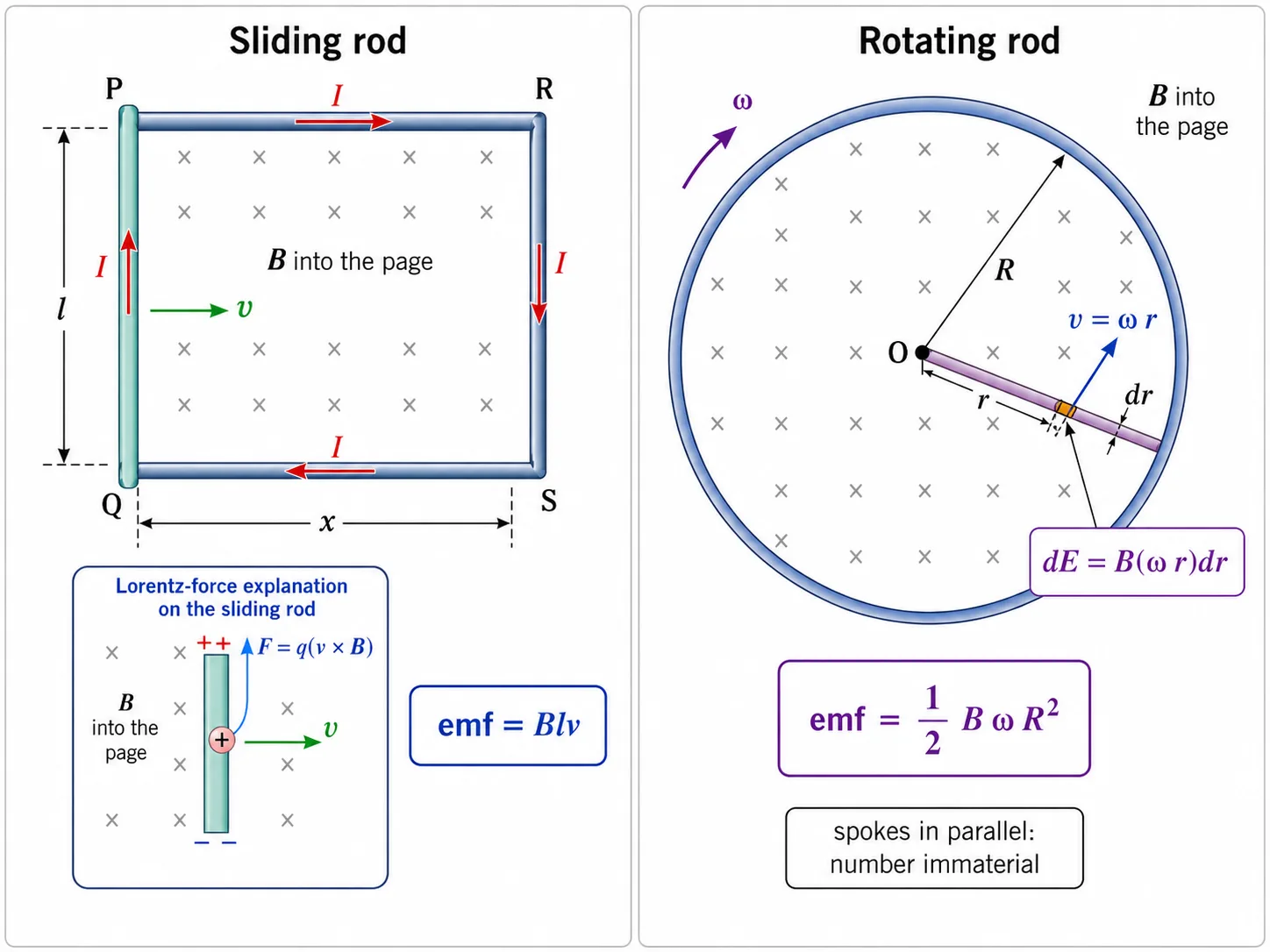
Key Point: The formula assumes , the rod's length, and are mutually perpendicular. In general it is the perpendicular components that count - if the rod moves parallel to the field, no flux is swept, and .
The Lorentz-Force Explanation
The same result drops out of Chapter 4 physics — no Faraday's law needed. Each free charge inside the moving rod travels with velocity through field , so it feels the Lorentz force
directed along the rod (towards Q for positive charges, by ). The charges pile up: one end of the rod becomes positive, the other negative, until the resulting electric field balances the magnetic push.
The work done in carrying a charge across the rod's length is , so the emf - work per unit charge - is
exactly as before. The moving rod is a genuine seat of emf, like a battery with the positive terminal at the end the positive charges drift to.
And when the conductor is stationary? With the magnetic part of vanishes - yet experiments (Section 1!) show emf is still induced when changes. The inescapable conclusion, and the deepest line of the chapter:
A time-varying magnetic field generates an electric field. (This induced electric field differs in character from the electrostatic field of fixed charges.)
This is the fundamental significance of Faraday's discovery: electricity and magnetism are two faces of one subject.
The Rotating Rod
A rod of length rotates with angular speed about one end, perpendicular to a uniform field (think of a wheel spoke). A small element at distance moves with speed , contributing . Integrating along the rod:
Check by the area method: the rod sweeps area at the rate , so - identical.
With :
[NEET Important] For a wheel with many spokes, all spokes are emf sources in parallel between the axle and the rim - same emf each - so the number of spokes is immaterial: the emf stays .
[JEE Tip] Don't mix the two formulas: translating rod → (linear in length), rotating rod → (quadratic in length). The factor is the give-away that an integration over the rod happened.
Solved Examples
Example 1: The rotating metre rod
A metallic rod of 1 m length rotates at 50 rev/s about an axis through one end, perpendicular to a uniform field of 1 T. Find the emf between the centre and the rim.
Solution:
- Formula: with .
- .
- Answer: V. (Physically: the Lorentz force drives free electrons along the rod until a steady charge separation — and emf — is reached.)
Example 2: The wheel with ten spokes
A wheel with 10 metallic spokes, each 0.5 m long, rotates at 120 rev/min in a plane normal to the earth's horizontal field G. Find the emf between axle and rim. (1 G = T.)
Solution:
- rev/s, so rad/s; T.
- .
- Answer: V.
- The spokes don't matter: all ten emfs sit in parallel between axle and rim — same emf, so the number of spokes is immaterial.
Example 3: An aircraft's wings as a rod
A jet with a wing span of 25 m flies horizontally at 1800 km/h where the vertical component of the earth's field is T. Find the emf between the wing tips.
Solution:
- Convert: km/h m/s.
- Formula: .
- Answer: V — the flying wings are a 25 m motional-emf rod!
Example 4: Full circuit bookkeeping on rails
A rod of length 0.2 m slides at 2 m/s on rails in a perpendicular field of 0.5 T; the circuit resistance is 0.5 . Find (a) the emf, (b) the current, (c) the force needed to keep the rod moving, (d) verify the power balance.
Solution:
- (a) V.
- (b) A.
- (c) The field opposes the motion (Lenz) with force N; an equal external force is needed.
- (d) Mechanical power in: W. Heat out: W. They match — Lenz's law balancing the books.
Example 5: Which end is positive?
A rod PQ moves to the right with velocity in a field pointing into the page (rod vertical, P at top). Which end is at higher potential?
Solution:
- Force on positive charges: . With to the right () and into the page (), points along — towards P (up).
- Positive charge accumulates at P: the top end is the positive terminal.
- The rod acts as a battery of emf with P as its + terminal.
Example 6: Motion parallel to the field
The same rod now moves parallel to instead. What emf is induced?
Solution:
- Moving along the field gives for parallel vectors.
- The Lorentz force on the charges vanishes; no charge separation occurs.
- . Only the mutually perpendicular geometry generates motional emf.
Example 7: A fresh rotating-rod numerical
A 0.5 m rod rotates at 100 rad/s about one end in a perpendicular field of 0.2 T. Find the emf across it.
Solution:
- .
- V.
- Answer: 2.5 V, with the outer end's polarity set by .
Example 8: Two methods, one answer
For the rotating rod, show the 'swept-area' method reproduces the integration result.
Solution:
- In time the rod turns by , sweeping area .
- .
- Identical to — integrate the Lorentz emf or differentiate the flux: same physics, same answer.
Example 9: Charge through the circuit
In the rails setup of Example 4 (B = 0.5 T, l = 0.2 m, R = 0.5 ), the rod moves 0.1 m. How much charge flows?
Solution:
- Flux change: Wb.
- Charge: C.
- Independent of the rod's speed — the charge counts the flux change, not the rate.
Example 10: The stationary-conductor puzzle
A stationary loop sits in a changing magnetic field, and a current is induced. The magnetic force on its stationary charges is zero. What drives the current?
Solution:
- With , the force is — only an electric field can move the charges.
- So we must conclude: a time-varying magnetic field generates an electric field, which drives the induced current.
- This induced differs from the electrostatic field of charges (its field lines close on themselves) — the fundamental significance of Faraday's discovery.