
Magnetic Flux: Counting Field Through a Surface
Faraday's genius was finding the one quantity whose change explains every observation: magnetic flux.
For a plane of area in a uniform field :
where is the angle between and the area vector (normal to the surface - recall Chapter 1).
For non-uniform fields or curved surfaces, sum over area elements:
Essentials:
- Flux is a scalar.
- SI unit: weber (Wb) = T m. (And from Faraday's law below, 1 Wb = 1 V s.)
- : maximum flux (field perpendicular to the surface, i.e. along the normal). : zero flux (field in the plane of the surface).
Key Point: The classic trap - when the coil's plane is parallel to , the area vector is perpendicular to and the flux is zero. Always work with the angle to the normal.
Faraday's Law of Induction
The magnitude of the induced emf in a circuit is equal to the time rate of change of magnetic flux through the circuit.
The negative sign indicates the direction of the emf and current - that's Lenz's law, coming in Section 3.
For a closely wound coil of N turns, the flux change through each turn is the same, so the emfs add:
This is why practical coils have many turns - the induced emf is multiplied by N.
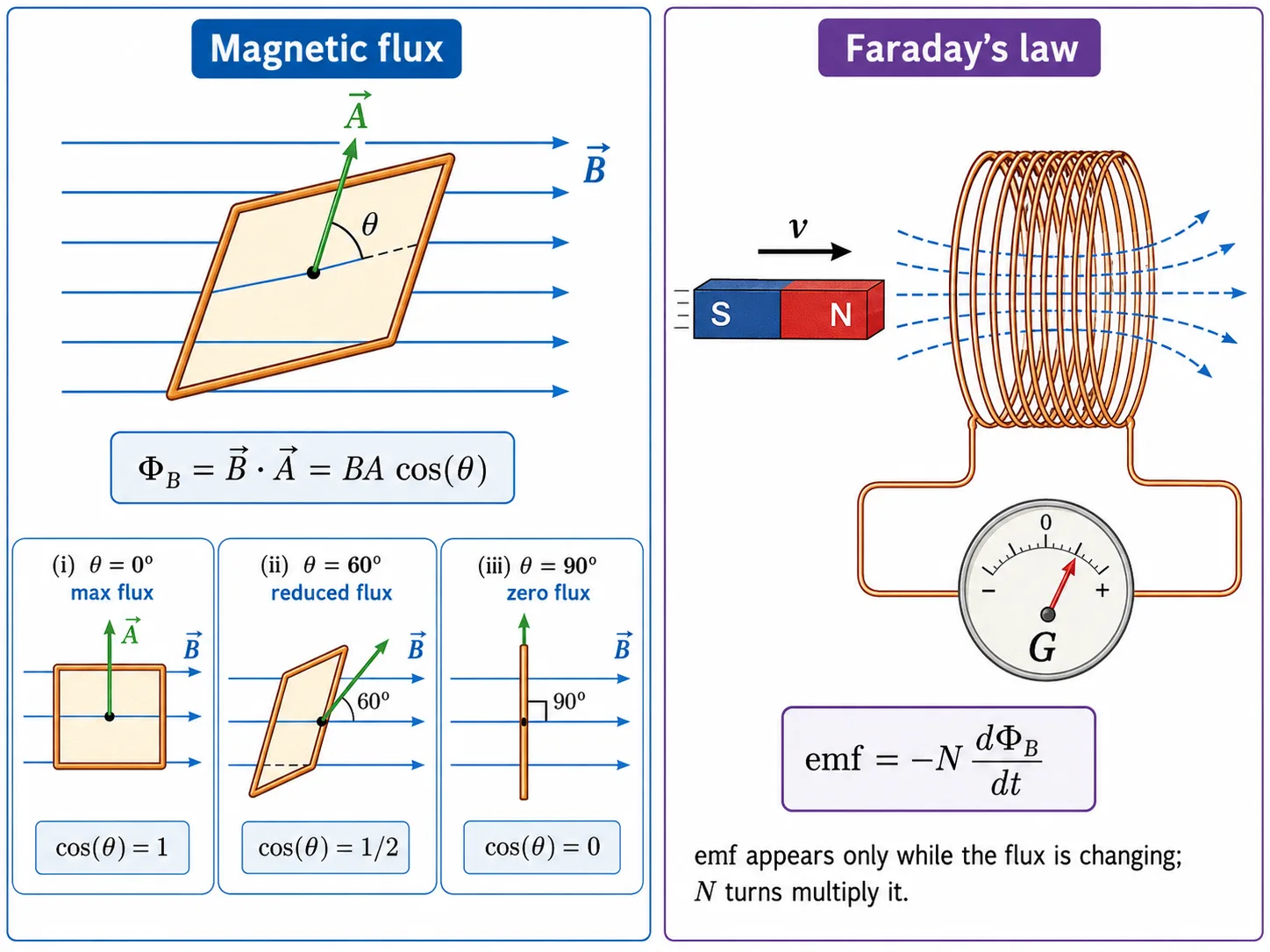
The law instantly explains all three experiments of Section 1: the moving magnet (Experiment 1) and moving coil (Experiment 2) change through C by changing B at the coil; the tapping key (Experiment 3) changes B from zero to maximum and back. In every case, emf appears only while is changing.
Three Handles on the Flux
Since , you can induce an emf by changing any one (or more) of the three factors:
- Change B — move a magnet, vary a neighbouring current (Experiments 1-3), or collapse a field with time.
- Change A — shrink or stretch a loop in a field, or slide a rod that changes the enclosed area (motional emf, Section 4).
- Change — rotate a coil in a field, so varies with time. This is exactly how the AC generator works (Section 7).
[JEE Tip] The induced charge that flows when the flux changes is independent of how fast you change it:
(From , integrate over time.) Fast flip or slow flip, the same charge flows - only the current differs. Ballistic galvanometers exploit exactly this.
[NEET Important] A steady field through a stationary loop - however strong - induces nothing. Only matters.
Solved Examples
Example 1: The collapsing north-east field
A square loop of side 10 cm and resistance 0.5 is placed vertically in the east-west plane. A uniform field of 0.10 T is set up across the plane in the north-east direction, then decreased to zero in 0.70 s at a steady rate. Find the induced emf and current.
Solution:
- Geometry: the loop's area vector points north (normal to the east-west vertical plane); the field points north-east, so .
- Initial flux: Wb.
- EMF: V = 1.0 mV.
- Current: mA.
- Note: the earth's field also threads the loop, but it is steady — it induces nothing.
Example 2: Flipping a coil in the earth's field
A circular coil of radius 10 cm, 500 turns and resistance 2 has its plane perpendicular to the horizontal component of the earth's field, T. It is rotated about its vertical diameter through 180 degrees in 0.25 s. Estimate the induced emf and current.
Solution:
- Initial flux (per turn): Wb.
- Final flux: after a 180-degree flip, Wb.
- EMF: V.
- Current: A.
- These are estimated (average) values — instantaneous values depend on the rotation speed at each instant.
Example 3: Flux at an angle
A plane loop of area 0.05 m sits in a uniform field of 0.3 T, with its area vector at 60 degrees to the field. Find the flux through it.
Solution:
- .
- Wb.
Example 4: The parallel-plane trap
A coil's plane is parallel to a 2 T magnetic field. What is the flux through the coil?
Solution:
- Plane parallel to means the area vector is perpendicular to : .
- — zero flux, no matter how strong the field.
- Maximum flux requires the field along the normal (), i.e. perpendicular to the coil's plane.
Example 5: EMF from a steadily dying field
A 100-turn coil of area m lies with its plane perpendicular to a field that falls steadily from 0.5 T to zero in 0.1 s. Find the induced emf.
Solution:
- T/s.
- .
- Answer: V (while the field is collapsing).
Example 6: Time-dependent flux (JEE pattern)
The flux through a loop varies as mWb. Find the magnitude of the induced emf at s.
Solution:
- mV.
- At s: mV.
- Note: emf depends on the rate of change — the constant 5 mWb contributes nothing.
Example 7: Why N turns help
A single loop develops 2 mV when a flux change occurs. What emf develops in a closely wound 250-turn coil for the same flux change per turn?
Solution:
- Each turn links the same changing flux, and the turn emfs add in series.
- mV mV V.
- This is why Faraday wound coils with hundreds of turns — and why .
Example 8: Weber, volt-second and tesla
Show that 1 weber = 1 volt-second, and express the weber in terms of tesla.
Solution:
- From Faraday's law : V = Wb/s, so 1 Wb = 1 V s.
- From : 1 Wb = 1 T m.
- Both forms appear in exams; they are the same unit seen through two laws.
Example 9: Average vs instantaneous emf
In the flipped-coil example above, why are the computed emf and current called 'estimated' values?
Solution:
- We used — the average emf over the quarter second.
- The instantaneous emf depends on the rotation speed at each instant, which varies unless the rotation is uniform.
- Average values answer 'how much overall'; instantaneous values answer 'how much right now'. Know which one a question wants!
Example 10: Induced charge is rate-independent (JEE pattern)
A 100-turn coil of area m and total circuit resistance 2 is flipped through 180 degrees in a field B = 0.01 T (initially along the normal). How much charge flows, and does flipping faster change it?
Solution:
- Flux change per turn: Wb.
- Charge: C.
- Flipping faster raises the emf and current but shortens the time — the charge is unchanged: depends only on the total flux change, not the rate.