
The Machine That Runs Civilisation
Of all the ways to exploit electromagnetic induction, none matters more than the AC generator — the modern machine (used in power stations) whose development is credited to Nikola Tesla. It converts mechanical energy into electrical energy.
The principle comes straight from Section 2's three handles on flux: keep and fixed, and change the angle between them by rotating the coil. The effective area presented to the field lines is , so rotation makes the flux — and hence an emf — oscillate.
Construction:
- A coil (the armature) mounted on a rotor shaft, its rotation axis perpendicular to the field .
- The coil is rotated by an external agency (falling water, steam…).
- Its ends connect to the external circuit through slip rings and brushes — sliding contacts that let the coil spin while staying connected.
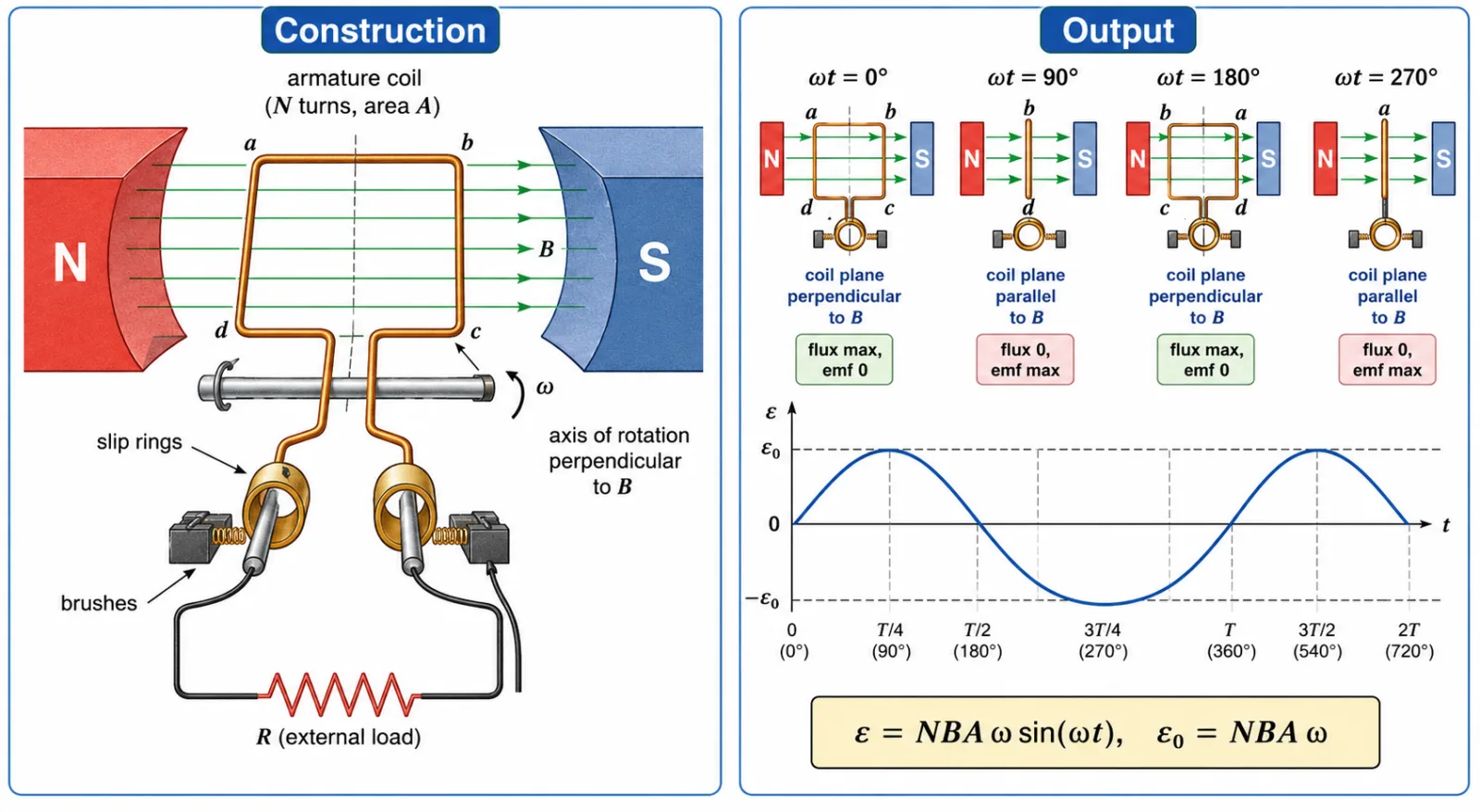
The EMF Equation
Rotate the -turn coil (area ) at constant angular speed in field , with at . Then and the flux is
Faraday's law for turns:
where is the maximum (peak) emf, reached when . With :
Since the sine swings between and , the polarity of the emf reverses periodically - the current direction alternates: alternating current (AC).
Key Point (the classic trap): the emf is maximum when or - coil plane parallel to , flux zero, but flux changing fastest. The emf is zero when the flux is maximum ( or ). Flux and emf are 90° out of phase.
[JEE Tip] Over a full cycle the average of is zero — the average emf over a complete cycle is zero, though the energy delivered is not (that story — rms values — is Chapter 7's).
Real Generators (and One Cyclist)
Where does the rotation come from?
- Hydroelectric generators: water falling from a height (a dam) spins the turbine that turns the armature.
- Thermal generators: steam at high pressure — produced by burning coal or other fuels — drives the rotation. (Efficiency of conversion is hardly 50 percent… but that's an engineering battle.)
- Nuclear power generators: nuclear fuel supplies the heat instead of coal.
In commercial generators the magnitude is impressive — outputs of order 100 MW from a single machine, with the emf alternating at the supply frequency.
And a charming counterpoint: Kamla on her stationary bicycle, pedalling a 100-turn coil — human-powered induction, computed below. The physics is identical; only the scale differs.
[NEET Important] Memorise the dependency chain of the peak emf: — linear in every factor. Double any one of , , or and the peak emf doubles. (Doubling also doubles the output frequency — a favourite two-effect question.)
Solved Examples
Example 1: Kamla's bicycle generator
Kamla pedals a stationary bicycle whose pedals drive a 100-turn coil of area 0.10 m, rotating at half a revolution per second in a uniform 0.01 T field perpendicular to the rotation axis. Find the maximum voltage generated.
Solution:
- Data: , , , .
- Formula: .
- V.
- Answer: V. Honest human effort, modest voltage — now you see why power stations use turbines!
Example 2: A power-scale peak emf
A 200-turn coil of area 0.02 m rotates at 50 rev/s in a 0.5 T field. Find the peak emf.
Solution:
- rad/s.
- .
- Answer: V, alternating at 50 Hz.
Example 3: EMF at an instant
For the generator of Example 2 ( V), find the emf when the coil has turned 30 degrees from the flux-maximum position.
Solution:
- with .
- .
- Answer: 314 V — halfway to peak at 30 degrees, not at 45: the growth is sinusoidal, not linear.
Example 4: Where is the emf zero? Maximum?
State the coil orientations at which the generator emf is (a) zero, (b) maximum, and reconcile with the flux.
Solution:
- (a) Zero emf at or — coil plane perpendicular to , flux at its extreme (), but momentarily not changing.
- (b) Maximum emf at or — coil plane parallel to , flux zero but changing at its fastest rate.
- Flux and emf are a quarter-cycle (90°) out of phase: one peaks where the other vanishes.
Example 5: Doubling the rotation speed
A generator's angular speed is doubled. What happens to (a) the peak emf, (b) the output frequency?
Solution:
- (a) : the peak emf doubles.
- (b) : the frequency doubles too.
- One knob, two effects — both linear. (To double emf without changing frequency, double , or instead.)
Example 6: Why slip rings?
What do the slip rings and brushes do in an AC generator?
Solution:
- The coil rotates continuously; fixed wires would twist and snap.
- Each coil end is joined to a slip ring rotating with the shaft; a stationary carbon brush presses on each ring, maintaining sliding electrical contact.
- They deliver the coil's alternating emf to the external circuit unchanged. (A DC dynamo would use a split-ring commutator instead — that's the difference question examiners love.)
Example 7: EMF a split-second after flux maximum [JEE Numerical]
A 50 Hz generator has peak emf 311 V. Find the instantaneous emf s after the flux through the coil is maximum.
Solution:
- At flux maximum the emf is zero; from there with rad/s.
- (30 degrees).
- V.
Example 8: Average emf over a cycle
What is the average of the generator emf over (a) one complete cycle, (b) the half cycle from to ? [JEE Tip]
Solution:
- (a) over a full cycle is zero — average emf = 0 (equal positive and negative lobes).
- (b) Over half a cycle, , so .
- Zero average doesn't mean zero effect — power involves , which is never negative (Chapter 7).
Example 9: Boosting Kamla
Kamla's machine (Example 1) is upgraded: turns doubled to 200, field raised to 0.03 T, same pedalling rate. Find the new peak voltage.
Solution:
- (A and unchanged): factor .
- V.
- Linear dependencies make scaling instant — no need to recompute from scratch.
Example 10: Reading a generator at 45 degrees [NEET Numerical]
A 20-turn coil of area 0.5 m rotates at 80 rad/s in a 0.1 T field. Find (a) the peak emf, (b) the emf when the coil has turned 45 degrees from the flux-maximum orientation.
Solution:
- (a) V.
- (b) V.
- Note: at 45 degrees the emf is about 71 percent of peak, not half — sinusoidal, not linear, growth.