
A Coil Talks to Itself
A coil doesn't need a neighbour — changing its own current changes its own flux, inducing an emf in itself. This is self-induction.
Flux linkage is proportional to the current:
where is the self-inductance (coefficient of self-induction). When the current varies:
The self-induced emf is called the back emf: it opposes any change - increase or decrease - of current in the circuit. Work must be done against it to establish or change a current.
Key Point: The minus sign works both ways. Rising current → back emf fights the rise (slows growth). Falling current → back emf fights the fall (sustains the current). The coil is a stubborn conservative: it likes its current exactly as it is.
[NEET Important] This is why switching OFF a highly inductive circuit produces a spark across the switch: the large from the rapid break drives the current through the air gap.
Self-Inductance of a Long Solenoid
For a long solenoid (cross-section , length , turns per unit length) carrying current , the interior field is . The flux linkage of all turns is:
Comparing with :
Fill the interior with a material of relative permeability (e.g. soft iron):
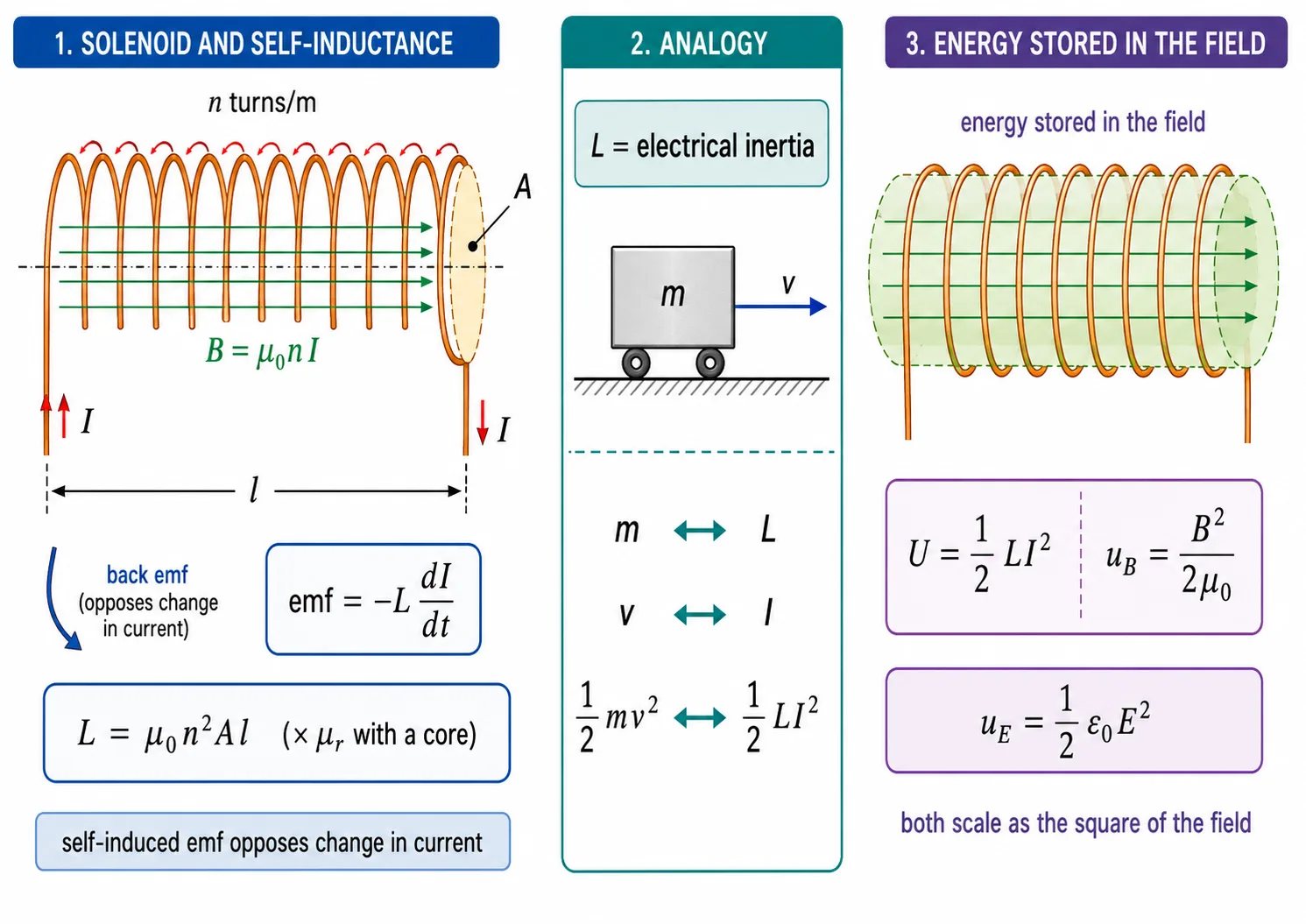
Like , the self-inductance depends only on geometry (, , ) and the medium () - never on the current.
[JEE Tip] Re-express via total turns : . The (or ) dependence is the most-tested scaling in this topic: double the turns (same length) and quadruples.
Electrical Inertia & Stored Magnetic Energy
A beautiful analogy: self-inductance is the electromagnetic analogue of mass. Mass resists changes in velocity; resists changes in current. It is electrical inertia.
Because the back emf opposes the growth of current, the source must do work to establish a current. The rate of work is (ignoring resistive losses). Integrating from 0 to :
This energy is stored as magnetic potential energy - compare , with and .
Energy density: for the solenoid, . Dividing by the volume :
The perfect twin of the capacitor's electrostatic energy density - both proportional to the square of the field, and both completely general, valid in any region containing fields.
Two coils together: with currents in both, fluxes superpose: , so
Solved Examples
Example 1: Energy in a solenoid
Obtain the magnetic energy stored in a solenoid in terms of , and .
Solution:
- Stored energy: with .
- From : .
- .
- Per unit volume: .
Example 2: The capacitor comparison
How does this compare with the electrostatic energy of a capacitor?
Solution:
- Capacitor (Chapter 2): .
- Both energy densities are proportional to the square of the field strength.
- Though derived for a solenoid and a parallel-plate capacitor, both results are general — valid for any region of space containing the fields.
Example 3: L of a solenoid
A solenoid has 1000 turns/m, cross-section m, length 0.5 m. Find its self-inductance.
Solution:
- .
- H.
- Answer: mH. (With a soft-iron core of , this would leap to 0.63 H!)
Example 4: L from the back emf
The current in a coil falls steadily from 5.0 A to 0 in 0.1 s, inducing an average emf of 200 V. Estimate the self-inductance.
Solution:
- .
- A/s, so .
- Answer: H.
Example 5: Energy stored
How much energy is stored in that 4 H coil when it carries a steady 2 A?
Solution:
- .
- Answer: 8 J — recoverable when the current is switched off (often as that spark!).
Example 6: Both directions of stubbornness
The current through an inductor is (a) increased, (b) decreased. Give the polarity of the back emf in each case.
Solution:
- (a) Rising : back emf opposes the rise — it acts like a battery opposing the driving source.
- (b) Falling : back emf reverses — now it acts with the original current direction, trying to sustain it.
- Both follow from one sign: . Opposition is always to the change.
Example 7: Energy density numerical
Find the magnetic energy density in a 1.0 T field, and compare it with the electric energy density in air at its breakdown field, V/m.
Solution:
- Magnetic: J/m.
- Electric (at breakdown): J/m.
- Takeaway: an ordinary 1 T magnetic field stores about times more energy per unit volume than the strongest practical air-gap electric field — one reason magnetic storage of energy interests engineers.
Example 8: Doubling the turns
A solenoid's total turns are doubled, keeping its length and area fixed. What happens to and to the energy stored at the same current?
Solution:
- with : doubling doubles , so quadruples.
- at the same also quadruples.
- The scaling is the most-tested line of this section.
Example 9: Back emf from a time-dependent current [JEE Numerical]
The current through a 10 mH inductor varies as A. Find the back emf magnitude at s.
Solution:
- A/s at s.
- .
- Answer: 0.14 V, directed so as to oppose the rising current (the -as-inertia picture: is the analogue of ).
Example 10: Two coils at once
Coil 1 ( mH) carries a current rising at 5 A/s, while a neighbour ( mH) carries one rising at 10 A/s. Find the magnitude of the total emf induced in coil 1.
Solution:
- Superpose the fluxes: .
- .
- Answer: V = 70 mV.