
Superposition and Coherence
The superposition principle: at any point, the resultant displacement is the (vector) sum of the displacements of the individual waves. All of interference is this one sentence, exploited.
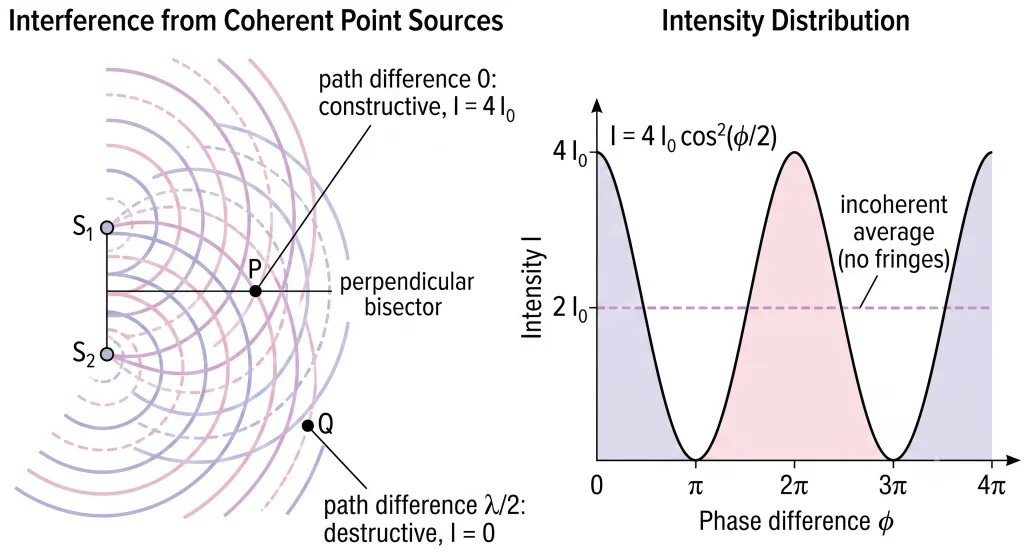
Picture two needles S, S bobbing identically in water. At any point P, each wave arrives with some phase; if the phase difference at P stays constant in time, the sources are coherent. Identical bobbing guarantees it.
The bright case: if (or the path difference ), the waves arrive in phase: , , resultant . Intensity goes as amplitude squared:
The dark case: path difference — waves arrive exactly out of phase, , resultant zero:
The General Point — and the Incoherent Collapse
For an arbitrary phase difference between the two arriving waves (, ), the resultant amplitude is , so
— smoothly interpolating between () and 0 (). A path difference corresponds to .
Incoherent sources: if the two sources' relative phase drifts randomly (as for two separate lamps), at P changes erratically and rapidly; the eye/detector sees the time average :
Key Point: coherent addition averages amplitudes (then squares); incoherent addition averages intensities. The whole drama of fringes lives in that difference: vs 0 vs the flat .
[JEE Tip] Unequal amplitudes : , so . Given an amplitude ratio 2:1, the ratio is 9:1 — a JEE perennial.
Solved Examples
Example 1: Conditions, stated cleanly
Write the path-difference conditions for constructive and destructive interference of two coherent sources.
Solution:
- Constructive (bright): , — arrival in phase, .
- Destructive (dark): — arrival out of phase, .
- Valid wherever the two sources maintain a fixed phase relationship — i.e. are coherent.
Example 2: A point off the bisector [NEET Numerical]
Two coherent sources emit 600 nm light in phase. At P, the path difference is 1.8 m. Bright or dark?
Solution:
- — an integer.
- Bright (third-order constructive), .
- Had it been 1.5 m (), P would be perfectly dark.
Example 3: Phase from path [JEE Numerical]
For 500 nm light, what phase difference corresponds to a 125 nm path difference, and what is the resulting intensity (each source alone gives )?
Solution:
- .
- .
- Quarter-wavelength shifts give exactly the average intensity — neither bright nor dark.
Example 4: The incoherent pair [NEET Numerical]
Two identical but independent lamps each light a screen point with . What intensity results, and why are no fringes seen?
Solution:
- Independent lamps have randomly drifting relative phase: incoherent.
- — intensities add, everywhere the same.
- No fixed bright/dark geography = no fringes. (Section 5 shows Young's cure.)
Example 5: Unequal amplitudes [JEE Numerical]
Two coherent waves have amplitude ratio 2:1. Find .
Solution:
- ; .
- .
- General rule: — amplitude ratios in, intensity ratios out.
Example 6: From intensity ratio to amplitude ratio [JEE Numerical]
Two coherent beams give . Find the ratio of their intensities.
Solution:
- .
- .
- Unwind the squares carefully — the most common slip in this family.
Example 7: Where does the dark energy go?
In destructive interference the intensity vanishes. Is energy destroyed?
Solution:
- No. Interference only redistributes energy: dark fringes' missing energy appears in the bright fringes ( — twice the plain sum).
- Averaged over the pattern, — exactly the energy the two sources supply.
- Conservation holds fringe-by-fringe in the average; nature merely rearranges the lighting.
Example 8: Coherence, defined for marks
Define coherent sources and give the practical requirement behind the definition.
Solution:
- Two sources are coherent if the phase difference between their waves at a point does not change with time.
- Practically they must have the same frequency (else the phase difference drifts continuously) and a locked initial phase.
- NCERT's needles moving 'in identical fashion' — or Young's two slits fed by one source — are the canonical examples.
Example 9: The bisector is always bright
Why is every point on the perpendicular bisector of bright (for in-phase coherent sources)?
Solution:
- By symmetry, on the bisector: path difference zero everywhere on it.
- Waves arrive in phase: along the whole line.
- This is Young's central fringe in waiting — and why it stays put when wavelength changes.
Example 10: Three-intensity drill [JEE Numerical]
For two coherent sources of equal each, give the intensity at points where the path difference is (a) , (b) , (c) .
Solution:
- (a) : .
- (b) : .
- (c) : . The cosine-squared dial covers every case.