
Transverse Waves and Polarisation
Shake a horizontal string up and down: a wave runs along x while each point moves along y — the displacement is perpendicular to the propagation, a transverse wave. Because the vibration stays in one plane (x-y), it is a linearly (plane) polarised wave — here y-polarised. Shaking in the x-z plane instead gives a z-polarised wave.
If the plane of vibration changes randomly moment to moment (still always perpendicular to propagation), the wave is unpolarised.
Light is transverse: its electric field oscillates at right angles to the direction of travel. Ordinary light (sodium lamp, sun) is unpolarised — points every which way in the transverse plane.
Key Point: only transverse waves can be polarised. That light can be polarised is direct proof it is transverse (sound, being longitudinal, cannot be). A favourite one-mark gem.
Polaroids, the Half Rule, and Malus' Law
A polaroid is a sheet of aligned long-chain molecules. The -components along the chains are absorbed; only the component perpendicular to them passes — that perpendicular direction is the pass-axis.
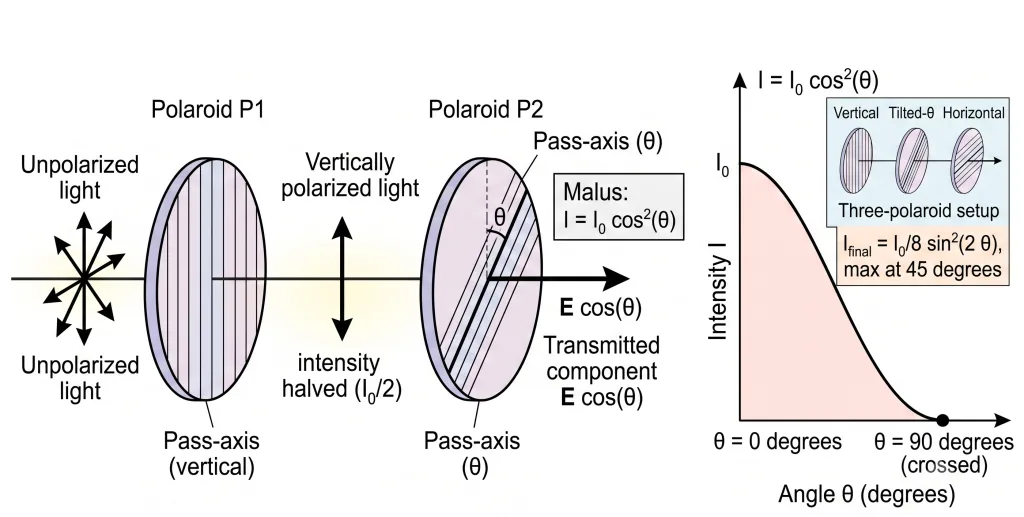
Unpolarised light through one polaroid P:
- The transmitted light is linearly polarised along P's pass-axis.
- Its intensity is exactly halved () — averaging over all random orientations gives .
- Rotating P changes nothing — the input was symmetric.
Polarised light through a second polaroid P at angle to the first — Malus' law:
- (axes parallel): full transmission.
- (crossed polaroids): zero — total darkness.
- Rotating P from 0 to 90 degrees dims the light from full to nothing.
[NEET Important] Two-step intensity through P then P for unpolarised input: first the half rule (), then Malus (). Do them in order — skipping the half is the standard error.
The Three-Polaroid Classic
Cross two polaroids (P, P at 90 degrees) so no light gets through. Now slip a third polaroid P between them at angle to the first — and light reappears! Tracking the intensity (NCERT's crossed-polaroid example):
- After P: (the polarised intensity entering the sandwich).
- After P (angle ): .
- After P (angle to P): .
Maximum at (); zero at or . The middle polaroid 're-aims' the polarisation so the last one can pass a component — a striking, deeply exam-favourite result.
[JEE Tip] With unpolarised input intensity , , so the three-polaroid output is , peaking at when . Memorise the .
Real-world polarisation: Polaroid sunglasses cut glare (reflected light is partly polarised), photographers' filters deepen skies, and LCD screens switch pixels by rotating polarisation.
Solved Examples
Example 1: The half rule [NEET Numerical]
Unpolarised light of intensity 80 W/m passes through one polaroid. What emerges?
Solution:
- One polaroid on unpolarised light transmits half.
- W/m, now linearly polarised along the pass-axis.
- Rotating this single polaroid would not change the 40 — the input was directionless.
Example 2: Malus at 30 degrees [NEET Numerical]
Polarised light of 40 W/m falls on a polaroid whose axis is at 30 degrees to the light's polarisation. Find the transmitted intensity.
Solution:
- Malus: .
- W/m.
- Parallel would give 40; crossed would give 0.
Example 3: Two polaroids from unpolarised [JEE Numerical]
Unpolarised light of 100 W/m passes through P then P, with P at 60 degrees to P. Find the final intensity.
Solution:
- After P (half rule): W/m.
- After P (Malus): W/m.
- The two-step recipe — half first, then .
Example 4: Crossed polaroids [NEET Numerical]
What fraction of unpolarised light passes through two polaroids whose axes are perpendicular?
Solution:
- After P: half. After P at 90 degrees: .
- Zero transmission — crossed polaroids are dark.
- The basis of LCD switching and glare elimination.
Example 5: The three-polaroid revival (NCERT's crossed-polaroid example) [JEE Numerical]
Unpolarised light (intensity ) passes through three polaroids: P, then P at , then P crossed with P. Find the output and the angle of maximum.
Solution:
- After P: . After P: .
- After P (at to P): .
- Maximum at : . Without the middle polaroid the crossed pair gives zero — the inserted sheet revives the light.
Example 6: Finding the angle [JEE Numerical]
Through two polaroids, the transmitted intensity is half the maximum (for polarised input). Find the angle between their axes.
Solution:
- .
- .
- At 45 degrees a polaroid passes exactly half the polarised intensity — a handy benchmark.
Example 7: Why polarisation proves transversality
State the deep significance of the polaroid experiments.
Solution:
- Only transverse waves have a vibration direction perpendicular to travel that can be selectively absorbed.
- Polaroids do exactly that to light — so light's vibrations are transverse.
- Sound (longitudinal) cannot be polarised; the fact that light can is direct evidence of its transverse, electromagnetic nature.
Example 8: Rotating the single polaroid
Unpolarised light passes through one polaroid. Why does rotating it leave the transmitted intensity constant?
Solution:
- Unpolarised light has uniformly distributed over all transverse directions.
- Any pass-axis orientation samples the same average — half the intensity.
- So rotation changes nothing (unlike a second polaroid, where Malus' law makes rotation dramatic).
Example 9: Three polaroids at 30 degrees [JEE Numerical]
Unpolarised light of 64 W/m passes P, then P at 30 degrees to P, then P at 30 degrees to P (i.e. 60 degrees to P). Find the output.
Solution:
- After P: W/m.
- After P: W/m.
- After P: W/m. Apply Malus at each junction in turn.
Example 10: Sunglasses and glare
Why do polaroid sunglasses cut glare from a wet road?
Solution:
- Light reflected off horizontal surfaces is partially horizontally polarised.
- Polaroid lenses are mounted with a vertical pass-axis, blocking that horizontal glare.
- Diffuse (unpolarised) light from the scene still passes at half intensity — so you see the road, minus the dazzle. Malus' law, worn on the face.