
Why Two Lamps Fail, and Young's Fix
Illuminate two pinholes with two separate sodium lamps and you see… nothing — no fringes. An ordinary source emits light in bursts with abrupt phase changes every ~ s, so two independent sources have no fixed phase relation: incoherent, intensities just add.
Young's 1801 trick: a single source S illuminates one pinhole, whose light then falls on two closely spaced pinholes S and S. Because S and S are fed from the same original wavefront, any phase jiggle in S appears identically in both — they are locked in phase, i.e. coherent. Spherical waves from S and S overlap on the screen and produce a steady pattern of bright and dark fringes.
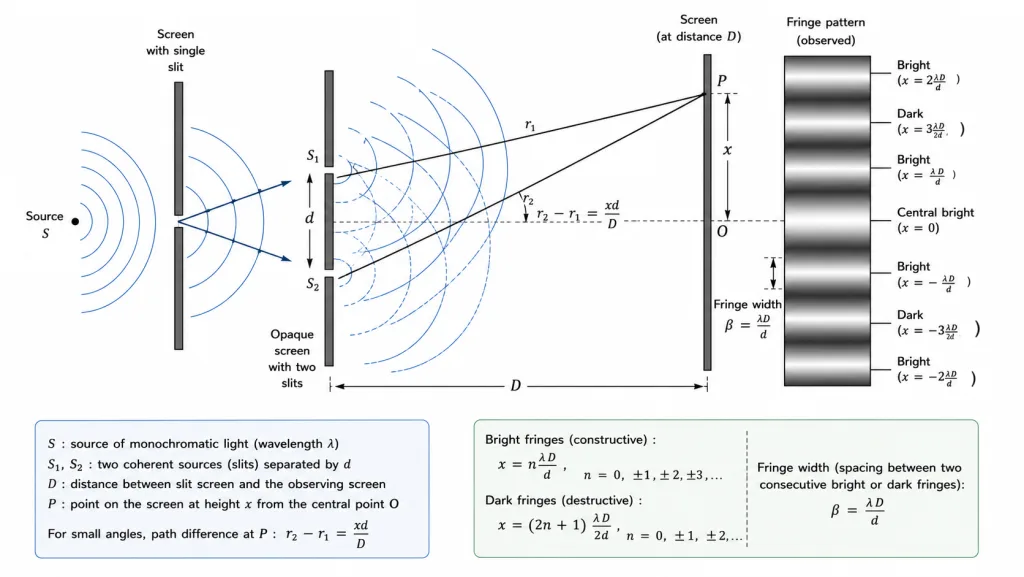
The Fringe Formulas
Slit separation d, screen distance D (), point P at distance x from the centre. The path difference is .
Bright fringes ():
Dark fringes ():
Consecutive bright (or dark) fringes are equally spaced by the fringe width:
This is the chapter's flagship formula — the one that let Young measure (rearrange to ).
The variation rules (every exam loves these):
- : red fringes wider than blue.
- : move the screen back, fringes spread.
- : closer slits, wider fringes.
- Immerse the apparatus in water (n): , so — fringes shrink.
[NEET Important] Central fringe (n = 0) is bright and wavelength-independent — in white light it is white, flanked by coloured fringes. [JEE Tip] Angular fringe width — independent of D.
Solved Examples
Example 1: Fringe width [NEET Numerical]
In a double-slit setup, d = 0.5 mm, D = 1.0 m, = 600 nm. Find the fringe width.
Solution:
- .
- m = 1.2 mm.
- Visible, measurable bands — the experiment's whole point.
Example 2: Measuring the wavelength [JEE Numerical]
Fringes 0.9 mm wide are seen with d = 0.4 mm and D = 0.6 m. Find .
Solution:
- .
- m = 600 nm.
- Exactly how Young first pinned down the wavelength of light.
Example 3: Position of a fringe [NEET Numerical]
For = 1.2 mm, where is the 3rd bright fringe and the 2nd dark fringe from the centre?
Solution:
- 3rd bright: mm.
- 2nd dark: mm (n = 1 gives the 2nd dark).
- Bright at integer , dark at half-integer — fingers off by one cost marks here.
Example 4: Immersion in water [JEE Numerical]
The fringe width is 1.2 mm in air. What does it become when the whole apparatus is dipped in water (n = 1.33)?
Solution:
- In water , so .
- mm.
- Denser medium, shorter wavelength, tighter fringes.
Example 5: Changing the slit separation [NEET Numerical]
If the slit separation d is doubled (everything else fixed), what happens to the fringe width?
Solution:
- .
- Doubling d halves — fringes crowd together.
- (Bring the slits closer to spread fringes out — the opposite manoeuvre.)
Example 6: Two wavelengths, coincident fringes [JEE Numerical]
Light of 480 nm and 600 nm illuminates a double slit together. At what order do their bright fringes first coincide?
Solution:
- Coincidence: , i.e. .
- Smallest integers: (for 480 nm), (for 600 nm).
- The 5th fringe of 480 nm overlaps the 4th of 600 nm — a standard two-colour overlap problem.
Example 7: Number of fringes in a width [JEE Numerical]
How many bright fringes fit in a 1.5 cm wide region of the screen if = 1.2 mm?
Solution:
- Fringes per region .
- So about 12 fringes span the region (counting bright fringes).
- Wider screens or wider fringes hold fewer per centimetre — the geometry on a leash.
Example 8: Why the central fringe is white
In white-light Young's fringes, why is the central fringe white and the rest coloured?
Solution:
- At the centre (n = 0) the path difference is zero for every wavelength — all colours interfere constructively: white.
- Away from centre, depends on : each colour's fringe sits at a slightly different place.
- So flanking fringes spread into spectra; only the centre is achromatic. A classic reasoning question.
Example 9: Angular fringe width [JEE Numerical]
For d = 0.5 mm and = 600 nm, find the angular fringe width, and confirm it is independent of D.
Solution:
- .
- rad.
- D cancels — the angular spacing is fixed by alone, which is why it survives moving the screen.
Example 10: Shift on covering one slit with a thin sheet [JEE pattern]
Qualitatively, what happens to the fringe pattern if a thin transparent sheet is placed over one slit?
Solution:
- The sheet adds extra optical path to one beam, introducing a constant path difference.
- The whole fringe pattern shifts sideways (towards the covered slit) by — the fringe width is unchanged.
- (Beyond the rationalized core but a JEE staple: shift counts fringes, of them.)