
Snell's Law from Wavelets
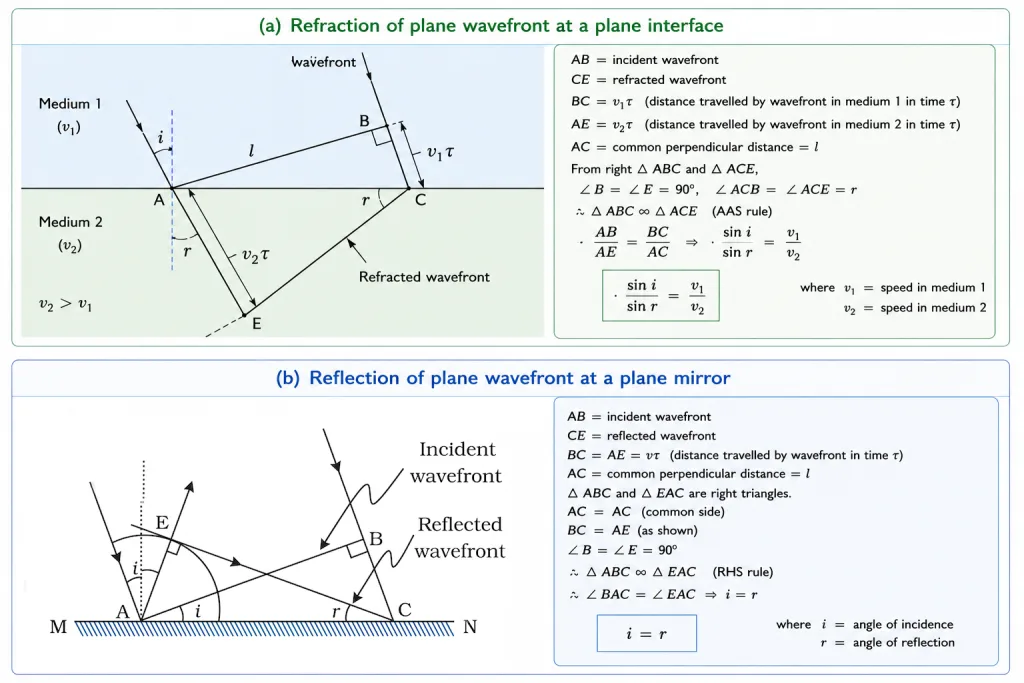
Let a plane wavefront AB strike the interface PP' between medium 1 (speed ) and medium 2 (speed ) at incidence angle i. In the time that B takes to reach C along the interface (), the wavelet from A has grown to radius in medium 2. The tangent CE is the refracted wavefront. From the two right triangles sharing AC:
With , : — Snell's law, derived from pure wave geometry.
And the model's testable verdict: bending towards the normal () requires — light is slower in the denser medium (Foucault-confirmed).
Wavelength Shrinks, Frequency Survives — and Reflection Too
If BC equals one wavelength , then AE is one wavelength in the new medium (crests stay in step), so
Entering a denser medium, speed and wavelength both drop by the factor n; the frequency — set by the source — never changes. (Refraction at a rarer medium runs the same construction with : the ray bends away, and beyond the critical angle no refracted tangent exists — TIR, meeting Chapter 9 again.)
Reflection: for a plane wave hitting a mirror, makes triangles EAC and BAC congruent, forcing — the law of reflection, also free of charge.
Wavefronts through Chapter 9's devices: a thin prism delays the thick-side portion → emerging plane wavefront is tilted; a convex lens delays the centre most → emerging wavefront is spherical, converging to the focus F; a concave mirror reflects a plane wave into a converging sphere. Hence the lovely equal-time principle: from object point to image point, every ray takes the same time (the central ray through a lens is shorter but slower inside the thicker glass).
[NEET Important] 'What changes on refraction?' — v and change, and phase relationships do not. Asked every single year.
Solved Examples
Example 1: NCERT Example 10.1, the conceptual triple
(a) Why do reflected and refracted light have the incident frequency? (b) Does reduced speed mean reduced energy? (c) What fixes intensity in the photon picture?
Solution:
- (a) Atoms behave as forced oscillators driven at the incident frequency; light they re-emit carries the same frequency.
- (b) No — energy depends on amplitude, not on propagation speed.
- (c) The number of photons crossing unit area per unit time (for a given frequency).
Example 2: Sodium light enters water [NEET Numerical]
Light of 589 nm (air) enters water (n = 1.33). Find its speed, wavelength and frequency in water.
Solution:
- m/s.
- nm.
- Hz — unchanged (check: in water gives the same).
Example 3: Speed ratio from angles [JEE Numerical]
A plane wave refracts with i = 60 degrees and r = 30 degrees. Find and .
Solution:
- .
- — the second medium is much denser; light there travels at .
- Wave geometry hands you both numbers at once.
Example 4: The tilted prism wavefront
Using wavefronts, explain why a thin prism deviates a plane wave towards its base.
Solution:
- The portion of the wavefront crossing the prism's thick side travels longer inside slow glass — it is delayed most.
- The emergent wavefront is therefore tilted, its normal (the ray) rotated towards the base.
- Same answer as ray optics, new mechanism: differential delay.
Example 5: The lens as a delay machine
Explain focusing by a convex lens with wavefronts, and reconcile the equal-time principle.
Solution:
- The plane wavefront's central part crosses the thickest glass and is delayed most; the emergent wavefront is spherical, centred on F.
- All perpendiculars (rays) of that sphere converge at the focus.
- Equal time: the central ray's path is shorter but spends longer in slow glass; edge rays travel farther in fast air — all arrive together. A focus is a point of simultaneous arrivals.
Example 6: Wavelength inside glass [NEET Numerical]
How many waves of 600 nm light (air) fit inside a 3 mm glass slab (n = 1.5)?
Solution:
- nm.
- Number waves.
- (In air the same 3 mm holds 5000 — the optical path is n times the geometric path.)
Example 7: Reflection, congruently
Sketch the Huygens proof that i = r in three steps.
Solution:
- While B advances to C (), the wavelet from A grows to radius — same medium, same speed.
- Triangles EAC and BAC share AC and have equal legs (), both right-angled — congruent.
- Hence the wavefront angles (and so the ray angles) match: .
Example 8: Crests in step [JEE Numerical]
A wavefront's crest enters glass (n = 1.5) while the adjacent crest is still one air-wavelength (600 nm) behind. What is the crest spacing once both are inside?
Solution:
- Both crests travel identically once inside; the spacing is set as each crosses: .
- nm.
- The 'crest from B reaches C as the crest from A reaches E' argument is exactly NCERT's .
Example 9: Frequency police [NEET pattern]
A student claims green light (5.5x10^14 Hz) becomes 'a different colour' underwater since its wavelength changes. Adjudicate.
Solution:
- Wavelength does shrink (by 1.33), but frequency — which the eye's response tracks — is unchanged.
- Perceived colour is tied to frequency/energy, not the in-medium wavelength.
- Divers see green as green. Claim rejected.
Example 10: Rarer-medium construction [JEE Numerical]
Light in glass (n = 1.5) meets the glass-air surface at i = 30 degrees. Use the wave relation to find r, and state what happens at i = 41.8 degrees.
Solution:
- , so : — bending away from the normal.
- At , : the refracted wavefront grazes the surface — the critical angle.
- Beyond it no tangent wavefront exists in air: total internal reflection, the wave version of Chapter 9's story.