
Light Bends Around Edges
Look closely at a sharp shadow's edge: instead of a clean line, there are faint bright and dark bands. Light has spread into the geometric shadow — diffraction. It is a general property of all waves (sound, water, light, matter waves). We rarely notice it for light because is far smaller than everyday obstacles — but it sets the ultimate resolution of every telescope and microscope, and paints the colours flashing off a CD.
Replace Young's double slit with a single narrow slit of width a (monochromatic, normal incidence) and a new pattern appears: a broad central bright maximum flanked by weaker secondary maxima, fading outwards.
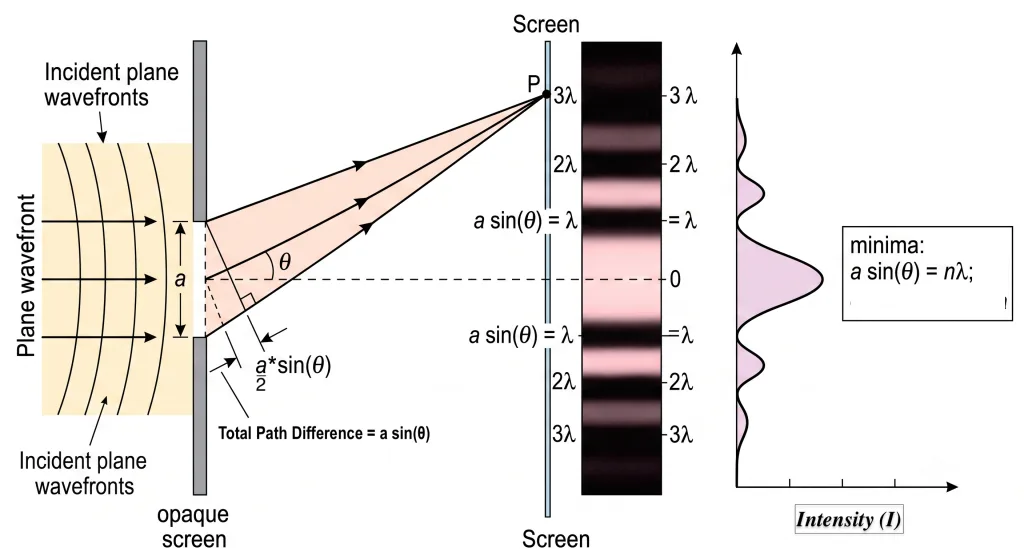
Huygens-Fresnel idea: treat each strip of the slit's wavefront as a secondary source; add their contributions at angle with the right phase differences. The slit-edge-to-edge path difference is .
The Single-Slit Conditions
Minima (zero intensity): when the slit divides into pairs that exactly cancel —
(note: is NOT a minimum — it's the central maximum.)
Secondary maxima (weak, between the minima):
Central maximum: stretches between the first minima at . Its angular width is — twice that of any other fringe; its linear width on a screen at distance D is . Narrower slit → wider central spread (the wave 'fans out' more).
Key Point — interference vs diffraction: in Young's double slit the bright fringe condition is ; in single-slit diffraction the minima are at . Same-looking equation, opposite meaning ( = slit separation vs = slit width; bright vs dark). The single most punished confusion in this chapter.
Feynman's caution (NCERT quotes it): 'No one has been able to define the difference between interference and diffraction satisfactorily… when there are a few sources it is called interference, with a large number, diffraction.' The double-slit pattern is genuinely a single-slit diffraction envelope times the double-slit interference fringes.
[NEET Important] Central maximum is twice as wide and far brighter than the secondary maxima; minima at (not bright!). The razor-blade-and-bulb home experiment (red fringes wider than blue, since ) is a Board favourite.
Solved Examples
Example 1: First minimum [NEET Numerical]
Monochromatic 600 nm light passes through a 0.2 mm slit. Find the angle of the first diffraction minimum.
Solution:
- (first minimum, n = 1).
- .
- rad — a small fan, as .
Example 2: Width of the central maximum [JEE Numerical]
For that slit, find the linear width of the central maximum on a screen 1.5 m away.
Solution:
- Angular width rad.
- Linear width .
- m = 9 mm — and the central band is twice as wide as the others.
Example 3: Narrower slit spreads more [NEET Numerical]
If the slit width a is halved, what happens to the central maximum's width?
Solution:
- Central width .
- Halving a doubles the central maximum's width.
- The narrower the aperture, the more the wave fans out — the heart of the diffraction limit.
Example 4: Interference vs diffraction equation trap [JEE Numerical]
For light of 500 nm: (a) a double slit with d = 0.1 mm — where is the 1st bright fringe angle? (b) a single slit with a = 0.1 mm — where is the 1st dark fringe angle?
Solution:
- (a) Bright: rad — a maximum.
- (b) Dark: the same angle rad — but a minimum.
- Identical equation, opposite physics: d-bright vs a-dark. Read the geometry, never the formula alone.
Example 5: Why doesn't a doorway diffract light visibly?
Explain why sound diffracts around a doorway but light seems not to.
Solution:
- Diffraction is significant when is comparable to the obstacle/aperture size.
- Sound's wavelength (~1 m) is comparable to a doorway → strong spreading (you hear around corners).
- Light's (~ m) is a million times smaller than the doorway → negligible spreading — hence sharp shadows and the success of ray optics.
Example 6: Second minimum [NEET Numerical]
For a = 0.25 mm and = 500 nm, find the angle of the 2nd minimum.
Solution:
- .
- .
- rad. Minima march out at ; the maxima sit between them.
Example 7: The CD's colours
Why does a CD flash rainbow colours in white light?
Solution:
- A CD's track is a fine periodic structure (a reflection grating) — its spacing is comparable to light's wavelength.
- Different wavelengths diffract to different angles, separating white light into colours.
- NCERT cites exactly this as everyday diffraction; the same physics as the single slit, periodically repeated.
Example 8: Red vs blue in the home experiment [NEET pattern]
In the two-razor-blade single slit, why are the red fringes wider than the blue?
Solution:
- Fringe positions scale with ().
- Red ( nm) > blue ( nm), so red's fringes sit at larger angles — wider.
- NCERT's exact observation with red/blue filters; longer wavelength, broader pattern.
Example 9: Double slit as envelope times fringes
Explain why a real double-slit pattern has fringes of varying brightness.
Solution:
- Each slit (width a) diffracts, producing a single-slit intensity envelope.
- The two slits (separation d) interfere, producing closely spaced fringes.
- The actual pattern is the product: interference fringes modulated by the diffraction envelope — so fringes near the envelope's minima are dim or missing (Feynman's point that the two phenomena are one).
Example 10: Resolution hint [JEE pattern]
Using the central-maximum width, explain why a larger telescope aperture sees finer detail.
Solution:
- A point source images not as a point but as a diffraction disc of angular size (a = aperture).
- Two stars closer than this angle blur together — the diffraction limit.
- Larger a → smaller → finer resolvable detail — the deep reason giant telescope mirrors matter (Chapter 9's aperture argument, now explained).