
Corpuscles vs Waves: A Century-Long Duel
What IS light? In 1637 Descartes proposed the corpuscular model — light as tiny particles — and derived Snell's law from it. Newton developed the model in his hugely influential OPTICKS, and his authority made corpuscles the orthodoxy (the model is often attributed to him).
In 1678 the Dutch physicist Christiaan Huygens proposed the rival wave theory. Both models explained reflection and refraction — but they made opposite predictions about one measurable thing:
If light bends towards the normal on entering a medium, the corpuscular model demands light travel faster there; the wave model demands it travel slower.
The referee arrived in 1850: Foucault measured light's speed in water and found it less than in air. The wave model was right.
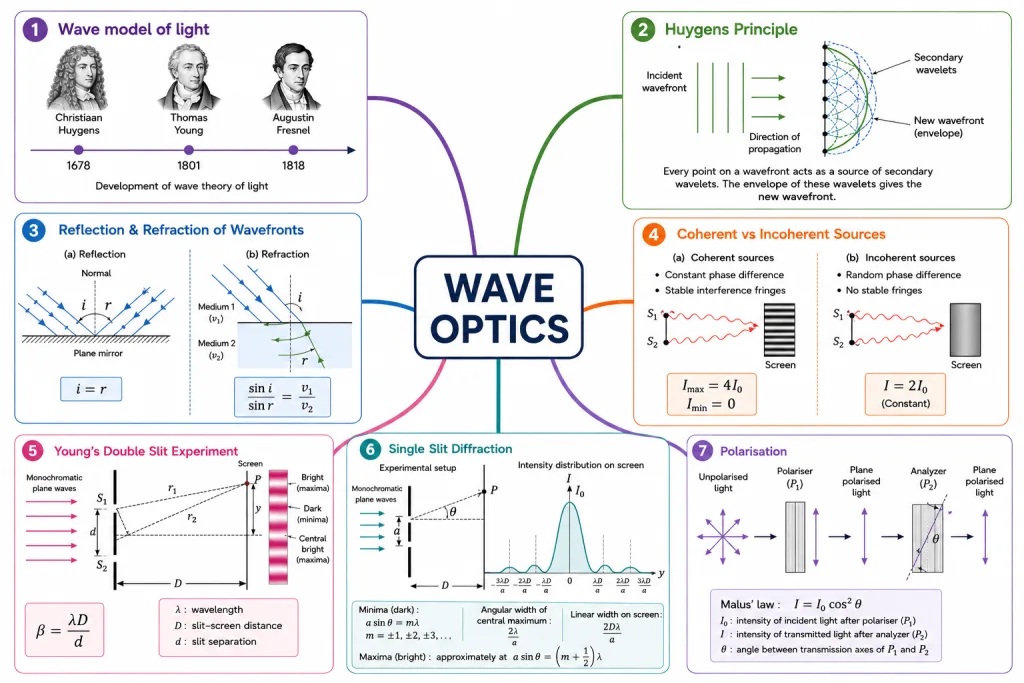
Young, the Tiny Wavelength, and Maxwell's Final Word
Even before Foucault, Thomas Young's interference experiment (1801) had firmly established that light is a wave — and allowed its wavelength to be measured: about 0.6 m for yellow light, astonishingly small.
That smallness explains why Chapter 9 worked: compared with everyday mirrors and lenses, the wavelength is negligible, so light travels in effectively straight lines. Geometrical optics is the limit — a ray is defined as the path of energy propagation in that limit. Forty years of interference and diffraction experiments after Young cemented the wave theory.
One mystery remained: waves were thought to need a medium — how does light cross vacuum? Maxwell answered it: light is an electromagnetic wave — self-sustaining, coupled, changing electric and magnetic fields (Chapter 8) needing no medium at all, travelling at the speed his equations predicted.
[NEET Important] The chapter's history quartet: Descartes/Newton (corpuscles), Huygens 1678 (waves), Young 1801 (interference proof), Foucault 1850 (speed in water), Maxwell (electromagnetic nature). Names-and-deeds questions recycle endlessly.
Solved Examples
Example 1: The decisive disagreement
State the one prediction on which the corpuscular and wave models clash, and how it was settled.
Solution:
- For light bending towards the normal on refraction: corpuscles require (faster in the denser medium); waves require (slower).
- Foucault (1850) measured light's speed in water: less than in air.
- Verdict: the wave model. One experiment, one fallen theory.
Example 2: Why geometrical optics works [NEET Numerical]
Yellow light has wavelength about 0.6 m. Compare this with a 6 cm wide mirror and explain why ray optics succeeded.
Solution:
- Ratio — the wavelength is a hundred-thousandth of the mirror.
- Diffraction (bending) effects scale with /size, so they are utterly negligible: light moves in straight lines to excellent accuracy.
- Hence geometrical optics — the formal limit .
Example 3: Frequency of yellow light [NEET Numerical]
Compute the frequency of 0.6 m yellow light.
Solution:
- .
- Hz — the half-petahertz scale of all visible light.
Example 4: What Young's experiment proved
Why is the 1801 double-slit experiment considered the turning point?
Solution:
- It produced interference fringes — alternating bright and dark bands.
- Particles cannot cancel each other; only waves can interfere destructively.
- It also yielded the first measurement of light's wavelength — turning the wave theory quantitative.
Example 5: The vacuum objection
What was the strongest early objection to the wave theory, and who dissolved it?
Solution:
- All known waves needed a medium; light demonstrably crosses vacuum (sunlight!).
- Maxwell showed light is an electromagnetic wave: changing E and B fields regenerate each other and propagate with no medium.
- The computed EM-wave speed matched light's measured speed — objection dissolved, theory crowned.
Example 6: Speed in water, predicted and measured [JEE Numerical]
Using n = 4/3 for water, compute the wave-model prediction for light's speed there — the number Foucault's experiment vindicated.
Solution:
- Wave model: .
- m/s — three-quarters of c, slower as waves demand.
- The corpuscular model would have required m/s — faster than light in vacuum!
Example 7: A ray, defined honestly
Give the wave-optics definition of a ray.
Solution:
- A ray is the path of energy propagation in the limit .
- Equivalently: the straight-line normal to the wavefront along which energy travels when diffraction is negligible.
- Chapter 9's entire machinery is this limit in action.
Example 8: Sorting the timeline [NEET pattern]
Arrange chronologically: Foucault's speed test, Huygens' wave theory, Maxwell's EM theory, Young's interference, Descartes' corpuscles.
Solution:
- Descartes (1637) → Huygens (1678) → Young (1801) → Foucault (1850) → Maxwell (~1860s prediction of EM waves).
- Theory, counter-theory, decisive interference, decisive speed, final unification.
- Exam shortcut: the dates ascend 1637-1678-1801-1850-1860s.
Example 9: Why Newton's model survived so long
Give NCERT's two reasons the wave theory was resisted.
Solution:
- Newton's authority — OPTICKS' tremendous popularity carried the corpuscular model.
- The medium problem — waves were believed to need one, and light crosses vacuum.
- Lesson embedded in the chapter: experiments (Young, Foucault), not authority, settle physics.
Example 10: Wavelength in glass [JEE Numerical]
Yellow light (0.6 m in air) enters glass (n = 1.5). Find its wavelength and frequency there.
Solution:
- Frequency is fixed by the source: Hz unchanged.
- Speed drops to m/s, so m.
- — the rule Section 3 derives from Huygens geometry.